Sensemitter is now Emhance.
Read more

Articles
Games and psychology: What players seek from their first session

Every game developer — especially in mobile gaming, where hundreds of titles launch daily — eventually asks the same question: why do some games hook players from the very first session while others fail to hold attention? What drives a player to stick with one game but abandon another after just a few minutes, even when the core mechanics are similar or nearly identical?
Most developers know how to study best practices from competitors and top-grossing games, but simply copying successful mechanics doesn't always work. Traditional game analytics tools often can't answer the deeper question of why players behave a certain way. By drawing on neuroscience and behavioural psychology, developers can gain a far richer understanding of players and their needs — going well beyond player profiles or audience segmentation.
In this article, Bogdan Baranovskiy, a specialist in UX research and psychology, explores the psychological and neurobiological factors behind player motivation and how first impressions shape long-term engagement. His insights are grounded in observations from playtesting conducted over the past six months.
Why Do People Play Games?
There are numerous theories and studies on player motivation. If you want to understand which players are likely to engage with your game, Nick Yee's decade of research is an excellent starting point. Here, though, we take a closer, more focused look at the First-Time User Experience — from the first few minutes to several hours of gameplay, depending on whether the game is casual or core.
Several psychological theories help explain early player interactions, particularly before players have fully discovered a game's action-oriented features. Two motivation theories stand out as especially useful, given their broad applicability both in games and in everyday life.
Intrinsic vs. Extrinsic Motivation
Intrinsic motivation is an internal drive fuelled by personal interest, curiosity, or the satisfaction of completing a task. A person might read a book simply because they enjoy learning — no external nudge required.
Extrinsic motivation, by contrast, is driven by external rewards or pressures. People engage in activities to gain rewards or avoid negative outcomes — studying to earn good grades, for instance, or to avoid failing a course.
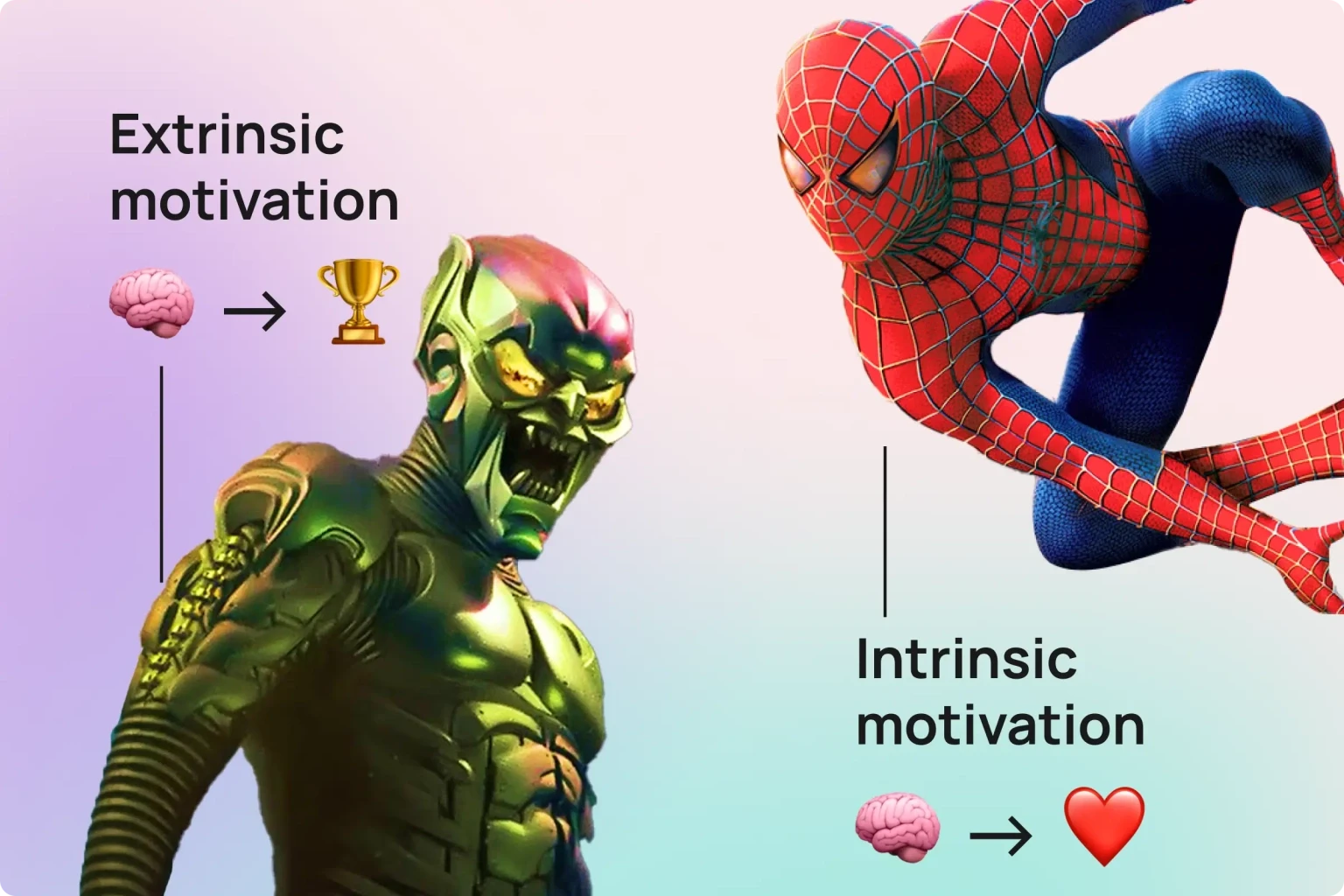
Both types of motivation can engage a person, but extrinsic motivation should not be overemphasised in the first-time experience. Leaning too heavily on it throughout gameplay is also risky. The reason is the overjustification effect: overreliance on external rewards can actively undermine intrinsic motivation. Someone who writes for personal enjoyment may lose interest once monetary rewards or excessive praise enter the picture — the activity shifts from personally fulfilling to meeting external expectations, eroding internal drive.
While this dynamic can be sustainable for someone who earns a living from their craft, regular players aren't being paid to play. When intrinsic motivation drops, player drop-off follows.
Players engage with a game because it's genuinely enjoyable, not just for external rewards. Early interactions should offer a sense of fun, exploration, and curiosity to tap into this intrinsic motivation.
Self-Determination Theory (SDT)
The Self-Determination Theory is a psychological framework that explains human motivation through three fundamental needs. In a game context, players are seeking:
Autonomy — a sense of free choice and control over actions within the game's world or mechanics.
Relatedness — a feeling of connection to the game world or its community. In multiplayer games, this is easier to observe (though not always easy to achieve). Single-player games can also foster relatedness through rich storytelling or deep world-building. Notably, players can now feel connected with a game simply by watching short videos or live streams — a trend that enhances relatedness through subtle, non-intrusive exposure.
Competence — the sense of being meaningfully challenged while still being capable of success (also the defining characteristic of Csikszentmihalyi's Flow Theory).
At its core, people play games to experience the emotions that arise when their needs for autonomy, competence, and relatedness are met — fuelling their internal drive to engage and keep playing.
The Role of Emotional Engagement in Early Game Experience
How do we ensure the experience is immersive, captivating, and aligned with players' needs from the very first session?
Historically, understanding player reactions could only be done through questionnaires, Q&A sessions, or post-game interviews. These methods provided some insight but had a critical flaw: without real-time evaluation, the data lost accuracy. Players would forget specific details, or their emotional responses would shift by the time they were asked.
Modern technology offers a more powerful approach. By using emotion recognition technologies to measure Central Nervous System activation, it's now possible to gather per-second data on player engagement — no questionnaires required.
This is the approach we take at Emhance, where we distilled this into a single, clear metric: emotional engagement.
What Is Emotional Engagement?
In psychological terms, emotional engagement is a state of alertness and responsiveness to stimuli. In a gaming context, it reflects the level of emotional engagement players experience while interacting with the content — and how effectively the game captivates and sustains their attention.
This state has measurable physiological markers, including pupil size, heart rate, and facial expressions. Together, these indicate how powerfully the game is impacting a player's emotions and attention in real time.
If emotional engagement shows a rising trend, the game is successfully capturing players' interest and reinforcing the desire to keep playing.
If emotional engagement decreases, players are losing interest and may soon disengage.
This isn't abstract theory. These patterns have been observed across games of many genres — from hyper-casual to hardcore — and the findings are consistent.
Key Observations About Emotional Engagement
Emotional engagement varies by genre, but it generally rises when players are engaged and falls when they face excessive difficulty or boredom. This trend holds for shooters, hidden object games, and match-three games alike.
Emotional engagement can spike rapidly during moments of frustration. Context matters — not all rises are positive, and identifying where sharp spikes occur (second by second, across the full tested flow) is essential.
Sustained focus has limits. People can't maintain high levels of focused attention for extended periods. On average, this lasts 20 to 40 minutes depending on task difficulty. Information introduced around the 40-minute mark may not be retained without reinforcement.
It's easier to maintain a consistent level of emotional engagement than to restore it after a significant drop.
Ads can cause sharp drops in emotional engagement. Delaying ads and offers by a few sessions leads to better immersion, improved retention, and — over the long term — increased revenue, as players are more motivated to make purchases once they're genuinely invested in the game.
What Raises Emotional Engagement Levels?
While this list isn't exhaustive, our observations across a broad range of games and genres consistently align with the psychological theories outlined above.
Challenge and Competition
The Flow state, as described by Mihaly Csikszentmihalyi, maps closely onto emotional engagement in games. When a game feels too difficult, players disengage — they believe they have little chance of succeeding. The same happens when a game feels too easy: without enough challenge, engagement drops. Tracking emotional engagement at these inflection points reveals exactly when and why interest shifts.
Challenge is a critical element across all genres, not just Souls-likes or PvP games. The key is calibrating difficulty to match players' interests and skill levels. Players are naturally drawn to games that provide their ideal level of challenge — whether that's a hyper-casual mobile title or a demanding console game.
Learning New Mechanics
In every game we've tested, tutorials and new mechanics consistently boost emotional engagement when they're introduced and as players learn them. From a neuropsychological standpoint, this is linked to dopamine release and activation of the Reticular Activating System (RAS) and amygdala — structures central to memory, engagement, and skill acquisition.
Implementing new mechanics is a universal tool across genres, from character development in RPGs to new facilities in city-builders. One of the most elegant executions of this was It Takes Two (2021), which won both Game of the Year and Best Family Game. The game tackled one of game design's hardest challenges — keeping gameplay enjoyable for both newcomers and experienced players — by introducing a fresh mechanic in every new location while weaving in competitive minigames with entirely distinct gameplay.
Novelty and Exploration
Emotional engagement rises with new or unexpected elements — surprise, mystery, and discovery. When a game becomes too predictable, interest fades. Here's why: when a goal becomes predictable, the brain begins preparing dopamine before the goal is reached, diluting the response into smaller, weaker signals. Instead of a strong emotional hit with each new objective, players experience a milder sense of satisfaction.
Novelty doesn't require an open world. The same sense of discovery can be achieved through story, narrative twists, or deep lore. Ghost of Tsushima is a good example: players first encounter foxes guiding them to hidden shrines, creating a feeling of mystery and delight. That interaction feels fresh and engaging. However, as it repeats predictably, the excitement fades — a reminder that novelty needs to be genuinely renewed, not just re-skinned.
Social Interaction
Social elements reliably boost emotional engagement — but what's often overlooked is that their effect extends beyond direct in-game interactions. Feeling part of a community is a powerful motivator and should be considered carefully in achievement design and risk assessment.
Games like Clash Royale and Brawl Stars have built strong communities by encouraging players to join clans and compete together. But if a community forms, maintaining healthy group dynamics becomes essential — community is a double-edged asset.
Narrative and Emotional Connection
Neuroimaging studies show that watching or interacting with characters activates the same brain regions involved in our own emotional experiences. In other words, players don't just observe digital characters — they respond to them much as they would to real people. This bond deepens engagement and creates a desire to return to those emotions.
Story-driven games use this to hook players from the start, but narrative can be layered into almost any genre, creating an additional sense of progression and amplifying first-session engagement. An immediate emotional connection gives players a reason to keep going — not just to see what happens next, but to feel what comes next.
The Power of First Impressions
Successful games that hook players from the first session don't achieve this by replicating popular mechanics. They do it by tapping into the psychological and neurobiological drivers of player motivation.
By understanding intrinsic motivation and addressing the needs for autonomy, competence, and relatedness, developers can meaningfully shape how players perceive and engage with their game from the very beginning.
People play games to experience specific emotions and fulfil personal desires — not simply to pass time. Focusing on elements that elevate emotional engagement — meaningful challenges, opportunities for learning, novelty and exploration, social connection, and compelling narrative — addresses the fundamental reasons players stay engaged.
Crucially: maintaining a growing trend in emotional engagement is key to retention. Once it's lost, it's far harder to recover.
At Emhance, we're actively exploring new ways to help developers understand and enhance player engagement through innovative technology. You can find our in-depth study on the mobile hit Royal Match here — where the insights discussed in this article demonstrate how a science-backed approach can elevate game design and long-term retention.
Want to learn more about how Emhance can improve your game? Get in touch.