Sensemitter is now Emhance.
Read more

Playables
Using emotional response analysis to optimize playable ads
74.2% of users did not convert. We used emotional response data to isolate why.
This case study summarises a test run on the Emhance platform focused on playable ads. The goal was to identify which content elements drive engagement, and how those elements relate to install conversion (CR) and cost per install (CPI).
A large share of respondents interacted with the playable, yet did not transition to the store or install. The analysis below outlines how the test was designed, what behaviour patterns emerged, and what recommendations followed.
What we set out to learn
Playable ads can create real interaction, but interaction does not always lead to store transition and install.
We aimed to understand:
how users emotionally respond while interacting with a playable
what differentiates users who install from those who stop earlier in the flow
which mechanics appear to support store transition and conversion
How we designed the test
We selected an audience aligned with the game’s player profile.
To assess real user interaction, the platform simulated:
an interactive game module (the playable ad)
and the App Store step
Respondents entered the survey, then completed:
gaze calibration: 19 seconds
baseline emotional state measurement: 10 seconds
Scenario prompt:
“You’ve played a mobile game and failed. You want to continue but don’t want to spend resources. Please choose an option to continue by watching an ad.”
We provided an option to close the ad to keep the synthetic test closer to real behaviour.
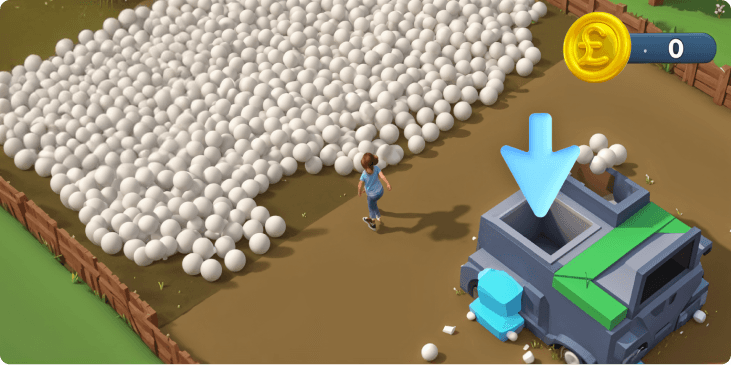
The ad was a playable and led to the Install button.
Audience segmentation: four behaviour patterns
Testing revealed four main patterns:
Not interested in watching ads (~10%)
Users waited for the close button and left the creative immediately.Interested, but not transitioning to the store (~75%)
Users actively engaged with gameplay but did not transition to the store for installation.Interested users leaving the store
Users reached the store but did not install the game.Users installing the game
This group was the most engaged and completed the installation.
Why ~75% of players closed the playable without opening the store
The largest group interacted with the playable but did not open the store. Within that group:
some users left as soon as the close button appeared (noted at ~20 seconds)
many users engaged for up to 1.5 minutes before exiting
This group is important because they show willingness to interact, and may be the most likely to move into store transition and install if the experience better matches their motivation.
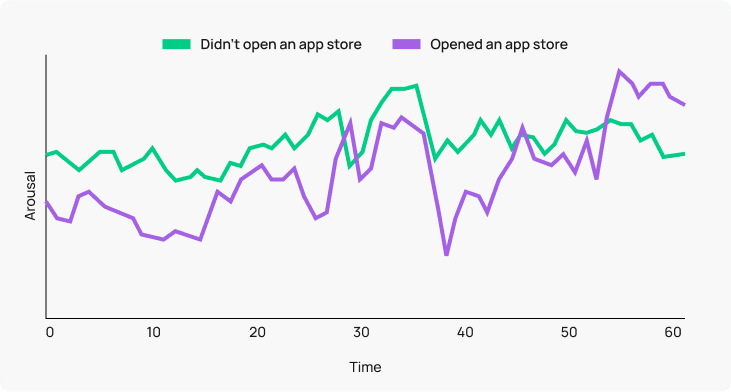
Main motivators: process vs result
A key split emerged around what users found rewarding in the playable:
Progression mechanic
This mechanic was associated with users who:
visited the store
installed the game
Users who were most impressed by upgrades and progression features were more likely to transition and install.
Stacking mechanic
This mechanic often generated engagement inside the playable, but many users:
left the creative afterwards
did not transition to the store
In other words: users could enjoy the process of collecting/stacking, remain engaged, and still stop short of store transition.
Why users did not click “Install” in the store
The study indicated a specific issue for users drawn to the stacking mechanic:
They became irritated after realising that the gameplay shown in the ad did not match what the App Store visuals suggested. This mismatch was linked to lost potential installs.
How to engage both motivations: what we recommended
We identified issues in emotional engagement and clarity, and recommended the following:
1) Optimise the first 10–20 seconds
Focus on presenting both mechanics early:
stacking
progression
This window matters because it shapes how the broadest audience interprets the playable experience.
2) Shorten purchase intervals to accelerate progress
Since the cohort drawn to progression was most likely to transition and install, we recommended making progression more dynamic:
shorter intervals between progress points
clearer feedback (animations, sounds, text)
The aim was that by the time the close button appears (~20 seconds), users are sufficiently absorbed that the close option is less salient.
Two additional playables we recommended building next
Based on the motivation split, we recommended creating two variants:
A playable designed for process-focused users
emphasises satisfying mechanics
interrupts gameplay to offer a continuation path
A more dynamic progression-led version
shorter intervals between progress points
clearer feedback (animations, sounds, text)
The intent was to learn more about audience expectations and measure before/after impact on CPI and CR. A part 2 follow-up was planned.
Closing note
User conversion is rarely explained well by broad labels. What matters is what users respond to during the experience, and what drives their next decision.
Emhance helps teams understand audience motivations and reactions using eye-tracking and facial coding, so playable and creative decisions can be tied to observable response patterns.
Request a demo: emhance.ai