Sensemitter is now Emhance.
Read more

Articles
How to Become a Game Tester
Written by:
Emer Rutherford
|
Marketing Generalist

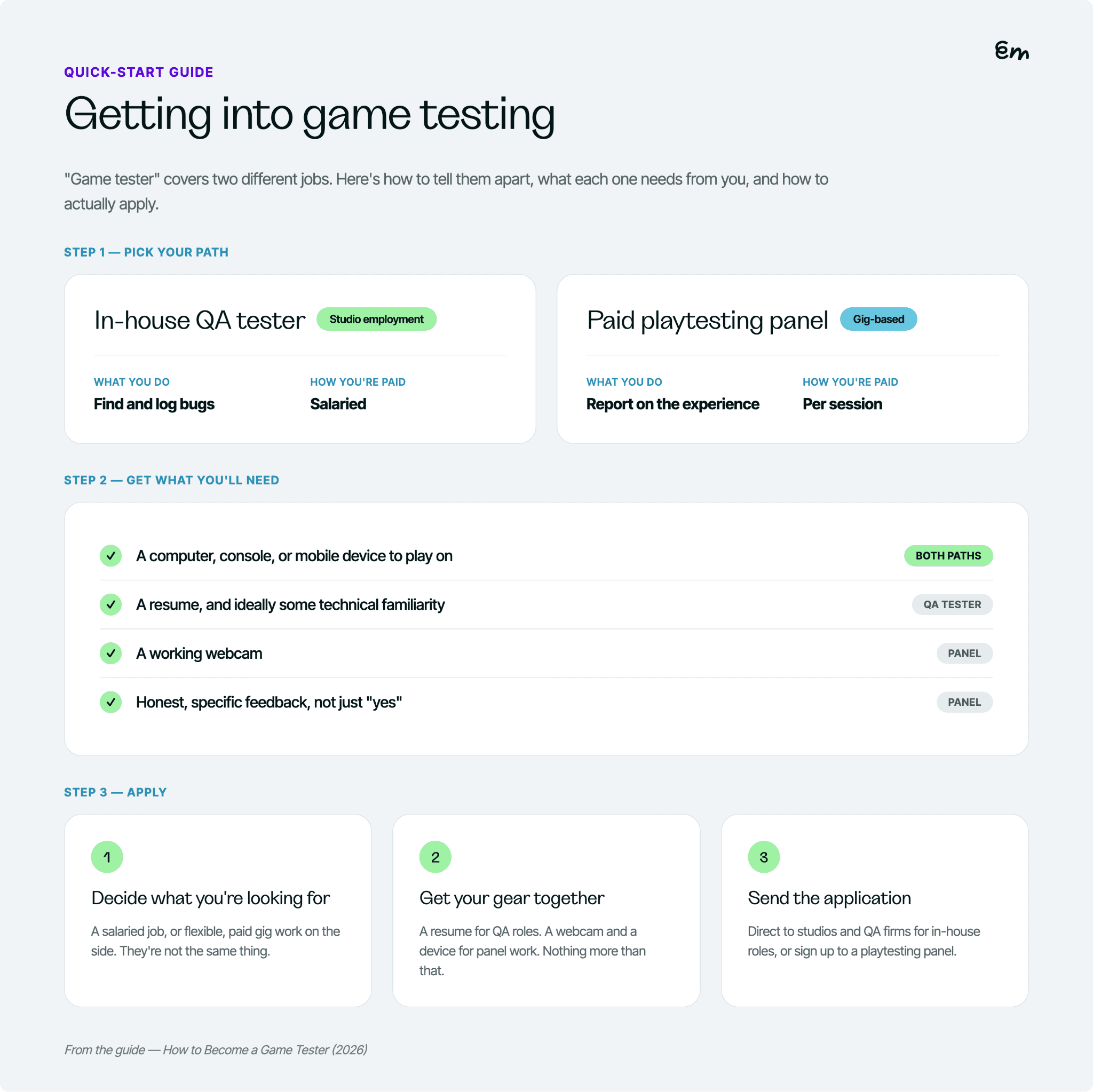
"Game tester" covers two different jobs that get searched for as if they're one. One is a technical, in-house role at a studio. The other is paid, remote, and open to almost anyone with a webcam. Most people looking into this haven't been told the difference exists, so they end up applying to the wrong one for what they actually want.
This guide covers both, what each one needs from you, and how to apply.
What a game tester actually does
A game tester plays a game before or during its release and reports back on what happened. What "reports back" means depends heavily on which kind of tester you are.
An in-house QA tester finds bugs: crashes, broken triggers, progression blockers, anything that stops the game from working as designed. The output is a ticket with steps to reproduce.
A playtester or research participant plays the game as a normal player would and reports on the experience: what was confusing, what felt good, where attention dropped. The output is feedback, not a bug list.
Both get called "game tester" in casual conversation and in job postings. They're not interchangeable.
The two paths in
In-house QA tester
This is direct employment, usually with a studio, publisher, or a QA outsourcing firm like Keywords Studios or Lionbridge. It's technical and detail-heavy: you're following test scripts, logging bugs in a tracker, and re-testing fixes. Entry-level roles exist, but the field has gotten more competitive, and a growing number of postings expect some familiarity with bug-tracking tools or basic scripting even at the junior level.
Paid playtesting panels
This is gig-based, not employment. You sign up for a panel, get matched to sessions for games that fit your profile, and get paid per session rather than a salary. The bar to get in is lower: no portfolio, no technical test, no prior experience. What panels are actually looking for is honest, specific feedback delivered consistently, not a resume.
Emhance runs a panel like this. Sessions are played on your own device, at home, and the panel is built around understanding what players actually feel while they play, not just what they say about it afterward.
Neither path is "better." They answer different questions: do you want a job, or do you want paid, flexible work on the side. The panel is the lower-commitment way to find out. You can try a session without applying anywhere else first.
What you need to get started
For a playtesting panel, the requirements are minimal: a computer or mobile device, a stable internet connection, a working webcam, and a willingness to give honest feedback rather than tell a studio what you think it wants to hear. No degree, no portfolio, no prior testing experience.
For an in-house QA role, expect to need a resume, and increasingly some evidence you understand how testing actually works: a bug report you've written, a QA course, or a portfolio project. A degree isn't required at most studios, but it isn't nothing either at the more competitive employers.
How to apply
For a QA role, studio and publisher career pages, and QA outsourcing firms like Keywords Studios, Lionbridge, and PTW, are the direct route. LinkedIn job search under "QA tester" or "game tester" surfaces most open roles.
For a paid playtesting panel, the application is usually a short form: some basic information about the games you play and the devices you own, and a webcam check. Emhance's panel works this way.
FAQ
Do you need experience to get a job as a game tester?
For a playtesting panel, no. For an in-house QA role, not always at the entry level, but it helps, and the bar has been rising.
Do you need a degree for game tester jobs?
Most studios don't require one for QA roles, though some prefer a background in computer science or a related field for more technical positions. Playtesting panels don't ask for one at all.
Are game tester jobs remote?
In-house QA is sometimes remote, sometimes on-site, depending on the studio. Playtesting panel work is remote by design: you play on your own device, wherever you are.
What's the difference between a QA tester and a playtester?
A QA tester hunts for bugs and technical issues. A playtester reports on the experience of playing: what was confusing, what felt good, what didn't land. Job postings often use "game tester" for both.
Can you do playtesting panel work alongside a QA job search?
Yes. Panel sessions are booked individually, not a standing commitment, so there's nothing stopping someone from doing panel work while applying to in-house roles elsewhere.
Is game testing a full-time career?
In-house QA can be: it's a real, salaried role with a path into other production or design jobs at some studios. Playtesting panel work is not a full-time replacement for that. It's session-based, paid per study, not hourly employment.
If you want to see what playtesting panel work actually involves, Emhance's panel is open to applications now.