Sensemitter is now Emhance.
Read more

Articles
Understanding the Focus metric in emotional analytics

Focus: measuring sustained attention in gameplay
Focus is a metric integrated into Emhance’s emotional analytics framework to deepen our understanding of player engagement. It captures how visually and cognitively concentrated a player is during specific gameplay moments.
Where emotional intensity reflects how strongly a player reacts, Focus reflects how long and how steadily they attend.
What Focus measures
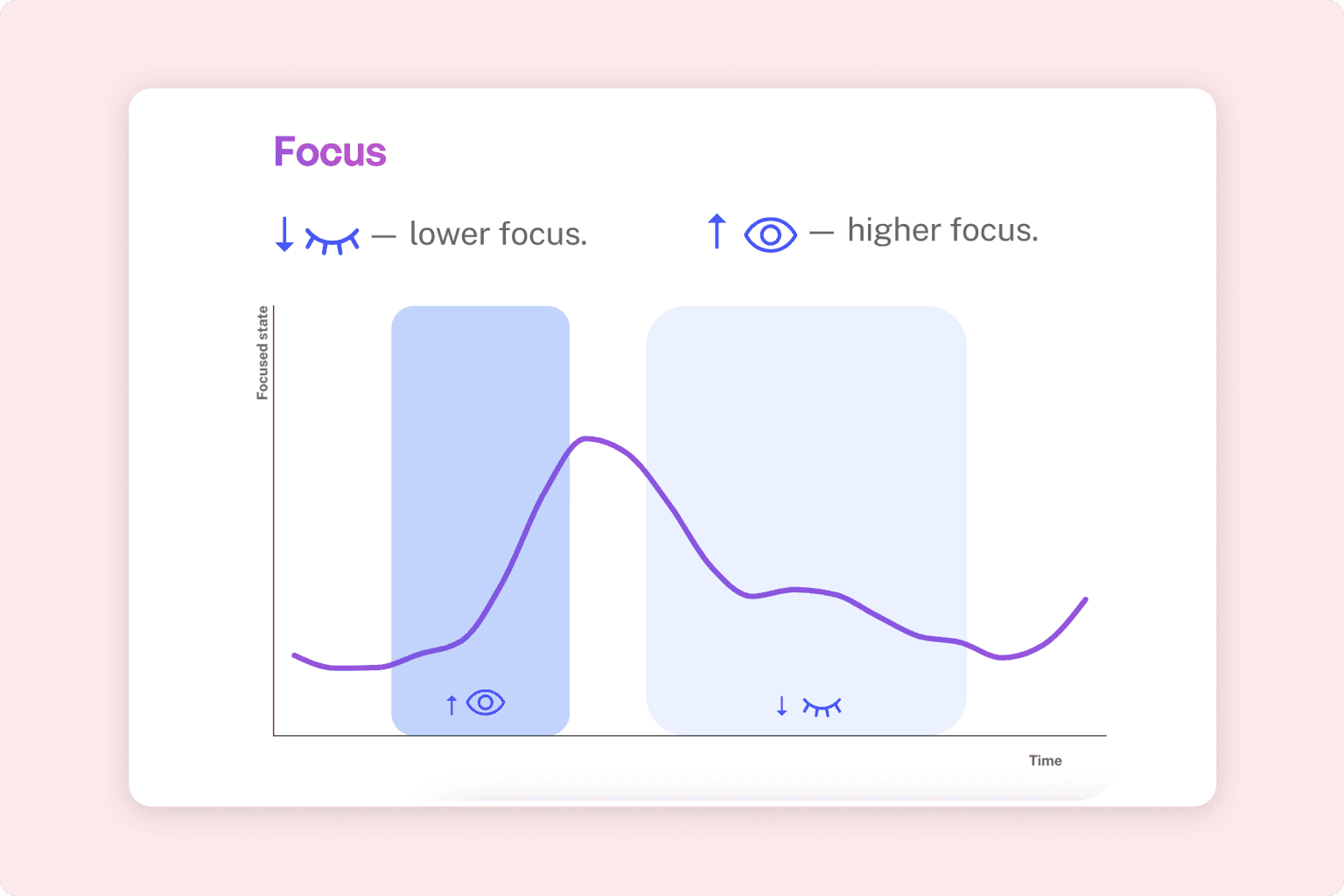
Focus is derived from blink dynamics and eye movement patterns.
We track:
Blink frequency
Blink duration
Micro eye movements
A reduced blink rate, combined with stable gaze patterns, indicates sustained concentration. When players are immersed in dialogue, scanning a hidden object scene, or solving a puzzle, they tend to blink less frequently.
Blink behaviour has a well-documented relationship with cognitive engagement. In this context, sustained visual persistence becomes a practical proxy for task-driven attention.
Why attention depth matters
Not all games rely on rapid reaction loops. Many genres are designed around deliberate pacing and extended concentration.
Examples include:
Hidden object games
Puzzle mechanics
Dialogue-heavy narrative sequences
Tutorial explanations
These slower segments often function as emotional setup. A period of deep concentration can amplify the impact of a reveal, resolution, or success moment that follows.
By layering attention tracking into our broader analytics framework, we examine both reflective engagement (sustained focus) and reactive engagement (emotional response). This combination clarifies not just what draws attention, but how that attention evolves over time.
Example: identifying the shift from challenge to friction
In a hidden object level within a first-time user experience, players explored freely without a timer.
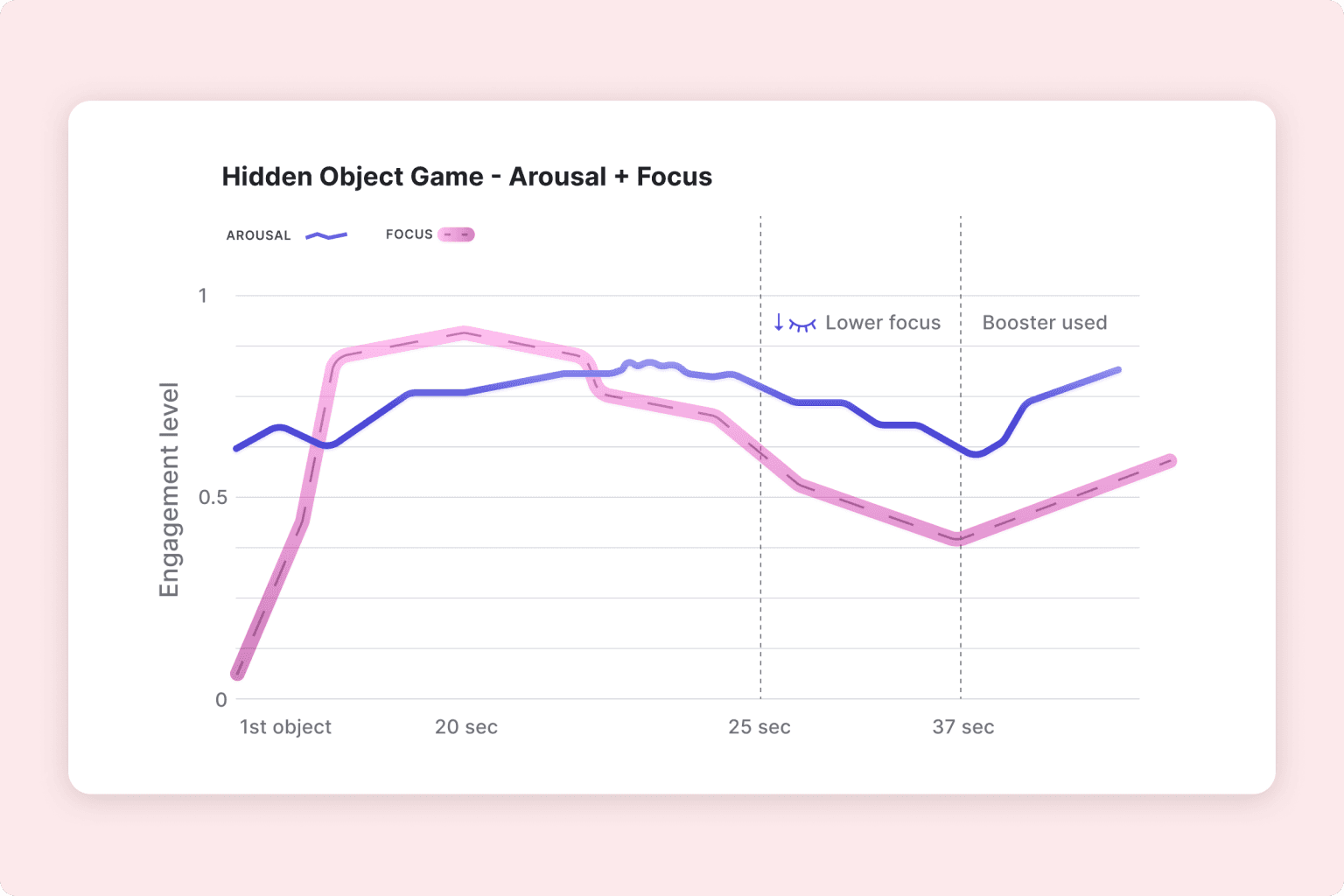
One participant located the first items quickly, within approximately 20 seconds. The final object required 17 seconds of searching.
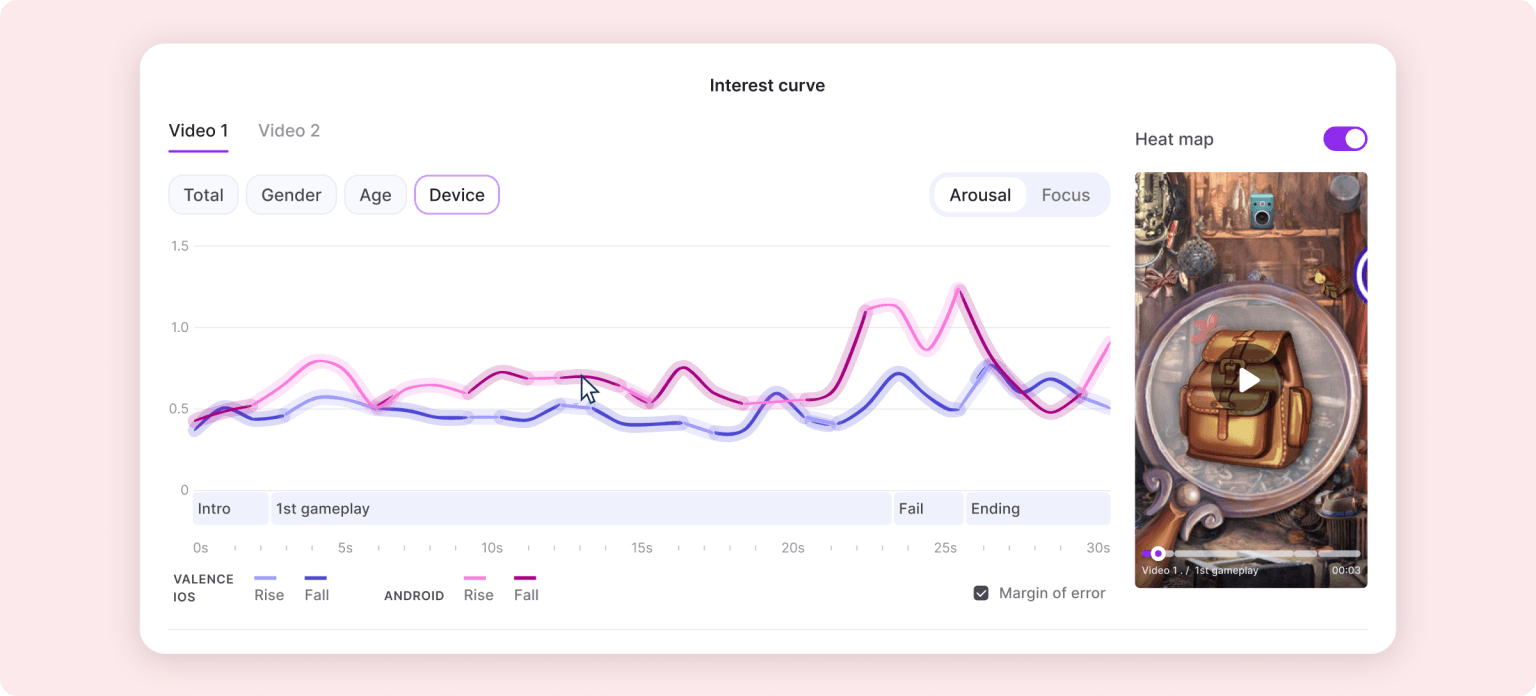
During the early search phase, sustained attention remained high and emotional intensity increased. The challenge felt engaging.
After roughly 5 seconds on the final item, emotional intensity began to taper while attention remained high. The player was still concentrated, but the experience was transitioning from stimulating to effortful.
By 17 seconds, attention dropped. The player disengaged and used a booster.
This behaviour has dual implications:
Booster usage supports monetisation.
Early-session friction increases churn risk if unmanaged.
The key insight is not that the player used a booster. It is the precise moment where engagement began to erode.
Design teams can intervene before attention collapses by introducing:
Progressive hint systems
Subtle contextual prompts
Adaptive guidance based on search duration
The objective is to preserve momentum while still allowing monetisation mechanics to function.
How Focus is reported
In client reports, raw attention data is translated into a normalised index ranging from 0 to 1.
This index enables fast interpretation at each gameplay step:
A score near 1 indicates sustained concentration.
A lower score indicates reduced visual persistence or distraction.
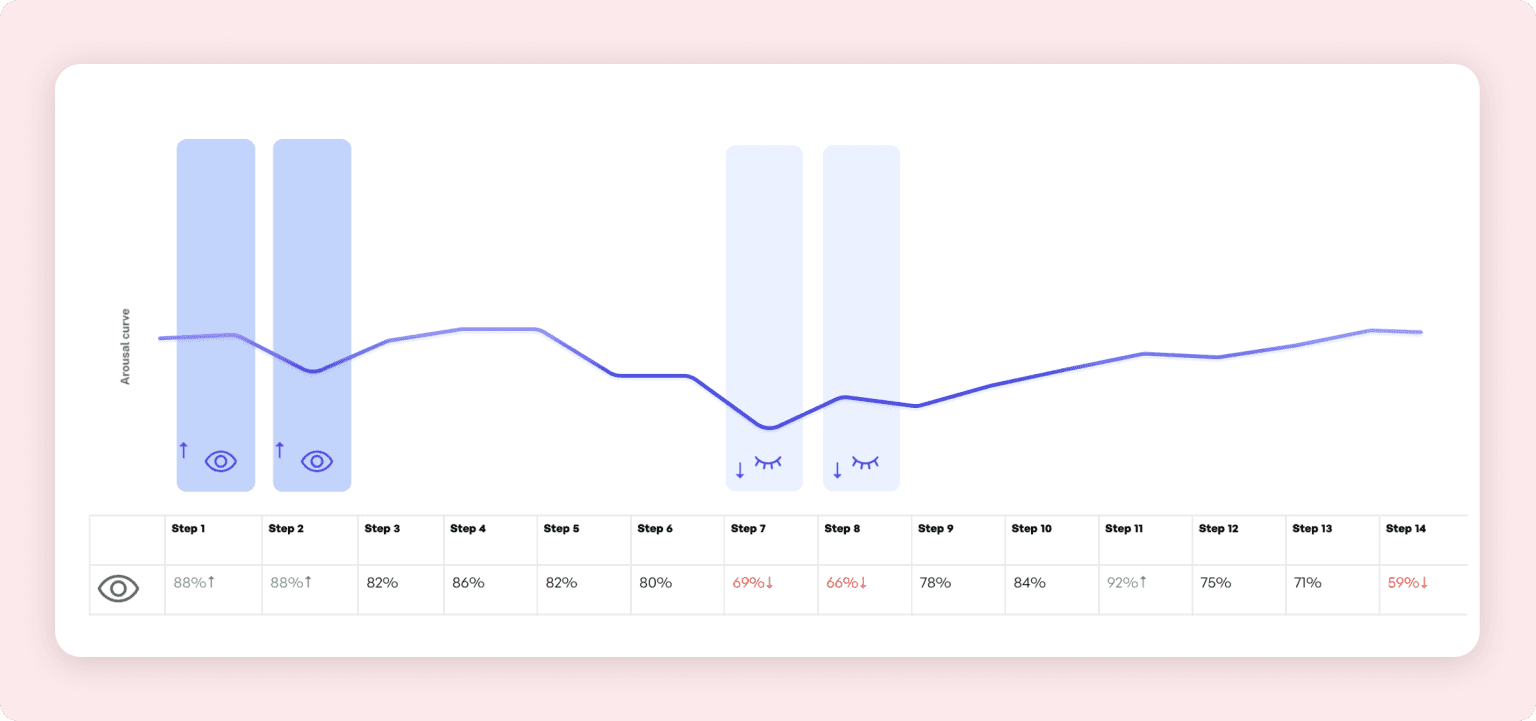
The metric is presented alongside behavioural and emotional context. It is not treated as a standalone optimisation lever, but as an explanatory layer.
Understanding attention depth clarifies moments of friction, hesitation, or absorption — particularly in complex or layered genres where engagement unfolds gradually rather than through immediate feedback loops.
Focus provides an additional analytical lens: not only what players do, but how steadily they stay with the experience while doing it.