Sensemitter is now Emhance.
Read more

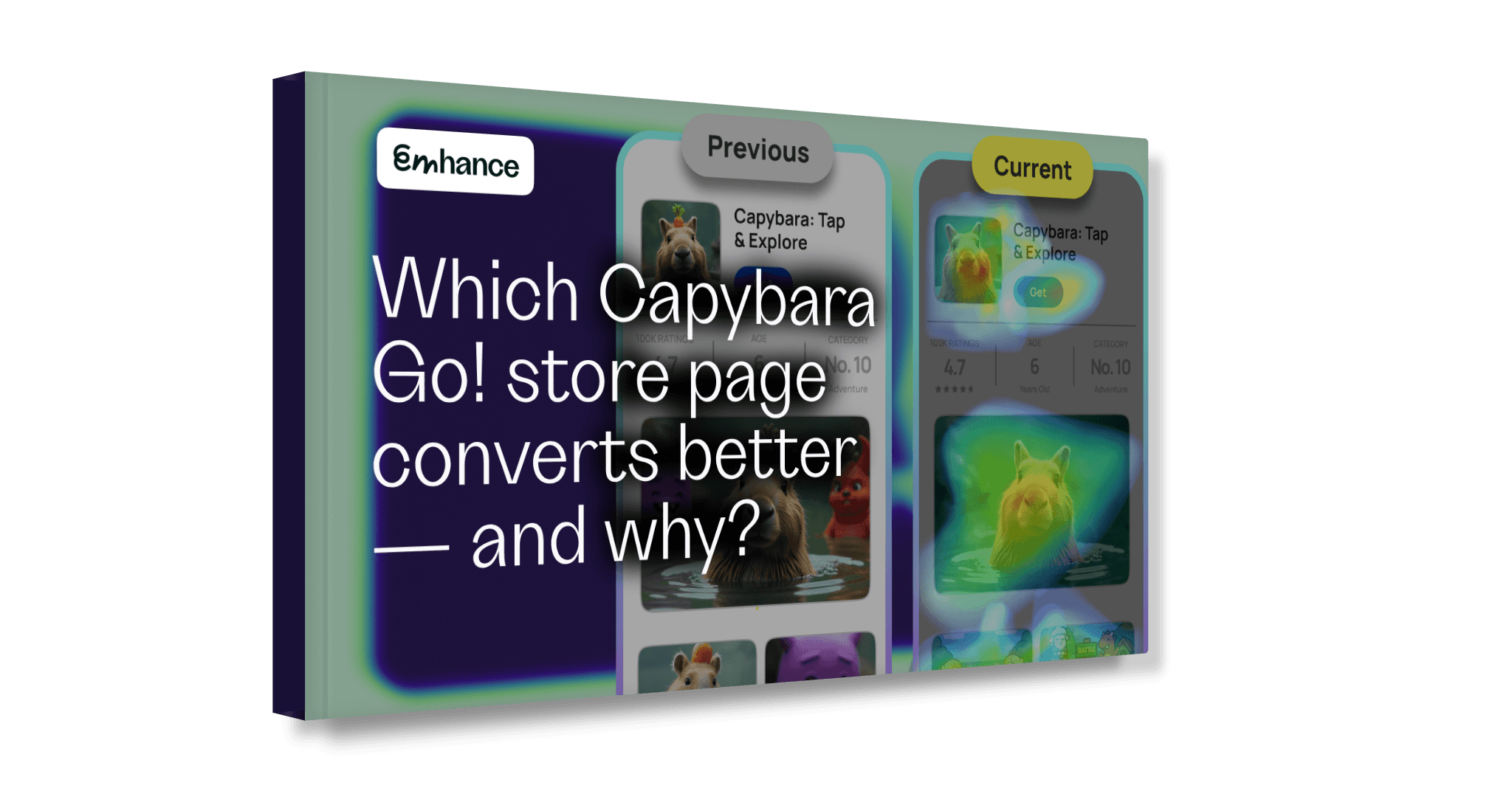
Emhance analyzed how changes to Capybara Go!’s app store page impact conversion, comparing the pre-launch version with the final release.
Beyond the A/B Test: The Psychology of the Capybara Go! Visual Evolution
Why Visual Shifts in ASO Are Never "Just" Aesthetic
Most ASO experiments tell you what changed.
They rarely explain why it changed—or which specific audience segments were actually moved by the shift.
In this independent research study, we analyze the evolution of the Capybara Go! Google Play store page. By comparing its early creative direction against its updated design, we uncover how specific changes to icons and screenshots fundamentally reshaped install intent across different age and gender groups.
Note: This study was conducted as independent research by our team to explore visual performance trends; we are not affiliated with the developers of Capybara Go!
Why This Study Matters
Store page conversion is the highest-leverage metric in mobile growth.
A visual update might look like a "refresh" to a designer, but to a user, it’s a shift in perceived brand DNA. In practice, these changes:
Redefine Audience Fit: Attracting new demographics while potentially alienating others.
Alter Emotional Engagement: Changing the "vibe" from casual fun to perceived mastery.
Influence Exploration: Dictating whether a user actually stays to read the description.
Impact Unit Economics: Shifting which segments convert directly impacts LTV and UA scale.
Understanding these shifts before scaling traffic is the difference between a calculated growth strategy and expensive guesswork.
The Research Lab: What We Explored
Using emotion-led diagnostics layered against behavioral intent signals, this study examines:
The Power of Simplicity: How the evolution of the icon affected perceived clarity and "clickability."
Compositional Psychology: How screenshot layouts guide the eye and shape engagement.
The Maturity Spectrum: How visual tone influences whether a game is perceived as "childish" or "sophisticated."
Segmented Resonance: Why different age and gender groups respond to vastly different creative cues within the same page.
We move beyond surface-level "likes" to analyze measurable emotional activation and downstream install intent.
Key Insights Inside
This report breaks down the behavioral patterns that drive the charts:
Visual Storytelling vs. Install Likelihood: The direct link between narrative art and conversion.
Demographic Divergence: Why specific creative treatments trigger strong responses in one segment while falling flat in another.
The "Maturity" Tax: How perceived age-appropriateness impacts your ability to expand your audience.
Asset Interaction: The hidden relationship between screenshot design and description engagement.
Strategic Repositioning: A framework for moving from raw data to actionable iteration.
Critical Questions Answered
How do visual styles influence age and gender groups differently?
Which specific store assets carry the most "decision weight" for a new user?
Can creative refinements unlock new player segments without losing your core?
How can emotional diagnostics predict performance before you spend your launch budget?
Who Should Read This Study?
This analysis provides a structured framework for any lead responsible for the bottom of the funnel:
UA Managers looking to sharpen CPI efficiency.
Growth Teams tasked with scaling paid traffic across diverse segments.
ASO Specialists seeking a scientific approach to creative iteration.
Product Marketers aligning store positioning with deep-seated player motivations.
The Strategic Reality
Creative updates rarely impact all users equally.
The real question isn't just "Does Version B perform better?" The real question is: Which audience segments are driving that improvement—and what specifically triggered the shift?
Download the Independent Study
Access the complete analysis, methodology, and segment-level findings from our Capybara Go! research.