Sensemitter is now Emhance.
Read more

Creatives
Emotion AI analysis of two rescue-mechanic mobile game ads — and what it means for creative ROI
We tested two "rescue mechanic" video ads with a US panel (ages 18–54) to understand how different audiences respond emotionally — by gender, by age, and second by second. One creative moment produced an engagement spike of roughly +85% in a specific audience segment. A different moment showed up as the consistent source of positive emotional engagement across both ads and all segments.
This case study covers what we observed and what it suggests for creative decisions.
What we tested
Two ads built on the same rescue mechanic:
Gardenscapes — a family-rescue scenario with a consistent tone throughout.
Top Girl — the same core mechanic, with a sharp tonal shift mid-video.
Audience: US viewers, ages 18–54, split by gender and by age band (18–34 vs 35–54).
What we measured: Engagement intensity, emotional valence, and visual attention — captured at the second level across the full runtime via facial coding and eye-tracking.
Is “rescue” as a core narrative good or overused?
It’s good — but only if you keep up the pace and offer hope of success. In both videos, viewers engage quickly from the start and stay engaged throughout the video. Engagement increases again during the packshot. These key moments suggest that the rescue hook and plot are effective at driving initial and sustained attention.
The main challenge for both videos is maintaining viewer engagement after the rescue hook is introduced. In the middle section — specifically during the second challenge — engagement levels plateau. This might be due to the segment being too long or too similar to the initial task, which was the most engaging moment.
Throughout most of the videos, engagement is driven by negative emotions. Positive emotional engagement only appears toward the end, when the carousel packshot shows the chance to retry. This moment of “hope” is crucial. The carousel is a great opportunity to not only shift emotional tone, but also showcase game variety.
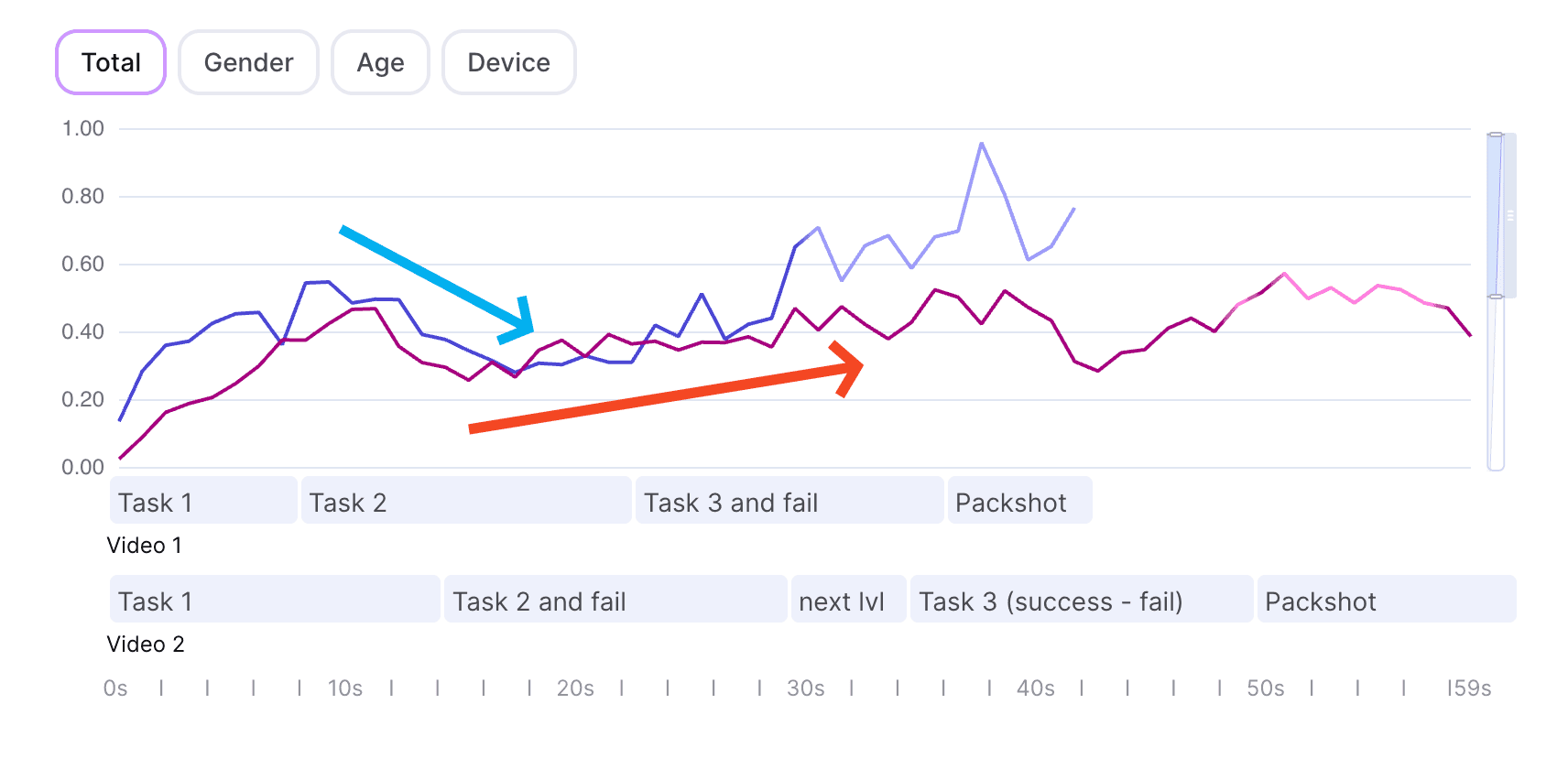
The rescue hook itself works: viewers engaged quickly from the start and stayed engaged throughout. Engagement then climbed again at the packshot. The narrative structure — hook, challenge, resolution — holds attention. The packshot is where it pays off emotionally.
What this suggests for creative decisions: If positive emotional engagement is concentrated at the packshot, it functions as the emotional resolution of the creative — not just a brand close. Worth testing: whether extending the packshot runtime, or making the success path and game variety clearer at that moment, affects downstream conversion.
The +85% spike — and what it means for targeting
A strong signal in one segment, and a divergence across others.
In Top Girl, the tonal pivot moment coincided with a ~+85% engagement spike in male viewers. The gap between male and female viewers reached approximately 0.3 points on the engagement scale at that moment. Before it, both genders had reacted similarly.
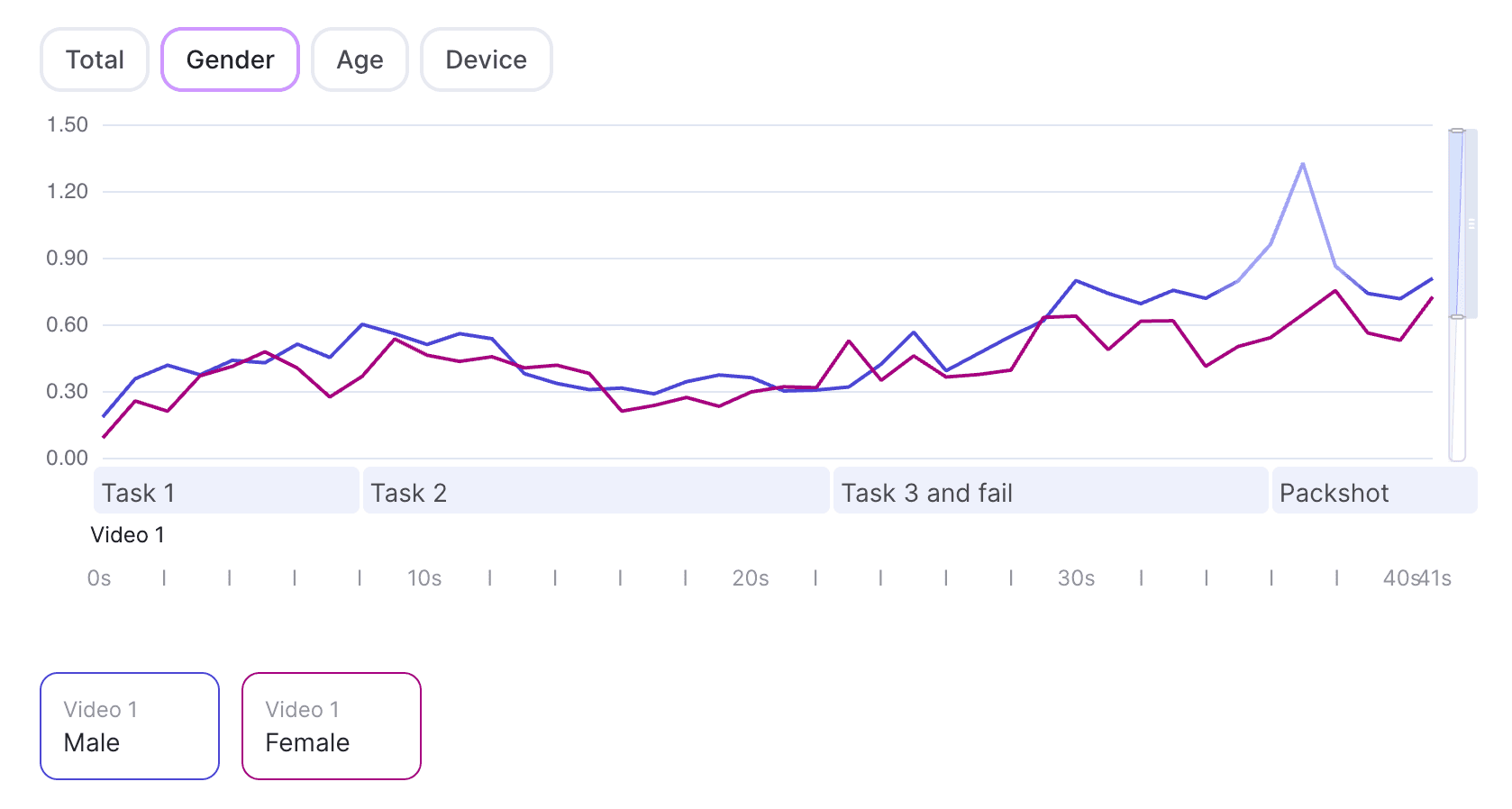
Top Girl is effective overall — it sustains nearly 100% viewer focus and produces what the data describes as an emotional "rollercoaster" that peaks at the packshot. But the emotional intensity is more segmented: the high-engagement moment works strongly for a specific segment, while the risk of disengaging other viewers is real.
A creative that produces high engagement in one segment while others disengage has a different audience profile than a broad-appeal creative. That is a targeting question, not a quality question.
What this suggests for creative decisions: A polarising creative is not a weaker creative — but it requires knowing which segment it is working for, and building the campaign around that audience. The data shows the segment exists and the response is strong. The question is whether the campaign structure reflects it.
Three additional findings
1. The mid-video plateau was a pacing problem, not a concept problem.
Both ads showed an engagement plateau during the second challenge sequence, across all segments. The probable cause identified in the data: the second task was too similar to the initial task, or ran too long relative to the opening — reducing the sense of novelty or progress.
Engagement didn't disappear at this point, but it stopped growing. The opening hook and the packshot both outperformed this section.
What this suggests: This is a structural issue rather than a concept issue — compressing the second challenge, varying its rhythm, or introducing a new information beat is a lower-cost intervention than rethinking the brief.
2. Age-based engagement tracked tonal consistency, not content type.
In Top Girl, the 18–34 group started with higher engagement than the 35–54 group, then dropped off when the creative shifted register mid-video. The probable cause: they came in expecting a mobile gaming ad, and when the creative pivoted into a different tone, the shift disrupted their expectations. Older viewers held steady through the same transition without the same dissonance.
In Gardenscapes, age differences were more pronounced overall. The older group engaged reliably throughout. The younger group was more likely to drop off in the middle section — and while they responded well to the packshot, they were less likely to reach it.
What this suggests: Audience age may be a weaker predictor of content preference than sensitivity to tonal discontinuity. A creative that holds its genre frame consistently may perform differently across age groups than one that shifts register mid-way.
3. The empathy-driven format was not a gender-specific response.
In Gardenscapes, men and women engaged comparably overall. Women showed a slightly stronger early response and a sharper engagement drop at the loss scene — reflecting emotional investment in the narrative outcome. Men responded more strongly to the packshot and the hopeful resolution.
Both genders engaged with the rescue narrative. The differences were in the timing and intensity of specific emotional beats, not in whether the format worked.
What this suggests: Creative decisions that treat empathy-driven content as a female-audience-only strategy may be drawing audience scope narrower than the observed data supports.
What this adds to performance-only data
Performance metrics show what happened after spend. They do not distinguish:
Where engagement dropped — at the second level
Whether a plateau is concept or structure — two different briefs, two different production costs
Whether a large spike represents broad appeal or segment-specific intensity — two different campaign strategies
Whether the packshot is functioning as emotional resolution or simply a brand close
This study is observational — directional rather than definitive, and based on two ads. The point is not to declare rules. It is to surface specific hypotheses worth testing before budgets scale, so creative decisions can be informed by what viewers actually feel rather than what we expect them to feel.
How Emhance runs this
Emhance uses facial coding and eye-tracking to capture emotional responses second by second — not what viewers report after the fact, but what their attention and expressions show while the creative is playing.
The output is moment-level data: where engagement peaked, where it dropped, which segment responded differently and at what point in the video. That is the level of resolution at which brief decisions can be made with confidence.
Want to know what your creative is doing to viewers before spend? Analyse my ads → emhance.ai