Sensemitter is now Emhance.
Read more

Articles
Arrow Puzzle - Genre Breakdown Report
Written by:
Emer Rutherford
|
Marketing Generalist

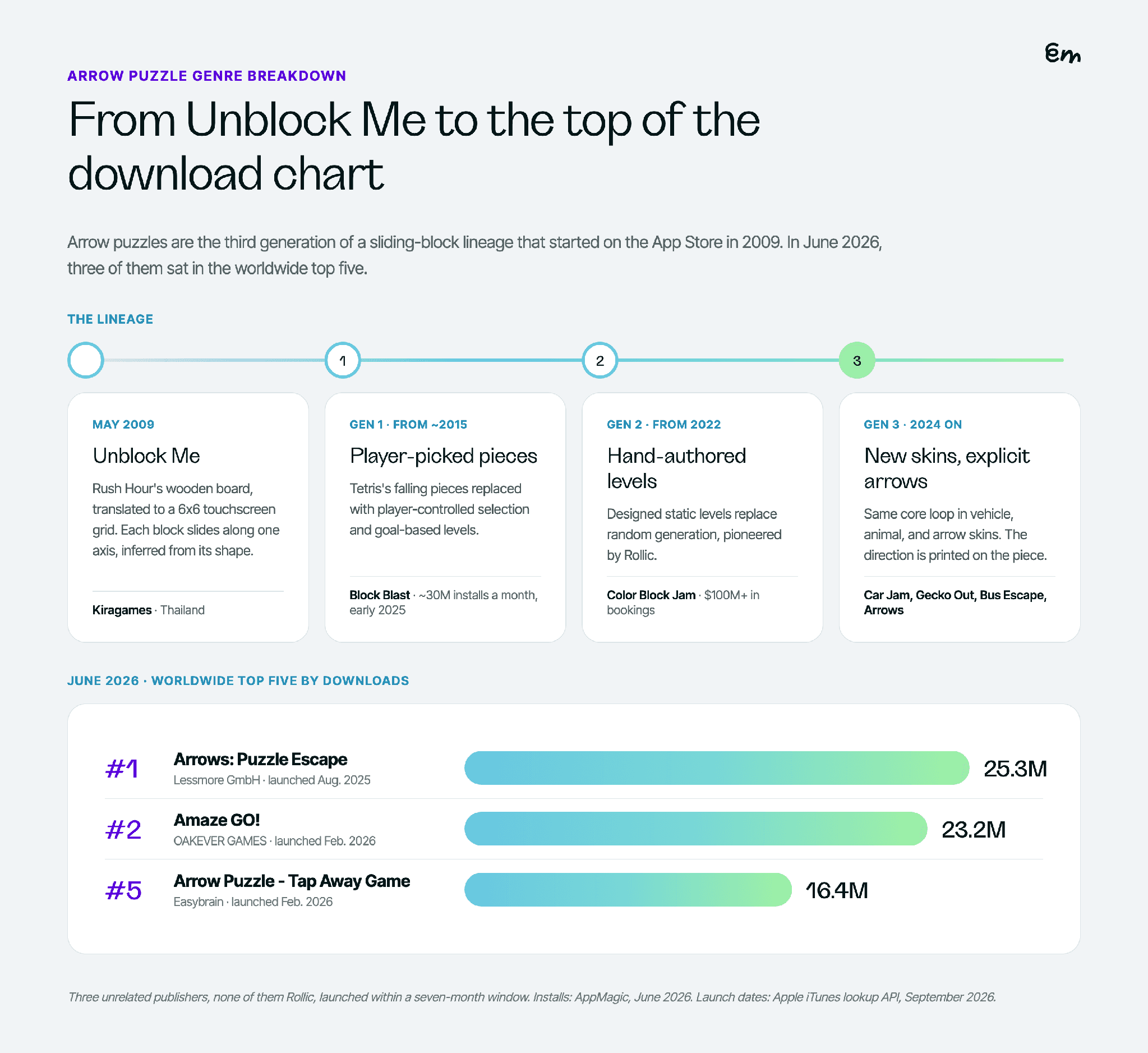
In June 2026, three arrow puzzle games sat in the worldwide top five most-downloaded mobile games. Arrows: Puzzle Escape took the top spot with 25.3 million installs. Amaze GO! took second with 23.2 million. Arrow Puzzle: Tap Puzzle Games, listed today as Arrow Puzzle - Tap Away Game, took fifth with 16.4 million.
An arrow puzzle is a directional sliding-block puzzle. Every piece on the board carries a fixed direction, shown by an arrow or a locked axis. Tap a piece and it slides that way until it hits an obstacle or exits the board. Clear the board, and you win the level.
This report covers where the genre came from, how it works, who plays it, how it makes money, and what the biggest titles are doing differently from each other. It also includes a first-session playtest Emhance ran itself, tracking engagement second by second across the three top June titles.
Where arrow puzzles came from
The mechanic descends from sliding-block puzzles: Klotski, Rush Hour, and the mobile game that first popularized the format, Unblock Me. Unblock Me launched on the App Store in May 2009, from Thai developer Kiragames. It translated the wooden Rush Hour board directly: drag a red block to the edge of a 6x6 grid, with every other block sliding along one fixed axis, inferred from its shape.
Sliding-block puzzles are not simple, even when they look it. A 2020 arXiv paper classified a fixed-block variant as PSPACE-complete: a category of planning problem that stays computationally hard no matter how much processing power gets thrown at it, the same complexity class as generalized chess. The mechanic looks trivial and is not.
The arrow variant, where each piece is marked with an explicit direction instead of an inferred one, is newer. Deconstructor of Fun's January 2026 analysis of the block-puzzle lineage places it as the third generation of the format. The first generation, from around 2015, replaced Tetris's falling pieces with player-controlled selection and goal-based levels; Block Blast is the flagship title, reported at around 30 million installs a month in early 2025. The second generation, from 2022, introduced hand-authored static levels instead of randomly generated ones, pioneered by Rollic; Color Block Jam, launched in June 2024, is the breakout title of this generation. The third generation, from 2024 on, adds distinct visual skins on the same core loop: vehicles, animals, and explicit arrow mechanics. Named titles in this wave include Car Jam, Gecko Out, Bus Escape, and Arrows.
Color Block Jam is worth a closer look, because its growth curve set the template the current wave is following. Developed by Istanbul-based Gybe Games and published by Rollic, it went from $175,000 in revenue in the fourth quarter of 2024 to $25.5 million in the first quarter of 2025, on 18.9 million downloads that quarter. It has since passed $100 million in bookings, Rollic's highest-earning IAP title. Day 90 retention sits at 10%, a strong number for hybrid-casual.
Rollic pioneered the template, but three unrelated publishers are winning with it now. The titles that led June 2026's install charts, covered later in this report, share no connection to Rollic.
How the mechanic works
Every arrow puzzle runs the same base loop. A grid holds a set of pieces, each locked to move along one axis. Tap a piece and it slides in its marked direction until it meets an obstacle, exits through a gate, or leaves the board. Clear the board, and the level ends.
Two things separate solvable-but-hard levels from unsolvable-feeling ones: obstacle placement and move order. Early titles generated boards algorithmically, shuffling backward from a solved state to guarantee a solution existed. Since Rollic's 2022 shift to hand-authored levels, designers place obstacles and gates deliberately, building toward a specific difficulty curve rather than a random one.
Puzzle designers describe the difficulty curve as a roller coaster: levels escalate gradually, spike into one clearly hard level, then drop back to something easy. The pattern shows up across the genre's biggest titles, and we saw it directly in our own playtest, below.
The variations
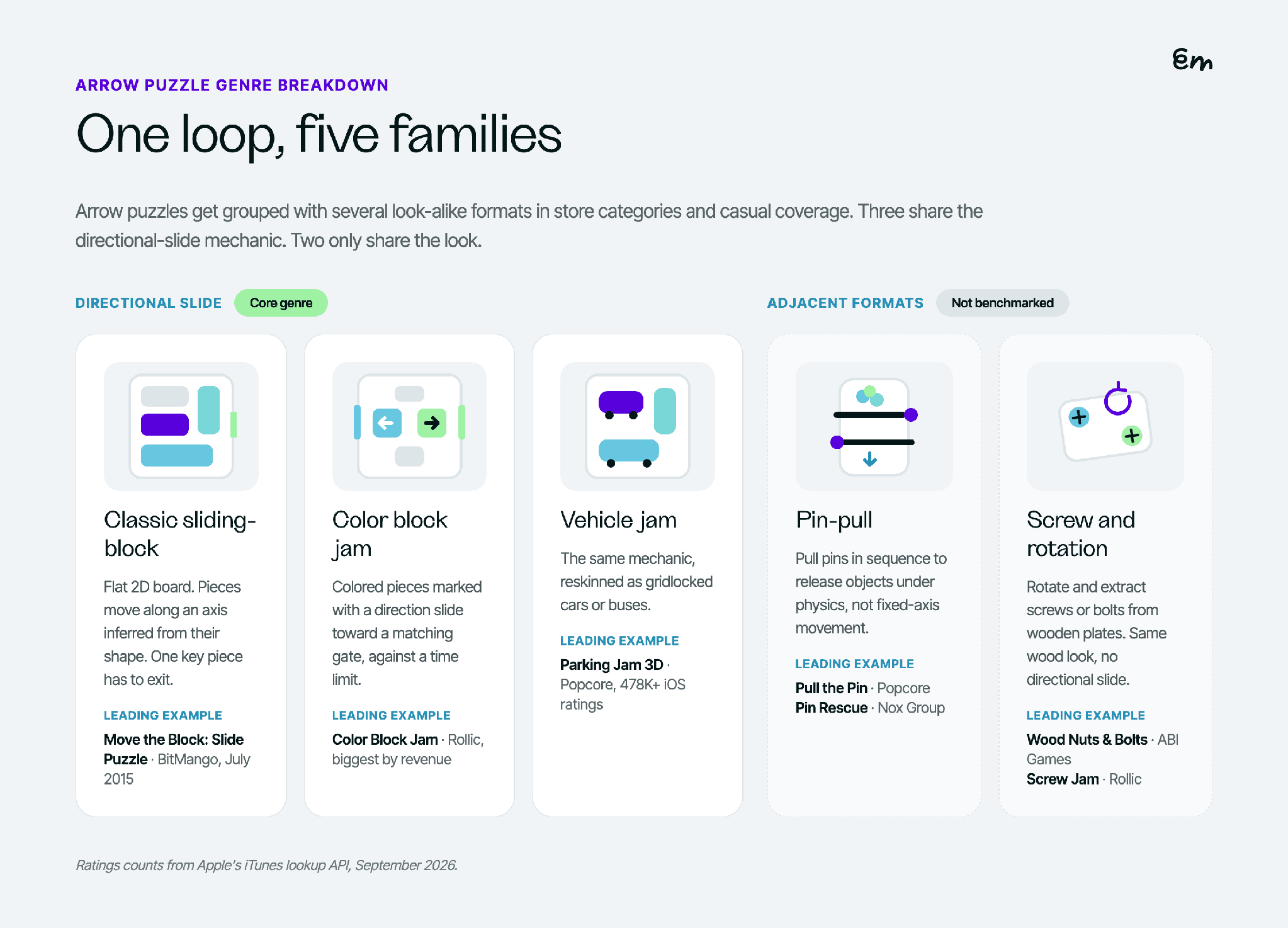
Arrow puzzles split into several visual and mechanical families, most sharing the same underlying loop.
Classic sliding-block. The original Unblock Me format: a flat 2D board, pieces move by inferred shape, one key piece needs to exit. Move the Block: Slide Puzzle, from Korean developer BitMango, launched in July 2015 and is the format's longest-running mobile example.
Color block jam. Pieces are colored and marked with a direction, sliding toward a matching-colored gate under a time limit. Color Block Jam is the category's biggest title by revenue.
Vehicle jam. The same mechanic, reskinned as gridlocked cars or buses. Parking Jam 3D, from Popcore, a Rollic subsidiary, launched in February 2020 and has the largest review base of any title we checked: 478,603 ratings on iOS as of September 2026.
Pin-pull. A related but mechanically distinct format. Instead of sliding pieces, the player removes pins from a stack or mechanism in sequence, releasing an object under physics rather than fixed-axis movement. Pull the Pin, from Popcore, and Pin Rescue, from Nox Group, are the leading examples.
Screw and rotation. Another adjacent format: players rotate and extract screws or bolts from wooden plates rather than sliding pieces. Wood Nuts & Bolts Puzzle, from ABI Games Studio, and Screw Jam, from Rollic, lead this format. It shares the genre's wood aesthetic and satisfying-motion appeal without sharing the directional-slide mechanic.
Because pin-pull and screw-rotation titles get bundled with arrow puzzles in casual coverage and store categorization, this report treats them as adjacent formats and focuses its benchmarking on true directional-slide titles.
Who's building in this genre
Leading the current download chart
Title | Publisher | Launched | iOS rating (Sept. 2026) | Mechanic | Monetization |
|---|---|---|---|---|---|
Lessmore GmbH | Aug. 2025 | 4.86, 421,172 ratings | Tap an arrow: it exits if the path is clear | Ads + rewarded video, with hint offers timed to when a player stalls | |
OAKEVER GAMES PTE. LTD. | Feb. 2026 | 4.65, 192,993 ratings | Tap arrows in the correct lane order | Ads; the fastest LiveOps rollout of the three, a daily streak by level 4 | |
Easybrain Ltd | Feb. 2026 | 4.82, 24,491 ratings | Tap arrows in order to clear the maze | Ads + rewarded video, gated by an energy system |
Leading the format by revenue and scale
Title | Publisher | Launched | iOS rating (Sept. 2026) | Mechanic | Monetization |
|---|---|---|---|---|---|
Rollic Games | June 2024 | 4.58, 136,347 ratings | Color slide to matching gate | IAP-led; boosters optional, not required | |
Popcore (Rollic) | Feb. 2020 | 4.45, 478,624 ratings | Vehicle slide | Ads + IAP, shared Popcore template |
Ratings and launch dates are pulled directly from Apple's iTunes lookup API, current as of September 2026. The top table's mechanic and monetization columns combine each title's own App Store description with what our playtest observed, below; we haven't run a full IAP audit on those three specifically.
The three chart leaders launched within a seven-month window: Arrows in August 2025, the other two in February 2026, five days apart. They come from three unrelated publishers, none of them Rollic or Popcore, the publisher group that dominates the wider block-puzzle lineage this genre descends from. Both titles in the second table trace back to Rollic, either directly (Color Block Jam) or through its Popcore subsidiary (Parking Jam 3D); Rollic reports more than 2 billion combined installs across hundreds of games since 2018. The current arrow-tap wave looks like a genuinely new competitive set, not an extension of an incumbent's existing franchise.
How big this is
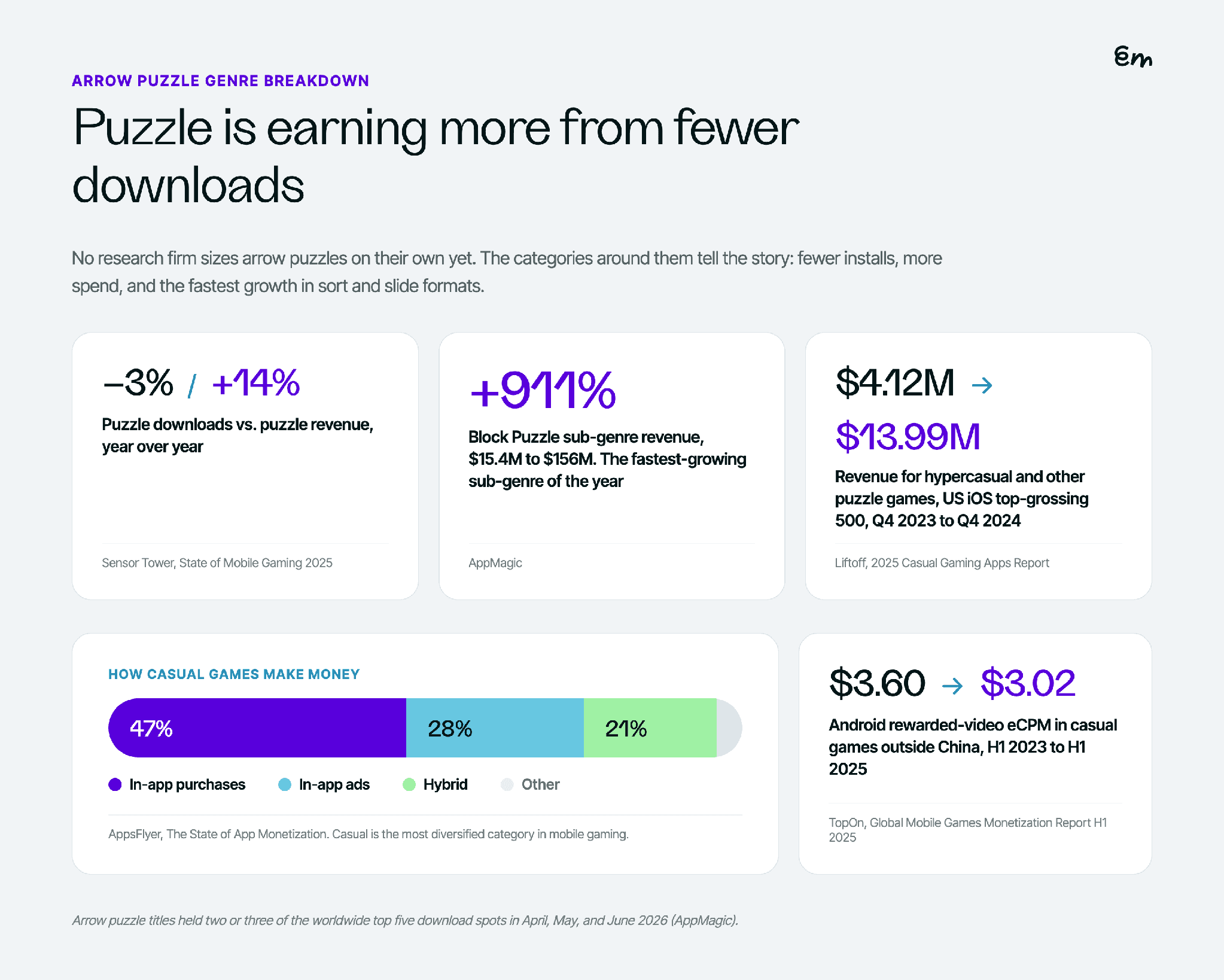
The wider puzzle genre is growing in revenue while shrinking in downloads. Sensor Tower's State of Mobile Gaming 2025 report found puzzle downloads fell 3% year over year while puzzle revenue climbed 14%, and puzzle now ranks second among all genres by time spent in-game. The same report's sharpest download-to-spend gap belongs to strategy games, not puzzle: strategy took only 4% of global downloads but 21.4% of consumer spend.
Within puzzle, the sort and slide formats are growing fastest. AppMagic data names "Block Puzzle" the fastest-growing sub-genre of the year in both revenue and downloads: revenue grew from $15.4 million to $156 million year over year, a 911% increase. Liftoff's 2025 Casual Gaming Apps Report tracked revenue for hypercasual and other puzzle games in the US iOS top-grossing 500 rising from $4.12 million to $13.99 million between the fourth quarter of 2023 and the fourth quarter of 2024.
No research firm currently sizes arrow puzzles as a standalone category. AppMagic does track "Arrow Puzzle: Tap Puzzle Games" as a distinct listing, itself a signal that the format has become large enough to name. What we do have is three months of install-chart data: arrow puzzle titles held two or three of the worldwide top five spots in April, May, and June 2026.
Who plays, and why
No research firm has published demographics specific to arrow puzzles. The audience data below comes from the broader mobile puzzle category, the closest available proxy.
Puzzle games skew mildly female. Statista's daily engagement data, worldwide, measured through February 2024, shows women averaging 19.1 minutes a day on puzzle games against 17.6 minutes for men: a real but modest gap, smaller than some marketing sources suggest. Ad-network data from adjoe's 2023 Mobile Games Index puts players over 50 and players in their 30s and 40s as the heaviest daily users, at 17.6 and 16.7 minutes a day respectively, with engagement highest in Africa, then Asia, then Europe.
What makes the mechanic itself appealing has more direct research behind it. Sliding-block puzzles require what cognitive scientists call means-end analysis: working backward from a goal, sometimes several moves deep. That's why the format shows up in executive-function research for children as well as in AI planning research for adults.
Alexandra Pulinets, senior creative strategist at AppAgent, describes the engagement loop of this puzzle family in six steps: low effort, a clear problem, a small amount of uncertainty, visible progress, a satisfying close, and an immediate next problem. No rules to learn up front is part of what separates it from match-3, which requires pattern recognition from the first tap. Arrow puzzles remove even that: the direction is printed on the piece.
How arrow puzzles make money
Hybrid-casual puzzle titles run a mixed model: in-app purchases, rewarded video, and interstitials together, rather than leaning on any one format. AppsFlyer's data places casual as the most diversified monetization category in mobile gaming: 47% of revenue from in-app purchases, 28% from in-app ads, and 21% from hybrid monetization, with the rest split across other models.
Rewarded video remains the ad format players tolerate best, but it's losing ground to interstitials on raw revenue in casual games, and its eCPM has been declining: TopOn's H1 2025 monetization report puts Android rewarded-video eCPM in casual games outside China at $3.60 in the first half of 2023, down to $3.02 by the first half of 2025.
Color Block Jam's monetization is worth naming directly, because it breaks from genre habits: every level is completable without spending, and boosters are framed as convenience, not a wall. IAP still makes up the larger share of its revenue over ads. Titles like Wood Nuts & Bolts run the opposite model. App Store reviews repeatedly cite 30- to 90-second forced ad views tied to booster use, with some players reporting the ads continue even after paying to remove them.
The typical hybrid-casual economy runs dual currencies, a soft currency earned through play and a hard currency purchased, with a meta layer of collections or decoration usually switched on by day three to day five of a player's lifecycle, and subscription-style ad-removal offers priced around $5 to $10 a month.
How progression is structured
Nearly every arrow puzzle uses the same skeleton: energy or lives gate how much a player can attempt in one sitting, levels escalate through the roller-coaster pattern described earlier, and a meta layer, usually a city, room, or collection the player builds up with earned currency, sits on top of the core puzzle loop.
Woodle Screw, a screw-puzzle title, ties this directly to its core mechanic: puzzle wins rebuild a city, block by block, instead of unlocking an unrelated reward screen. Industry researchers flag this as the exception rather than the rule. A 2023 Naavik analysis of hybrid-casual design found that most titles in the category build their puzzle core and their meta layer as separate systems, stitched together afterward rather than designed as one loop. The one title it names as an exception ties its meta layer directly to what the player earns in the core game, rather than to an arbitrary currency exchange.
Pixel Flow, a conveyor-belt sort puzzle adjacent to this genre, offers a related lesson. It has passed an estimated $100 million in IAP revenue, according to AppMagic. Its five-slot tray, tighter than the category standard of seven or more, forces deliberate play and generates the near-fail moments its monetization model is built around: the first purchase offer fires right after a player's first genuinely hard level clear, at peak investment, rather than on failure.
Live-ops patterns
The live-ops toolkit in this genre is borrowed directly from the wider casual-puzzle category: season passes, streak rewards, chain offers, and win-based events.
Two patterns show up repeatedly in current design writing. The first pairs competition with individual progress: pure leaderboards create a small number of winners and a large pool of players who lose every cycle, so top titles like Royal Match and Toon Blast now run a personal progress bar alongside the leaderboard, so non-competitive players still earn something. The second replaces finite seasonal collections with endless, repeatable ones, turning what used to be a two-month event into a permanent progression system. Royal Match reportedly cut coin rewards from level completion by around 30% to offset the inflation this caused.
Liftoff's 2025 report names "umbrella events," several smaller events and collectible sets bundled together, among the fastest-growing live-ops formats in casual games, and flags "thinking" minigames, puzzles closer to the arrow-slide mechanic than to slots or match-3, as the highest-adoption event content type in the category.
We found no live-ops analysis specific to arrow puzzles from any research firm. What exists is analysis of the broader hybrid-casual category the genre sits inside. That gap suggests the format is still young enough that its live-ops patterns haven't been studied on their own terms.
What the ads look like
Color Block Jam's dominant ad opens with on-screen text reading "Your Brain Age," updating as a stylized in-game hand manipulates the puzzle, borrowing the format of TikTok IQ-test content. Video makes up 84.9% of its creative mix, image ads 2%, and playables 13%, per ad-intelligence tracking from InsightRackr.
Two creative patterns repeat across the genre. The first shows a wrong move: a failed level clear, timed to make the viewer think they could solve it faster. The second poses a direct challenge in on-screen text, a version of "only 5% of people can solve this." Both are documented patterns across the wider puzzle category, not unique to arrow puzzles, but they map onto the mechanic directly: a failed slide or a stuck board is easy to stage and easy to read at a glance.
User-generated and creator-style video, unpolished, filmed like organic content rather than a produced ad, is the format studios are leaning into hardest across casual games generally. Liftoff's 2024 Mobile Ad Creative Index found campaigns that added UGC-style creative saw impression-to-install conversion rise by an average of 152%, and its 2025 edition, drawn from more than 4.7 trillion ad impressions, again named UGC a key differentiator for top apps.
What we saw in a first-session playtest
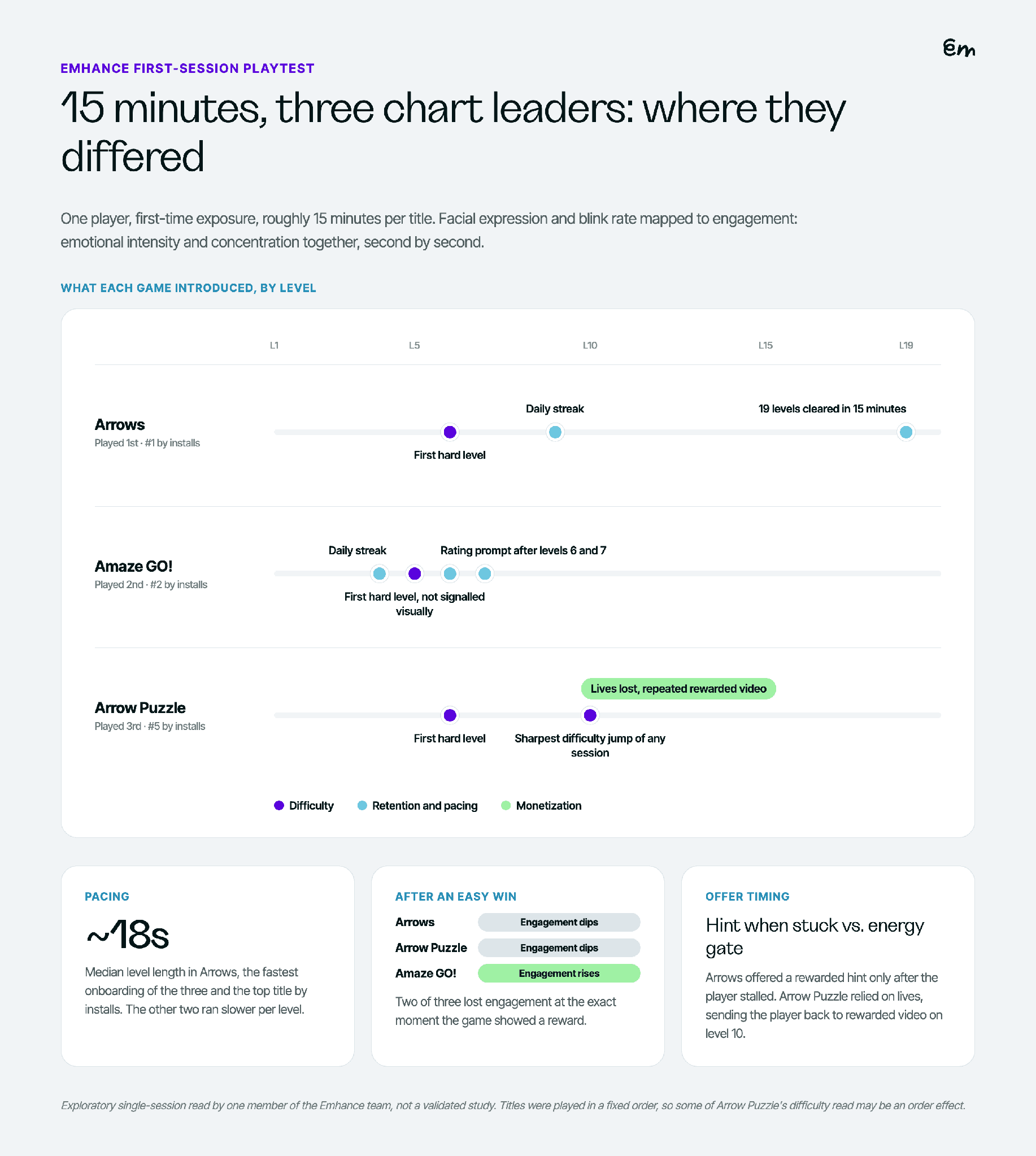
Emhance ran a first-session exploratory read across the three June 2026 top-five titles: Arrows, Arrow Puzzle, and Amaze GO. One member of our team played each title for around 15 minutes, first-time exposure to all three, while we tracked facial expressions and blink rate and mapped them into an engagement curve for each session: emotional intensity and concentration together, second by second.
This is a single-session read by one player on our team, not a validated study with recruited participants, and the three titles were played in a fixed order, Arrows first. Where that order might explain a result, we've said so below.
All three open the same way.
Tutorials are minimal: tap the arrow, nothing about the lives system explained up front. Engagement runs high through this stage in all three sessions, then drops once the puzzles start repeating the same simple pattern. In Arrows and Arrow Puzzle, that drop deepens into a small cliff right after the success animation on an easy level: engagement dips at the exact moment the game shows a reward. Amaze GO's success animations produced a rise in engagement instead, which tracks with its heavier production polish elsewhere in the build.
Difficulty introduction lands in nearly the same place.
Arrows and Arrow Puzzle both introduce their first genuinely hard level around level 6. Amaze GO introduces its first hard level around level 5, but doesn't signal the spike visually the way the other two do. In every session, the moment a harder or unfamiliar puzzle configuration appeared, engagement spiked immediately: the drop from repetition and the spike from difficulty sit right next to each other on the same curve.
Arrow Puzzle's difficulty curve stood out, and so did a UX problem.
Level 10 produced the sharpest difficulty jump of any session, enough that repeated life losses forced repeated rewarded-video views to keep playing. Arrow Puzzle also produced the only input-accuracy problem we saw: taps registering on the wrong piece, not the arrow actually tapped. Neither issue showed up in the other two games. Because Arrow Puzzle was played third, in the same order every time, some of the difficulty read may be an order effect rather than a true design difference. The UX registration issue isn't explained by order.
Amaze GO's polish shows up as a specific, small design moment.
Its pinch-to-zoom tutorial step produces a brief engagement dip, players bracing for another instructional screen, immediately followed by a small spike when the zoom reveals a hidden detail on the board. That single moment, dip then reveal then spike, is the clearest example in any of the three sessions of a deliberately built emotional beat rather than a side effect of pacing.
Pacing correlates with the download numbers.
Arrows, the top-ranked title by installs, also ran the fastest onboarding: a median level length of around 18 seconds and 19 levels completed in the first 15 minutes. Arrow Puzzle and Amaze GO both ran slower per level.
Monetization timing differed the most between Arrows and Arrow Puzzle.
Arrows' rewarded-video hint offer appeared only after the player had stalled, no movable piece found for several seconds, reading as a response to genuine difficulty rather than a fixed timer. Its interstitials stayed light through the full 15-minute session. Arrow Puzzle leaned on a harder energy gate instead: losing lives on level 10 forced the player back to rewarded video repeatedly, with no equivalent contextual hint offer observed.
Amaze GO shipped more retention features, faster, than the other two.
A daily streak appeared by level 4, against level 9 in Arrows. A rating prompt appeared twice, after levels 6 and 7. A social comparison line, "beats 70.59% of players," ran before a level start, a feature we didn't see in either other title.
All three run close variants of the same core loop. What separated the top-ranked title from the others was pacing and monetization timing.
Where the openings are
Two market signals point to the same conclusion: the base mechanic alone is no longer a differentiator. A wave of near-identical arrow-style titles from small publishers drove much of the genre's June 2026 download spike, and App Store reviews across nearly every title we checked, including the top-ranked ones, repeat the same complaints: forced ads that persist after paying to remove them, difficulty that swings between too easy and artificially blocked, and level design that reviewers describe as copy-pasted between competing titles.
A few gaps show up consistently.
Meta layers that connect to the core loop, rather than sitting beside it, are still rare. Woodle Screw's city-rebuild mechanic is a working example; most of the category runs a generic collection or decoration screen instead.
Social and competitive features are common across casual games broadly, roughly two-thirds of top mobile titles now carry at least one, but they're rare specifically within arrow puzzles. Block Jam 3D's weekly league is the clearest example we found; Amaze GO's single social-comparison line is a smaller version of the same idea. Most titles in the genre remain purely single-player.
Dynamic difficulty adjustment, tuning the curve to an individual player rather than running the same fixed sequence for everyone, is flagged by more than one industry analyst as underexplored across hybrid-casual puzzle generally, not just this genre.
AI-generated levels are already in use for producing content at volume, but analysts are consistent that AI can't substitute for human judgment on pacing and balance. The roller-coaster curve still has to be tuned by a person.
What this means for a studio considering the genre
The mechanic is proven and cheap to prototype, which is exactly why it's crowded. Differentiation has to come from somewhere other than the core loop.
Pacing is the first lever, and it's measurable before a single line of live-ops code gets written. Our playtest data and the install numbers point the same direction, with the fastest-onboarding title also the highest-ranked by downloads. A tight median level length in the first session is worth testing for directly.
Monetization timing matters more than monetization amount. The clearest design difference we saw between titles was in when the offer appeared. A hint offer triggered by genuine player difficulty reads completely differently from the same offer triggered by a fixed timer, even at an identical price.
A meta layer that's structurally tied to the puzzle mechanic, not bolted on afterward, is still a real gap in this genre specifically, even though the wider hybrid-casual category has mostly solved it elsewhere.
Success moments are worth testing on their own. Two of the three titles we played showed a drop in engagement right after their win animation, the exact moment the game is trying to reward the player. That's a specific, fixable problem, and it's the kind of thing that doesn't show up in an analytics dashboard: the drop-off looks the same whether a level was too easy or the reward itself fell flat.