Sensemitter is now Emhance.
Read more

Articles
How many playtesters do I need for a usability study on a mobile game?
Written by:
Emer Rutherford
|
Marketing Generalist

How many playtesters do I need for a usability study on a mobile game?
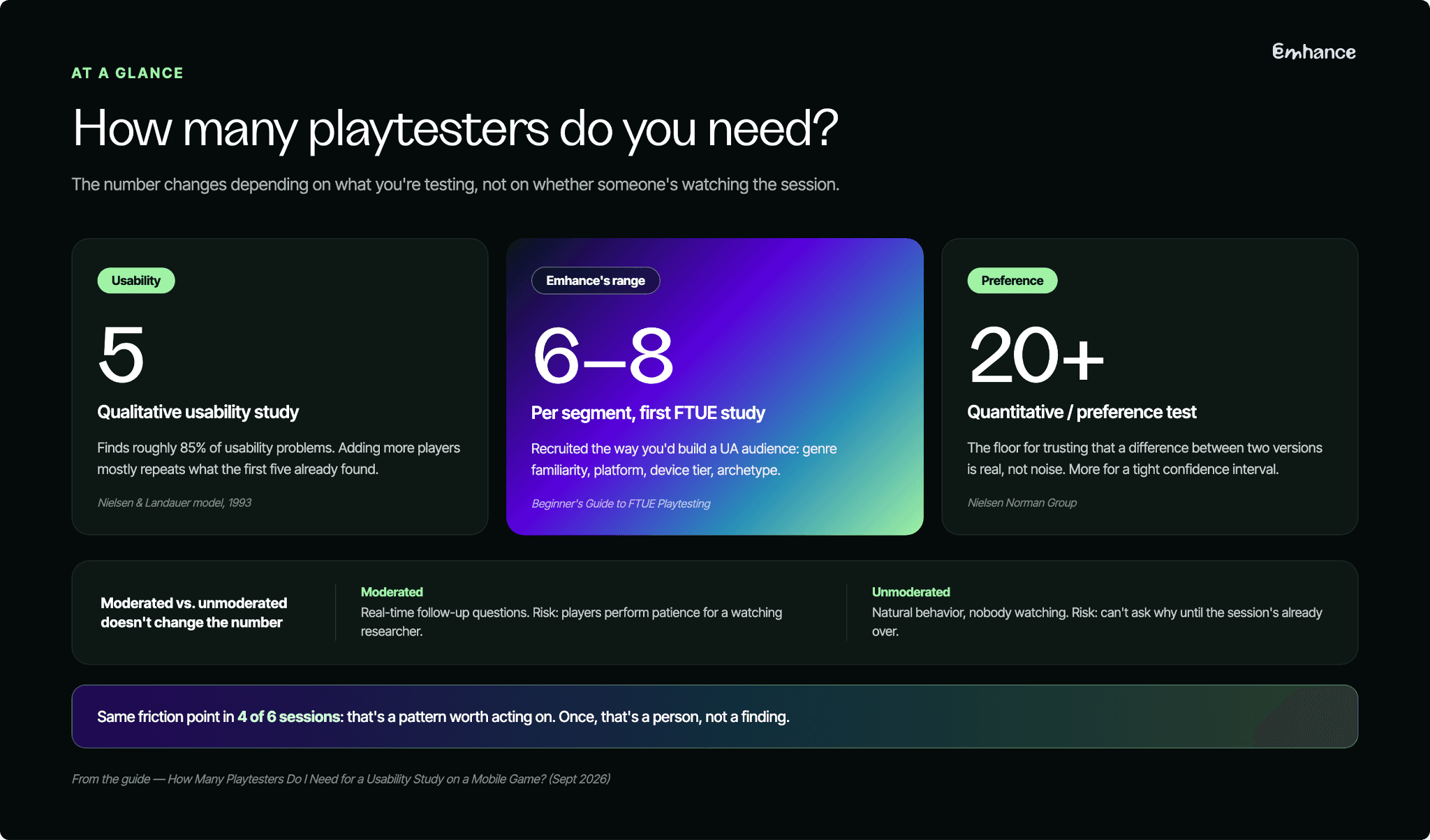
For a playtest, you need at least five players. Jakob Nielsen and Tom Landauer's model of usability testing found that one player surfaces about 31% of a game's usability problems on their own, and five together surface about 85% of them, with each additional player mostly repeating problems the earlier ones already found.
That number holds for a formative study: watching players use your interface and finding where they get stuck. Two things change it: what kind of question you're asking, and whether you need the answer to be a statistic.
Usability vs. preference changes the number
A usability study is qualitative. You're not proving a statistic, you're locating where players get confused or stuck, and five participants reliably surfaces most of it. The usability research firm Jakob Nielsen co-founded, recommends running three studies of five participants rather than one study of 15, because a smaller study lets you fix a problem and retest before the next round, instead of banking every finding into a single report at the end.
Preference testing is a different question: which onboarding flow do players prefer, which icon reads clearer, which of two tutorials converts better. That's a comparison, and you need enough participants to trust that the difference you're seeing is real and not noise. The Nielsen Norman Group puts the floor for that at 20 participants, more if you want a tight confidence interval.
Moderated vs. unmoderated doesn't change the number, it changes what you get
Moderated sessions, where a researcher watches live and asks follow-up questions, and unmoderated sessions, where a player plays alone on their own device, don't call for different sample sizes. Five is five either way. What differs is the kind of finding you get.
A moderator can ask a player what they expected to happen, in the moment. That comes at a cost: players tend to be more patient with confusing UI when someone's watching them play than they are alone on their phone at 11 p.m. Unmoderated sessions capture what actually happens with nobody watching, at the cost of not being able to ask why until afterward.
What a mobile studio's first study usually looks like
For a first FTUE or usability study on a mobile game, six to eight participants per player segment is the range our own beginner's guide to FTUE playtesting recommends, recruited against the same criteria you'd use for a paid UA campaign: genre familiarity, platform, device tier, and the player archetype you're designing for, if one applies. That's wide enough to see a pattern repeat across sessions and narrow enough to run in about a week.
Hitting that number matters less than knowing what to do with it once sessions are underway. The guide's rule of thumb for telling a real finding from a one-off: if the same friction point shows up in four of six sessions, that's a pattern worth acting on. If it shows up once, that's a person, not a finding. The same logic applies whether you're at five participants or eight: repetition across sessions is what turns an observation into something you can brief a fix against, not the raw headcount.
In practice, that's close to what a real study looks like end to end. Peaksel's FTUE study on The Vault, for example, ran six participants and traced a level 3 drop-off to a specific 45-second window, not a vague sense that "the tutorial needs work." That case is covered in full in how sessions catch what analytics can't on day one.
If you're scoping your first study, the full walkthrough (writing the research objective, recruiting without insiders, session design, and turning findings into a brief) is in our Beginner's Guide to FTUE Playtesting. Or if you'd rather talk it through, we'd be glad to take a look at your sample size and session design with you.