Sensemitter is now Emhance.
Read more

Articles
Best Player Experience Research Tools for Games
Written by:
Emer Rutherford
|
Marketing Generalist

A heatmap shows a dead zone in the middle of your shop screen. A funnel shows 40% of players stall on the same upgrade tier. A validated survey scale rates this build low on Challenge.
All three are true. None of them show what happened in the player's head at that moment.
Player experience research is the discipline underneath all of this: studying how a game actually feels to play, apart from a one-off playtesting study and apart from public feedback channels like reviews and Discord. This guide covers the tools studios use for it, what each one actually measures, and where it stops.
What to look for in a player experience research tool
Four questions before picking one:
Does it tell you what players did, or what they felt while doing it? Behavioral data (taps, drop-off points, session length) and experiential data (frustration, delight, confusion) are different signals, even when both get filed under “player experience.”
Is it built for games, or for software in general? A dead zone on a checkout page and a dead zone on a gacha pull screen look the same in a heatmap. They're different problems, and a tool without games context can't tell them apart.
Does it collect data, or organize data you already have? Some tools generate new research. Others make sense of research that's already scattered across your team.
Is the output something you can act on, or something you have to interpret first? A dashboard full of correct numbers is still homework if nobody has time to translate it into a fix.
The tools
1. UXCam: session replay and heatmaps
UXCam records how players move through a mobile app screen by screen, then aggregates those recordings into heatmaps of where they tap, scroll, and stall.
It's installed in 37,000+ products and processes more than 100 billion data points a month. It's built for mobile software broadly, not games specifically. A heatmap shows exactly where players are tapping and where they aren't. It doesn't show whether the players who stalled on that screen were confused, bored, or just deciding.
Best for: studios that want a visual record of where players are getting stuck in the UI, without needing games-specific benchmarks.
2. GameAnalytics: games-native behavioral telemetry
GameAnalytics tracks acquisition, engagement, and monetization events across mobile, PC, console, and Roblox, and is used by 100,000+ studios.
There's no video and no heatmap. It's aggregate telemetry: funnels, retention curves, segment performance, event tracking. It's fast and games-native. It can tell you a segment's retention dropped after an update. It can't tell you whether the drop was a bug, a balance issue, or players finding the new content boring.
Best for: studios that need games-specific behavioral metrics at scale, and already have a separate way of finding out why a metric moved.
3. Lookback: moderated and unmoderated video research
Lookback runs live, moderated interviews or fast unmoderated studies over video, recording the screen and the participant together.
It has 400,000+ users and 1.5 million+ research sessions run. Participants narrate what they notice. They can't narrate what they don't notice. It's general software research. Nothing about it is built around game sessions specifically.
Best for: qualitative depth on a specific flow, when a small number of rich sessions matters more than scale.
4. PXI (Player Experience Inventory): validated self-report scale
The PXI is an academic, peer-reviewed survey instrument built to measure player experience: 10 constructs split across functional consequences (ease of control, goals and rules, challenge, progress feedback, audiovisual appeal) and psychosocial consequences (meaning, curiosity, mastery, immersion, autonomy).
It's open-access, games-specific by design, and validated across multiple studies. It's still self-report. Participants rate statements like “It was easy to know how to perform actions in the game” after the fact. It captures what a participant can consciously reconstruct, not what happened to them moment to moment.
Best for: studios that want a structured, academically validated way to compare player experience across builds or genres using a consistent instrument.
5. Dovetail: research repository and synthesis
Dovetail doesn't collect new research. It centralizes feedback and findings already sitting in support tickets, surveys, sales calls, and past studies, then uses AI to surface patterns across all of it.
It's a synthesis layer, not a new source of signal. It's built for software teams generally, with no games-specific structure for things like FTUE stages or core-loop mechanics.
Best for: teams already generating plenty of player research who need one place to search and connect it, instead of re-running studies that already happened.
6. Emhance: emotion AI playtesting
Emhance measures what a player feels while playing, using facial coding and eye tracking through a standard webcam. No lab, no hardware, no interview.
Behavioral and self-report tools both describe the player from the outside. About 50% of in-game emotional responses never surface in a survey or an interview, because a player can't report a reaction they didn't consciously register. A heatmap doesn't have that problem so much as a different one: it doesn't measure emotion at all, only where a tap landed, and a tap timestamp can't tell "confused" from "concentrating."
Emhance tracks two signals together: emotional intensity (facial muscle activity) and concentration (blink suppression), mapped second by second across a session. A heatmap can show a stall on a screen. Emhance can show that engagement flatlined the moment a new mechanic appeared without explanation.
Best for: studios that already have behavioral data or survey scores showing something is wrong, and need to know what a player actually felt at the exact moment it happened.
How the tools compare
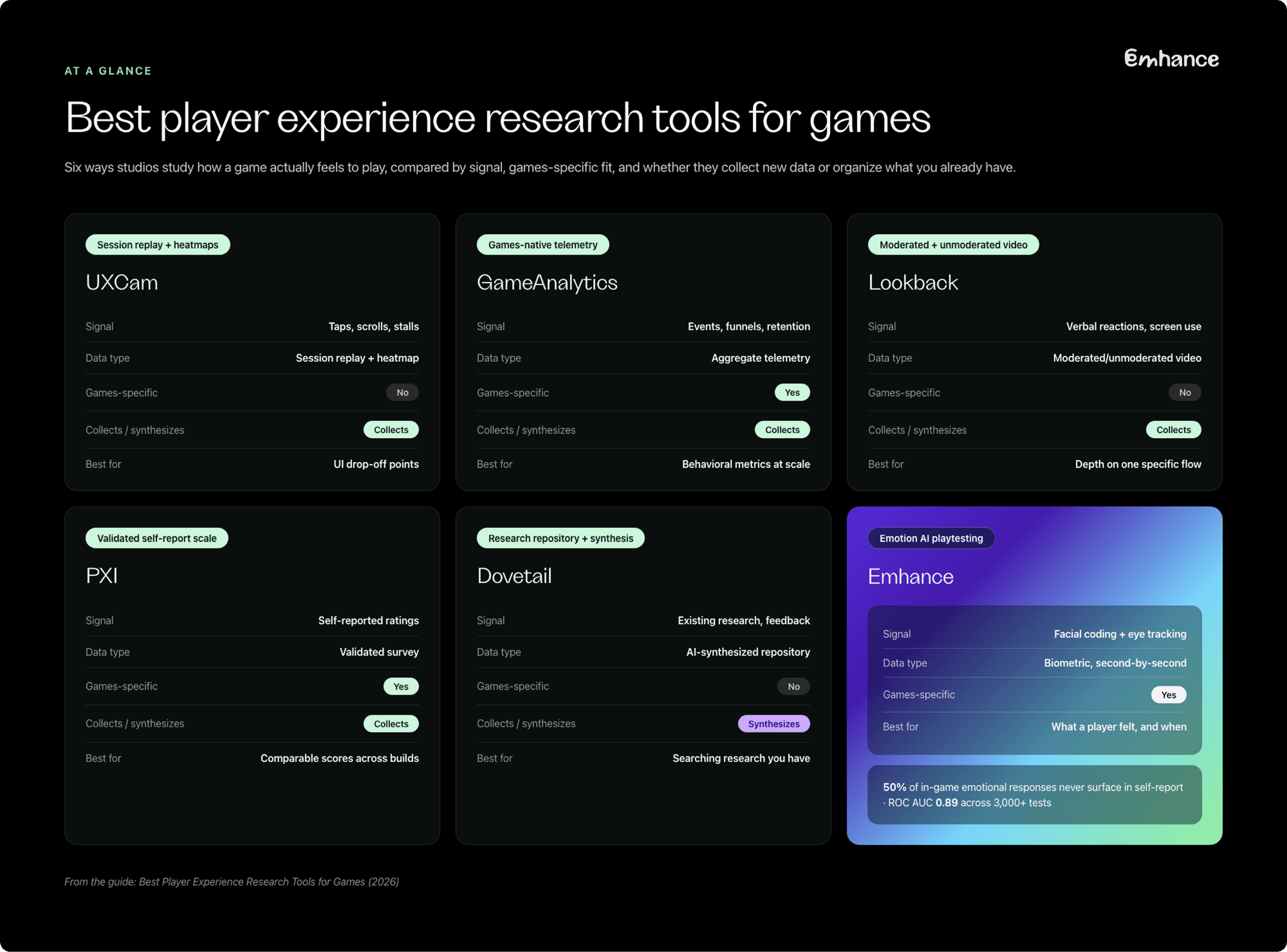
Choosing by the problem you actually have
You can see where players stall, but not why. A heatmap or funnel raises the question. It doesn't answer it. Pair behavioral data with a signal that captures what happened emotionally at that exact point.
Your research is scattered across five tools and nobody has time to read all of it. That's a synthesis problem. A repository tool is worth more here than another testing platform.
You want a consistent way to compare experience across builds or genres. A validated scale gives you a number to track over time. It won't diagnose why that number changed.
A metric moved and you need to know what to fix before the next release. This is where behavioral and self-report data run out of road. Neither can isolate the moment engagement broke.
FAQ: player experience research tools for games
What's the difference between player experience research and playtesting?
Playtesting is a structured study: recruiting a set of players and observing or measuring them in a session, usually pre-launch or pre-release. Player experience research is broader. It includes ongoing behavioral analytics, survey instruments, and research synthesis that studios run continuously, on live games as well as new ones.
Is a heatmap enough to understand player experience?
It's enough to know where. It shows players tapping less, scrolling past, or stalling on a specific screen. It doesn't distinguish a player who's confused from one who's bored from one who's just pausing to think: three states that produce identical behavioral data and different fixes.
Do I need a validated academic scale like the PXI, or is a custom survey good enough?
A validated scale gives a consistent, comparable measurement across builds, teams, or genres. That's useful if you need to track experience over time rather than just once. A custom survey is faster to deploy but harder to compare against anything else. Either way, both are self-report. Participants can only rate what they consciously noticed.
Why isn't Emhance in the same category as GameAnalytics or UXCam?
It's measuring a different layer. Analytics and session-replay tools describe what a player did: where they tapped, when they stalled, when they left. Emhance measures what a player felt while doing it, using facial coding and eye tracking instead of inferring emotion from behavior after the fact.
How do these tools fit together, rather than compete?
Most studios end up using more than one. Behavioral analytics finds where something is wrong. A biometric layer explains why. A repository tool keeps the findings from both somewhere a team can find again next quarter.
Where to start
Behavioral analytics and survey scales are good at telling you where and how much. Neither was built to tell you why, and why is usually the part that decides what to fix before the next release.
If you already have the where and need the why, we'd be glad to show you what that looks like on your own game.