Sensemitter is now Emhance.
Read more

Articles
The Best Concept Testing Tools for Mobile Games in 2026
Written by:
Emer Rutherford
|
Marketing Generalist

Somewhere in every studio's history is a game that tested well and still failed. The concept scored high in a poll. The pitch deck landed in the greenlight meeting. Six months later, day-one retention is below benchmark and nobody can point to the moment it went wrong.
That's not a concept testing failure. Concept testing did its job — it told you people liked the idea. It was never built to tell you whether the finished game would hold anyone's attention once they were actually playing it. Those are two different questions, and most of the tools in this category only answer the first one.
This guide covers the tools studios use to validate a concept before development, what each one actually tells you, and where that answer stops being useful.
What to look for in a concept testing tool
Four questions before picking one:
Does it show your concept to real players, or infer a reaction from data about players like them? A poll and a prediction model answer different questions, even when both come back in minutes.
Is it built for games, or a general market-research tool pointed at a game idea? Genre conventions, monetisation patterns, and player motivation frameworks are specific to games — a platform without that context is guessing at the same things you are.
What decision does the output actually support? Greenlight-or-kill, feature prioritisation, and genre-fit are three different jobs. Know which one you're buying before you pick a tool.
What does it not tell you? Every tool in this category has a ceiling. The honest ones are clear about where it sits.
The tools
1. PickFu — audience polling
PickFu puts a concept, a piece of art, or a name in front of a panel of real players and returns ranked preferences with written feedback, often within minutes.
Its own playbook for game concepts runs five steps: competitive research, core mechanics, art direction, feature prioritisation, then overall concept validation — each tested against a fresh slice of the panel (roughly 100 respondents per step for a solid directional read, fewer on a tighter budget). That structure makes it easy to test one variable at a time instead of asking "do you like this" about everything at once.
Best for: fast, cheap directional reads on a specific decision — an icon, a name, a mechanic — before committing development time to it.
2. GameRefinery — market and competitive benchmarking
GameRefinery doesn't ask anyone what they think of your concept. It compares your concept's feature set against a database of live games, scored against what's actually driving revenue in your genre.
The logic: rather than finding a market for a game you've already designed, check what's already working in the market first. If nothing comparable exists in the data, that's a signal worth investigating either way — a genuine gap, or a segment that's been tried and hasn't worked.
Best for: checking whether a concept's feature set fits a proven, monetisable pattern in its genre before locking a design.
3. Solsten (Elaris) — AI-predicted psychological response
Solsten's Elaris tool builds psychological player personas and predicts how a described concept will land with them, without recruiting anyone or running a session. The pitch is explicit: concept validation in minutes, not months.
The trade-off is the one every prediction-from-description tool shares — it's evaluating a description against a model of players, not testing the concept on an actual player. That's a genuinely useful early filter. It's also a hypothesis, not a finding, the further the concept sits from what the model has seen before.
Best for: an early, low-cost gut check when there's a concept on paper and no budget yet for primary research.
4. Quantic Foundry — motivation-framework fit
Quantic Foundry's Gamer Motivation Model breaks player motivation into 12 factors, built from factor analysis across survey data from 466,000+ gamers and grouped into three broader clusters (Action-Social, Mastery-Achievement, Immersion-Creativity). Rather than testing a concept with anyone, studios map a concept's mechanics and themes against the model to predict which motivational segment it's likely to resonate with — Quantic Foundry has worked with 200+ studios and publishers on exactly this kind of audience-fit question at the concept stage.
It's the most theoretical tool in this guide — no players see the concept, no session runs, no poll comes back. What it's good at is catching a mismatch early: a mechanic built around competitive, Excitement-driven play pitched at an audience that profiles heavily toward Immersion and Story is a problem a motivation model flags immediately, before a popularity poll would necessarily catch it. The limit is the same as any model: it's only as accurate as the mapping between the concept and the framework, and it says nothing about execution quality.
Best for: checking whether a concept's core appeal actually matches the motivational profile of the audience it's aimed at, before spending on a poll or a build to find out the hard way.
5. General market-research platforms
Tools like Attest, Zappi, and Maze weren't built for games, but plenty of studios already run one for other products and just point it at a concept — a survey, a preference test, a landing-page click-through rate.
They work fine for a broad interest check. What they don't carry is any games-specific context — no genre benchmarks, no player-motivation framework, no sense of what "engaging" means inside a five-minute mobile session versus a checkout flow.
Best for: a studio that already has one of these platforms for other work and wants a quick directional signal without buying a new tool.
6. Emhance — what happens after the concept tests well
Every tool above answers some version of "do people like this idea." None of them puts a real player in front of a real, playable build.
That's the gap Emhance sits in. Once a concept clears its first gate and there's a prototype or vertical slice worth playing, Emhance uses facial coding and eye tracking to measure what a player actually feels while playing it — not what they say about the pitch. About 50% of in-game emotional responses never surface in a survey or interview, which is exactly the layer a concept score can't see: whether the mechanic that sounded fun on paper still holds attention once someone's thumbs are on it.
Engagement here means two signals together — emotional intensity (facial muscle activity) and concentration (blink suppression) — mapped second by second, not a single score. A concept that polled well can still open with 45 seconds of confusion once it's actually in someone's hands; a concept testing tool has no way to catch that, because there's nothing to play yet.
Best for: studios with a prototype or vertical slice who want to know whether the concept holds up in play before committing to full production.
How the tools compare
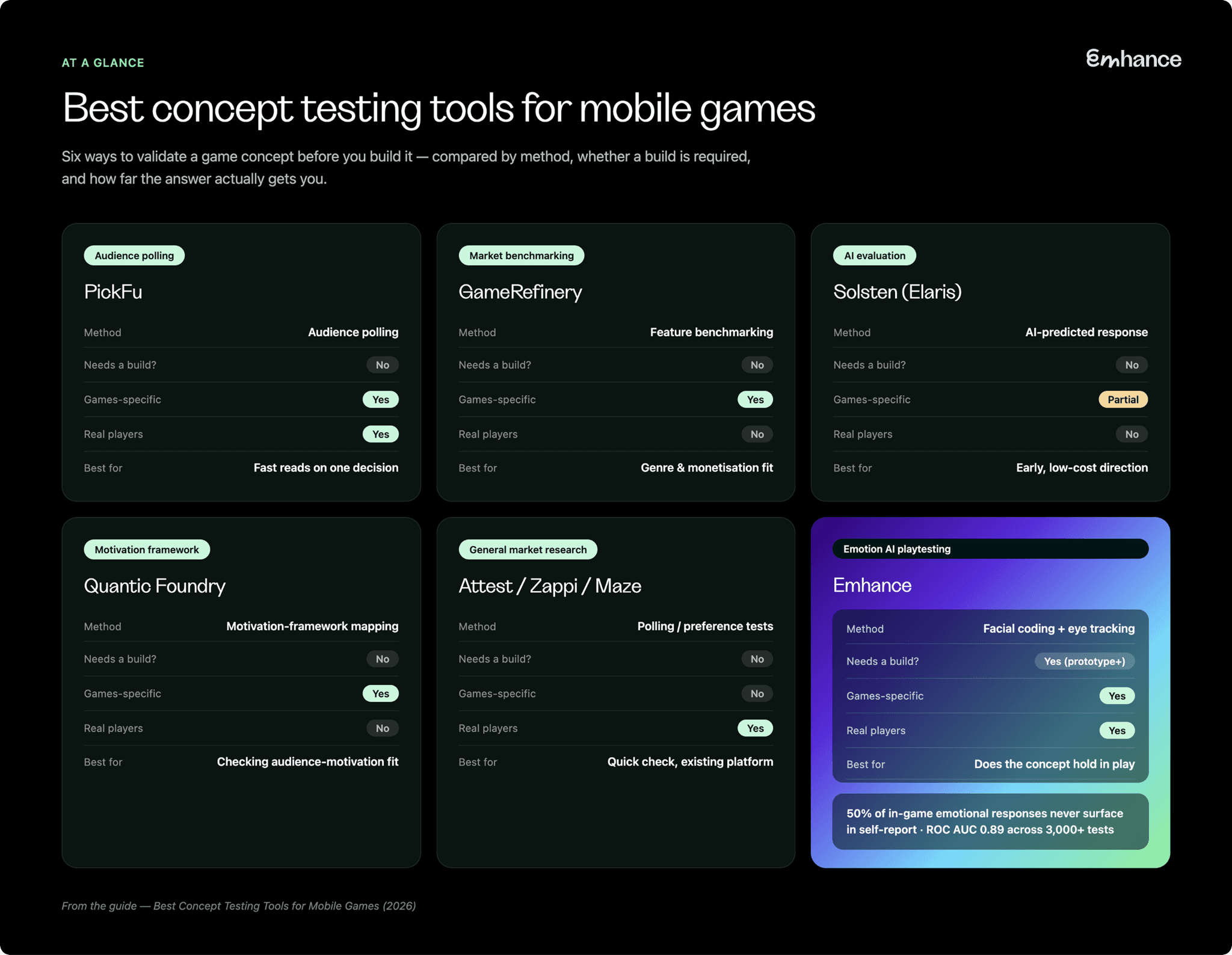
Choosing by the problem you actually have
Multiple directions, need to cut the list fast. PickFu is built for exactly this — one variable tested at a time against a real audience.
Want to know if the idea fits a pattern that actually makes money. GameRefinery's benchmarking answers that more directly than asking anyone's opinion.
No budget for primary research yet, just want a first filter. Solsten's Elaris gets you a directional read from a description alone — treat it as a hypothesis, not a verdict.
Worried a concept is aimed at the wrong audience before spending anything on testing it. Quantic Foundry's motivation model catches that kind of mismatch from the design brief alone, without a session or a poll.
Already run market research for other products. A general platform like Attest, Zappi, or Maze avoids adopting a new tool for one test.
The concept already tested well and there's something playable now. This is where concept testing's job ends. Whether the built thing actually holds attention is a different question, answered by watching someone play it — not by asking them what they thought of the pitch.
FAQ: concept testing for mobile games
What is concept testing for a mobile game?
Concept testing puts an idea — a pitch, a description, art, a name — in front of an audience before any significant development happens, to gauge interest and catch obvious problems early. It's the cheapest gate in the whole pipeline, because there's nothing built yet to throw away.
How is concept testing different from playtesting?
Concept testing evaluates an idea. Playtesting evaluates a build. A concept can score well in a poll and still produce a confusing or boring first five minutes once it's actually playable — those are different failure modes, and no amount of concept testing catches the second one.
Does a concept that tests well guarantee good retention once it's built?
No. Concept testing measures interest in an idea, not what happens once a player's hands are on a working version of it. Plenty of concepts that polled well have shipped with FTUE (first-time user experience) problems nobody could have seen in a survey, because the survey never showed anyone the actual game.
Can a studio skip concept testing and go straight to a prototype?
Depends on the cost of being wrong. Concept testing is cheap insurance against building the wrong thing entirely — a mechanic nobody wants, a theme that doesn't land, positioning that doesn't fit the market. Skipping it isn't reckless for a small, cheap prototype; it's a real risk for anything that costs a real sprint to find out.
How much does concept testing cost?
Audience-polling tools like PickFu start around the cost of a single poll — tens of dollars per test at the low end. AI-prediction tools are priced for speed and low commitment. Full-suite platforms and general market-research tools run higher, usually as a subscription, since they're selling ongoing access rather than one test.
Glossary
FTUE (first-time user experience): the first minutes a new player spends in the game — where most retention is won or lost, and where concept testing has no visibility at all.
Vertical slice: a small, playable section of a game built to represent the final product's quality and feel, used to test the concept once it's more than an idea.
Panel: the pool of people a research tool draws test participants from — size, targeting options, and turnaround time vary widely between tools.
Self-report: anything a player tells you directly — a survey answer, a poll response, a written comment. Most concept testing tools in this guide run on it; the exceptions map a concept against a pre-existing model instead of collecting a fresh reaction to it.
Where to start
Concept testing answers one question well: will people be interested in this idea. It was never built to answer the next one — whether the finished game holds anyone's attention once they're actually playing it.
If a concept has already cleared that first gate and there's a prototype worth testing, that's the point to bring in something that measures the play itself, not the pitch.