Sensemitter is now Emhance.
Read more

Articles
Should I use analytics or playtesting to find out why players churn on day 1?
Written by:
Emer Rutherford
|
Marketing Generalist

Should I use analytics or playtesting to find out why players churn on day 1?
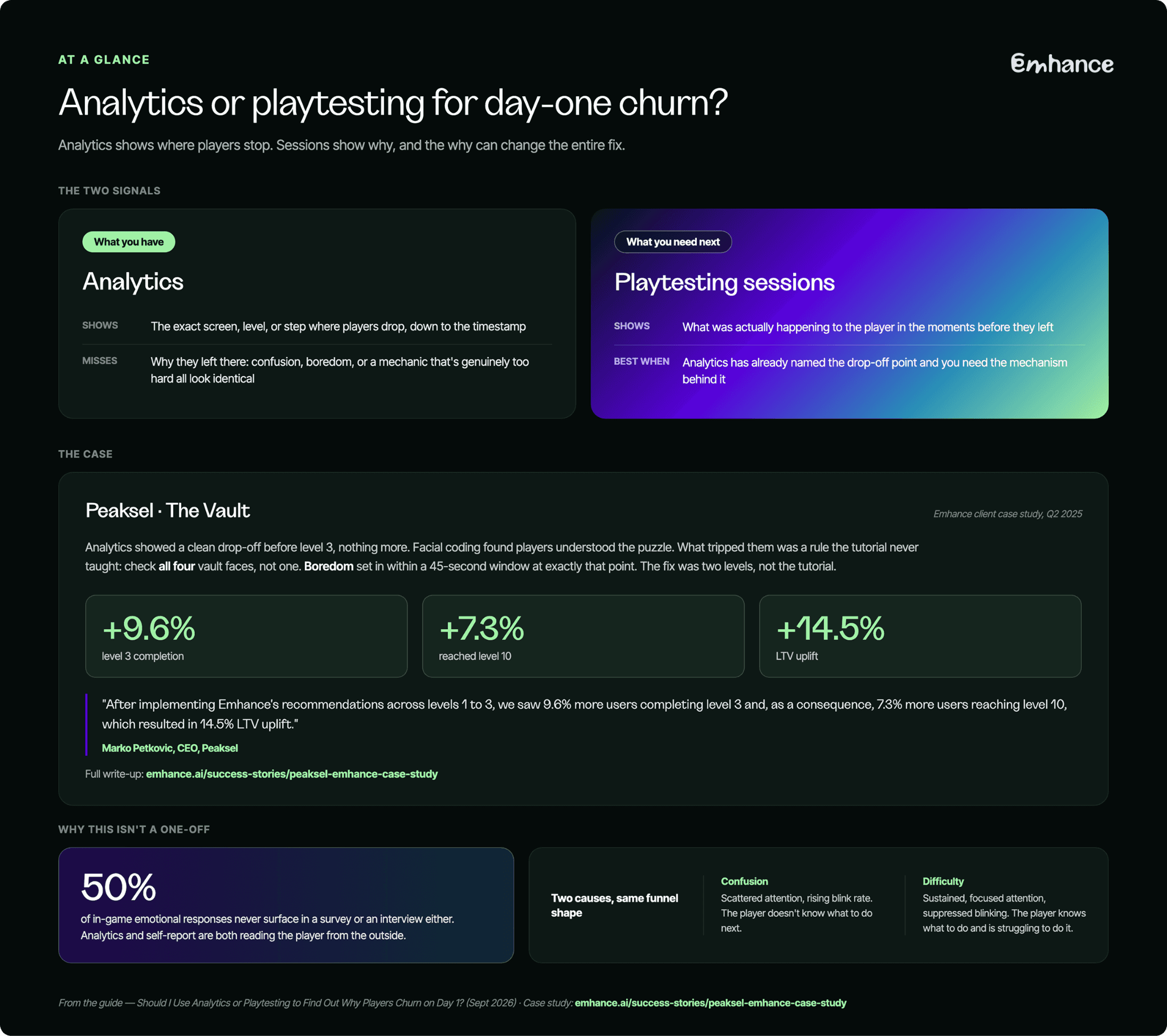
Both, for different jobs. Analytics shows you the exact point where players stop, and playtesting (watching real sessions, not just the events they log) shows you what was happening to the player right before they left.
What analytics can tell you, and where it stops
Event logs and funnels are precise about location. If day-one retention is soft, analytics can usually name the exact screen, level, or step where the drop happens, down to the timestamp. What it can't do is explain the drop, because the same funnel shape can come from at least three different causes: the player was confused, the player was bored, or the mechanic was genuinely too hard. All three produce an identical line on the same chart. Each one needs a different fix.
A quick way to tell which one you need
Signal you have | What it tells you | What it doesn't tell you |
Analytics (funnel drop-off, D1 retention) | Where players leave | Why they left at that exact point |
Store reviews or support tickets | What frustrated players who bothered to write in | What silently pushed everyone else out |
A/B test results | Which version performed better | Why one version worked and the other didn't |
If you haven't looked at your funnel yet, start there. It's faster, and it tells you exactly where to point a session-level study instead of guessing.
An example of a problem only sessions caught
Peaksel ran a puzzle game called The Vault. Analytics showed a clean drop-off before level 3. That's all it showed: players were leaving, and leaving at that exact point.
Emhance ran a study with six participants, ages 18 to 44, in the US and Germany, on Android. Sessions were free gameplay observation with pre- and post-session interviews, and facial coding (FACS) plus concentration mapping ran throughout. The tutorial had taught players to interact with one vault face at a time, in a fixed order. The live level asked them to explore four faces at once and notice which ones had hidden interactive elements. Facial coding showed boredom setting in within the first 45 seconds of that level, not frustration and not confusion about the puzzle mechanics themselves. Players understood the puzzle. They didn't know the game had changed the rules of exploration.
That distinction mattered for the fix. Peaksel redesigned levels 1 through 3, not the tutorial and not the full onboarding flow. Level 3 completion rose 9.6%, the share of players reaching level 10 rose 7.3%, and LTV rose 14.5%.
"After implementing Emhance's recommendations across levels 1 to 3 of our game, we saw 9.6% more users completing level 3 and, as a consequence, 7.3% more users reaching level 10, which resulted in 14.5% LTV uplift." — Marko Petkovic, CEO, Peaksel
Read the full write-up on our Peaksel success story page.
It isn't just this one case
The gap between what analytics shows and what a player actually experienced is a structural pattern, and it shows up in more places than one puzzle game. About 50% of in-game emotional responses never surface in a survey or an interview either, which is the other tool teams usually reach for once analytics runs out of answers. Self-report and event logs both read the player from the outside, after the fact. Session-level emotional data reads what's happening while it's happening.
Two causes that look the same in a funnel
Confusion and difficulty are the pair that gets confused most often, and it's a distinction Emhance's research treats as a directional pattern worth watching for, not yet a validated large-scale finding. Both show up as the same drop-off point. In session-level data, confusion tends to show scattered attention and a rising blink rate: the player doesn't know what to do next. Genuine difficulty tends to show sustained, focused attention with suppressed blinking: the player knows exactly what to do and is struggling to do it. Lowering difficulty fixes the second case and does nothing for the first.
If your day-one funnel has a drop you can see but can't explain, we'd be glad to take a look at it with you.