Sensemitter is now Emhance.
Read more

Articles
Seasonal UA campaigns: best practices & creative testing

Seasonal campaigns introduce volatility into user acquisition. Holiday periods such as Black Friday, Christmas, Lunar New Year, Diwali, and other regional events create short windows of elevated competition and rising CPIs. Visual language shifts. Audience expectations shift. Auction dynamics shift.
The question is not whether to participate, but how to structure experimentation without destabilising existing performance.
This article outlines how to approach seasonal planning and where emotion-driven creative testing adds measurable value.
Seasonal creatives vs evergreen performers
At first glance, seasonal campaigns follow the same structure as any UA cycle:
Competitor review
Concept ideation
Production
Batch testing
Scaling
Production mechanics do not fundamentally change. What does change is thematic flexibility. Holidays allow emotional reframing — warmth, nostalgia, urgency, celebration, generosity. This can open new visual and narrative angles that are not viable year-round.

However, seasonal does not automatically mean superior.
In many cases, established top-performing creatives outperform new holiday-specific assets. The reason is structural:
They are already optimised by network algorithms
They have historical engagement data
They are behaviourally validated
Replacing them purely for thematic alignment can reduce efficiency.
Practical guidance:
Reintroduce proven creatives from prior seasonal cycles with minor updates. Refresh opening frames, pacing, or CTA sequences while preserving the core hook.
When to refresh creatives
Creative rotation is continuous. Monitoring install rate, CTR, IPM, and downstream retention is a daily function, not a quarterly one.
Some creatives fatigue within weeks. Others sustain performance for years. The decline pattern is rarely linear and is influenced by:
Auction pressure
Audience saturation
Algorithm shifts
Competitive creative density
A high-performing creative typically scales across multiple major networks. If performance is isolated to one platform, it may reflect placement conditions rather than intrinsic strength.
Practical guidance:
Test in small batches (3–6 creatives) to preserve signal clarity.
Replace underperformers quickly to prevent budget dilution.
Re-upload strong creatives with minor structural changes if decline begins. Subtle adjustments can reset optimisation patterns.
Budget allocation for testing
Creative testing requires structural investment. Not every concept will scale.
A disciplined framework typically allocates budget with the expectation that only a fraction of variants will become scalable performers.
To generate statistically meaningful signals:
Target 75–100 installs per creative before making scaling decisions.
Analyse early retention alongside CPI where possible.
Without continuous testing, performance plateaus. With undisciplined testing, budgets fragment.
The objective is controlled experimentation.
Where Emhance integrates into seasonal workflows
Emotion-driven creative analysis supports decision-making without disrupting established UA pipelines. Integration points are typically aligned to one of four moments:
1. During concept development
Before production is locked, emotional benchmarking can support ideation. Early testing of rough cuts or animatics clarifies whether a hook generates sustained attention and experiential consistency.
This reduces late-stage iteration cost.
2. Before traffic allocation
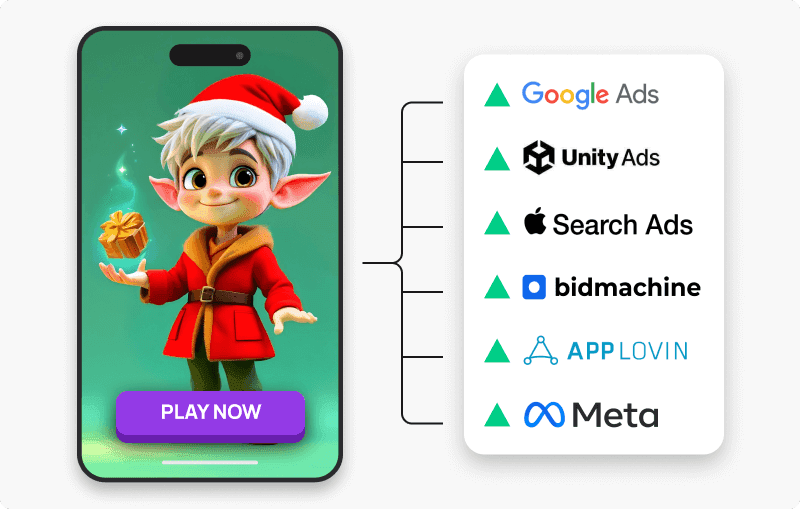
Testing creative batches prior to full A/B deployment identifies which variants are most likely to sustain engagement. This limits reliance on pure trial-and-error inside live auctions.
Emotion analytics surfaces:
Attention drop-off points
Friction during narrative transitions
Visual overload moments
3. When performance plateaus
If a creative is close to scaling but underperforms slightly, analysis can isolate the structural weakness. Often the issue is confined to:
The opening 3–5 seconds
The clarity of the payoff
The emotional pacing of the edit
Targeted adjustments are more efficient than rebuilding from zero.
4. Building a long-term creative knowledge base
Across multiple campaigns, emotional data accumulates into a structured playbook. Patterns emerge around:
Character framing
Colour intensity
UI density
Reward reveal timing
This transforms creative production from intuition-driven to evidence-informed.
Seasonal volatility requires structural discipline
Holiday periods encourage experimentation. They also amplify inefficiency.
Evergreen top performers may continue to outperform new thematic assets. At the same time, markets evolve, and creative fatigue is inevitable. Sustainable growth requires balancing stability with structured experimentation.
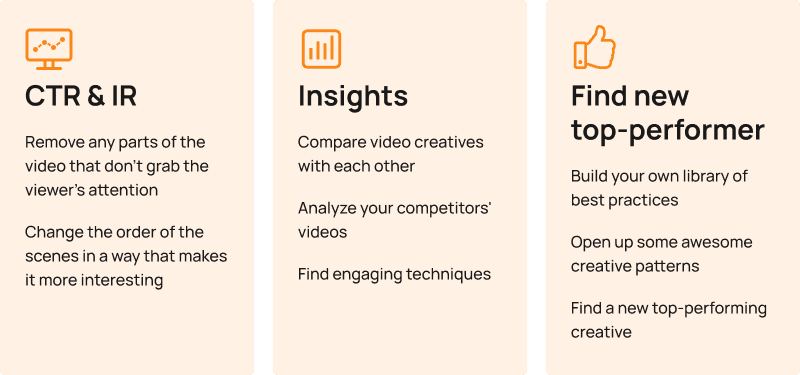
Emotion-driven testing enables:
Faster iteration cycles
Reduced wasted spend
Higher confidence in creative scaling decisions
If you want to integrate emotion analytics into your seasonal UA workflow, request a demo of the Emhance Platform.