Sensemitter is now Emhance.
Read more

Articles
Threaten the sheep: what emotional pacing in game ads really looks like
Written by:
Emer Rutherford
|
Marketing Generalist
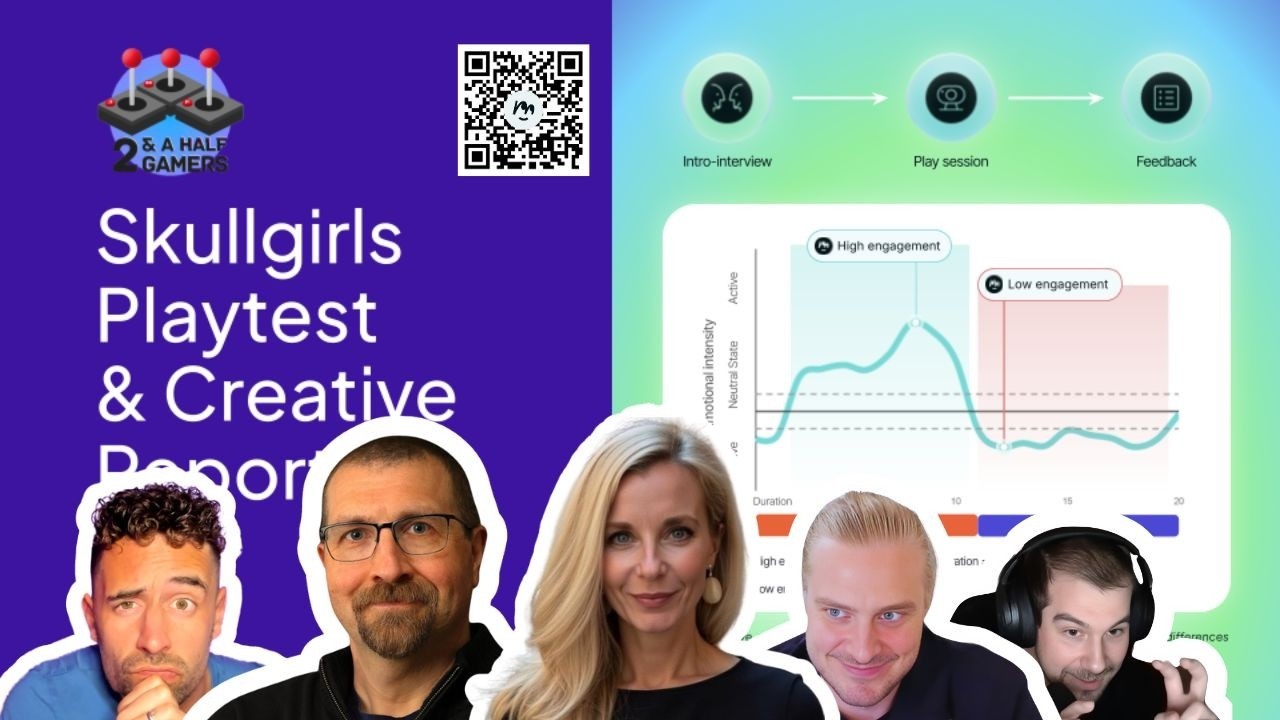
Our CEO Katie Madding and VP of Research John Hopson recently joined the 2.5 Gamers podcast for a full session with hosts Matej Lancaric, Jakub Remiar and Felix Braberg. John spent over 20 years studying player behaviour at Bungie (Halo, Destiny) and Blizzard (World of Warcraft) before joining us to build the research tooling at Emhance — so it was great to mine his insights in public!
The episode covered a lot: a live walkthrough of how our playtesting methodology actually works, a detailed breakdown of the first 15 minutes of Skullgirls, and a side-by-side comparison of mobile ad creatives. The thread running through all of it was the gap between what players say and what their behaviour actually shows — and what you can do with that gap once you can see it.
The attention budget: why three things is the limit
A big chunk of the episode focused on a playtesting breakdown of Skullgirls — specifically the first 15 minutes. The core game scored well: great art, sound design, high engagement once players were in actual fights. The onboarding was a different story.
John walked through our engagement curve in real time: "We're fighting. We're fighting. We're fighting. Stop. Now we're teaching something. Fighting. Fighting. Stopping to teach something." The tutorial was interrupting combat to explain mechanics players didn't need yet — blocking, throws, dashing — in a fight easy enough to win by button-mashing anyway. Players ended up simultaneously overloaded with information and underwhelmed by the challenge.
John's rule of thumb from Halo: no more than three things at a time. The number is less important than the principle. "For everything we teach, we have to give players a moment where they can immediately use it and see the impact. Just telling them 'you can do this combo to throw someone' — that information has no value unless they can immediately do it and feel why it matters."
Host Matej Lancaric had a phrase we ended up using a lot in the episode: the attention budget. Fill it up, wait for it to empty — that's when players have mastered what they've learned and start to get bored — then introduce something new. It also explains why genre matters: a Paradox grand strategy player arrives with a huge attention budget for dense information. A fighting game player in their first session has a much smaller one.
The Halo approach treated tutorial prompts as repeating reminders rather than one-off lessons. "We'd pop up 'press this button to pick up a weapon.' They do it. We snooze the message for five minutes. If they haven't picked up a weapon in five minutes, we bring it up again." Teaching something once and expecting players to recall it four hours later, when it actually matters in a boss fight, just doesn't work.
Key takeaway: Don't front-load the tutorial. Sequence mechanics so players can immediately apply what they've just learned. Teaching more than roughly three things at once exceeds the attention budget — the extra information doesn't land.
Emotional pacing: why flat engagement is a problem even when players are happy
A second issue our Skullgirls data surfaced: what happens at the end of each encounter. A player wins a fight. Engagement peaks. Then comes the sequence — victory animation, victory screen, reward screen, loading screen, cutscene — all stacked in a row. Each element is fine on its own. Together they create an extended valley in the engagement curve.
"Nobody on the team sat down and said, 'what we really want is five boring things back to back,'" John noted. "That's just the way things come together." This is exactly the kind of thing that's invisible without engagement data. Players complete every step — so the video looks fine. The signal tells a different story.
The broader principle: engagement curves should oscillate, not flatline. Maxing out excitement the entire time is as problematic as never reaching it. As John put it: "You don't want the game to be just nothing but explosions — you have to have some high moments and some low moments and give people a chance to relax in between." We see this in puzzle game studies too — players show intense focus while planning a move sequence, then relax while executing it, then focus hard again. That pulsing is the texture of good engagement.
Katie raised something we see across a lot of our studies: analytics teams often misread what's happening during difficult sections. When churn spikes at a hard moment, the instinct is to reduce difficulty. But our engagement data frequently shows those hard moments are peaks — heavy concentration, strong emotional reactions. The problem isn't the difficulty. It's that players weren't equipped with the right mechanics before they needed them.
Emotional pacing in ad creatives: threaten the sheep
The second half of the episode moved into creative analysis. We applied the same emotional engagement methodology to mobile ad creatives — obfuscated versions of real ads from a client and a competitor, both in the match-three space.
Two visually similar ads produced very different engagement curves. One (called "Cat Match 2" in the episode) generated a flat line — viewers experienced it as roughly the same throughout. Another ("Sheep Swipe") showed a dynamic curve: a moment of tension, then relief, then tension again. That oscillation, not the visual quality, was the difference.
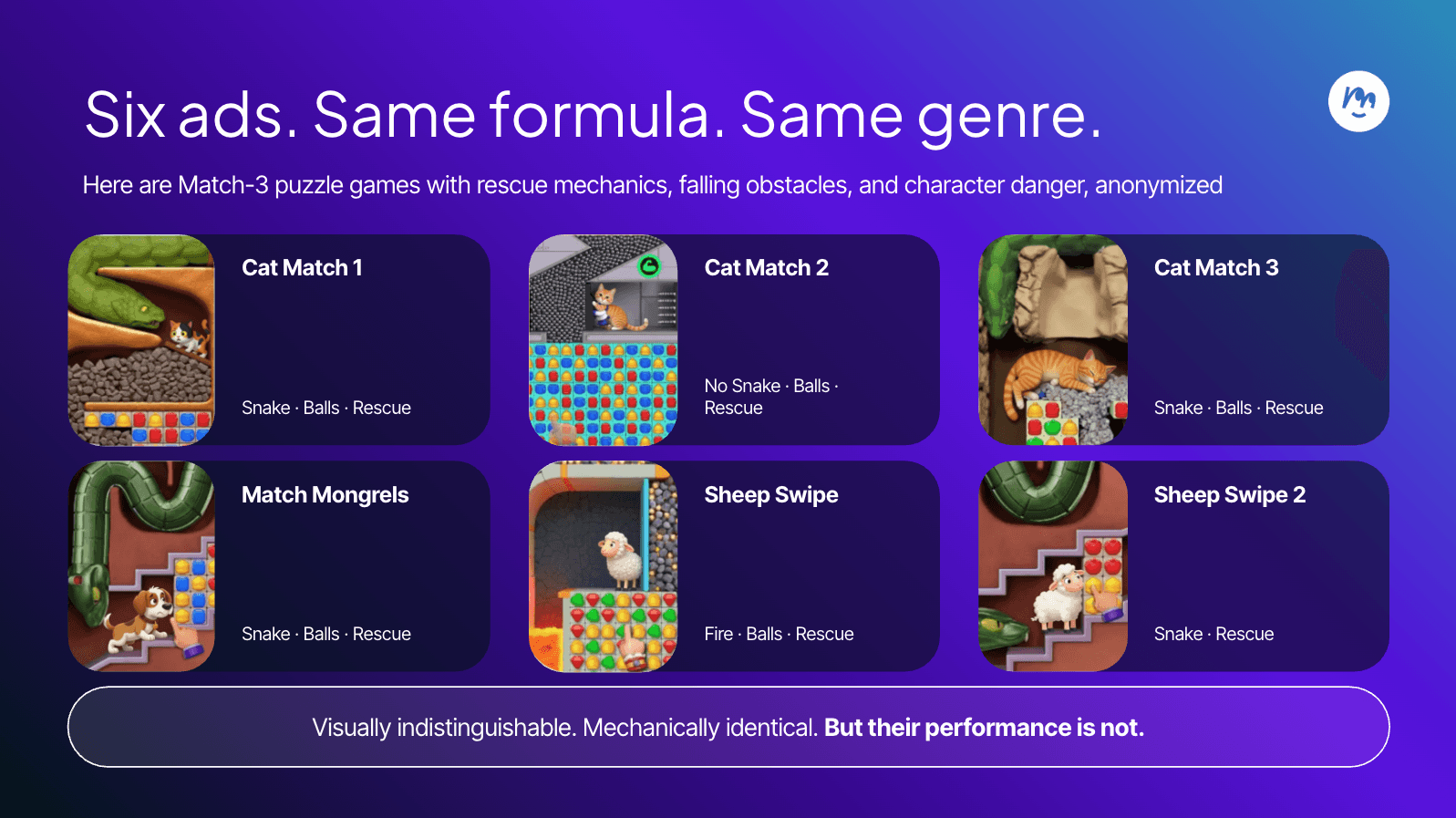
John's summary: "You don't want to kill the sheep in the first four seconds, but you need to at least threaten the sheep." The hosts recognised this immediately as the "near-death experience" creative format — well-established across Chinese and Turkish studios, and spreading into other markets and genres. What our data adds is the ability to pinpoint which specific moments within an ad are generating the engagement spike, and which are letting it down.
CTA placement matters here too. If the call-to-action fires during a low-engagement moment — a valley rather than a peak — the viewer's response is passive. Ads that placed the install prompt immediately after a failure or near-death moment performed better. The player is already emotionally invested: "I could have done that better. I could have fixed that." That's the moment to ask for the click.
Key takeaway: Emotional pacing matters in ads as much as in games. Tension and release — not flat excitement or a single climax — creates the engagement curve that drives install intent. CTA placement at a peak, not a valley, is the difference between a click and a scroll.
What players say vs. what they do
The thread that ran through both halves of the episode: the gap between what players report and what their behaviour actually shows. It's something we encounter in almost every study.
John's example from Bungie: a reviewer wrote that after 300 hours of Destiny, there was "nothing to do." His read: the player was clearly having fun moment to moment — 300 hours of actual play confirms that. But when they sat down to summarise the experience, it felt boring. Both signals are true. They're measuring different things.
"Those differences are opportunities," John said. "How did we fail to communicate? Why did this person play for 300 hours and still feel like there wasn't enough content?" The discrepancy isn't noise. It points to something specific — usually a failure in how the game communicates its own depth.
Katie's example came from the creative side: a pimple-popping ad. Our engagement data showed strong emotional response every time a pimple was popped. Post-viewing surveys returned: "Ew, disgusting, gross, I hate it." The ad was also one of the top performers on install metrics.
"You don't want to admit that you like popping pimples. No one's going to talk about that when they go out to dinner." Social desirability bias is real, consistent, and invisible in a survey. Players report preferring clean mechanics while responding strongly to the gross, tense, near-failure version — and then downloading the game.
The practical conclusion: don't build from survey data alone. When what players say contradicts what they do, that contradiction is the finding. It usually points to a communication gap, a social desirability effect, or an unmet expectation — and all of those are fixable once you can see them.
Key takeaway: Discrepancies between survey responses and in-moment behavioural data are not errors. They're signals. The gap usually points to a communication failure, a social desirability bias, or an unmet expectation — all diagnosable and fixable.
How we read player engagement
Our methodology combines facial analysis with gameplay recording. Participants play while a webcam tracks their facial expressions and attention levels. That data feeds into our AI to produce a second-by-second engagement curve — showing exactly where players were absorbed, frustrated, bored, or checked out.
We score an ROC-AUC of 0.89. The hosts asked Katie to translate that out of acronym-speak. Her version: our model correctly identifies whether a user is engaged or disengaged 89 times out of 100. "Basically, they're bored, we've lost them." A coin flip scores 0.5. 0.89 is the academic threshold for excellence.
One detail that came up on the show: we normalise for individual expressiveness. Some participants are very expressive. Others — John mentioned Eastern European participants — register the same emotional state with much subtler facial movements. A small twitch that would be unremarkable on one participant might be the equivalent of a broad smile on another. The model accounts for that baseline so reactions are comparable across everyone in the study.

Watch the full episode
The full episode includes a live walkthrough of our engagement reports, a deeper sample size discussion, and the complete creative analysis — watch it below.

Want to see what this looks like for your own game or creative? Book a demo with Emhance!