Sensemitter is now Emhance.
Read more

Articles
Emhance v PlaytestCloud. PlaytestCloud tells you what players do. Here's what it can't tell you.
Written by:
Emer Rutherford
|
Marketing Generalist

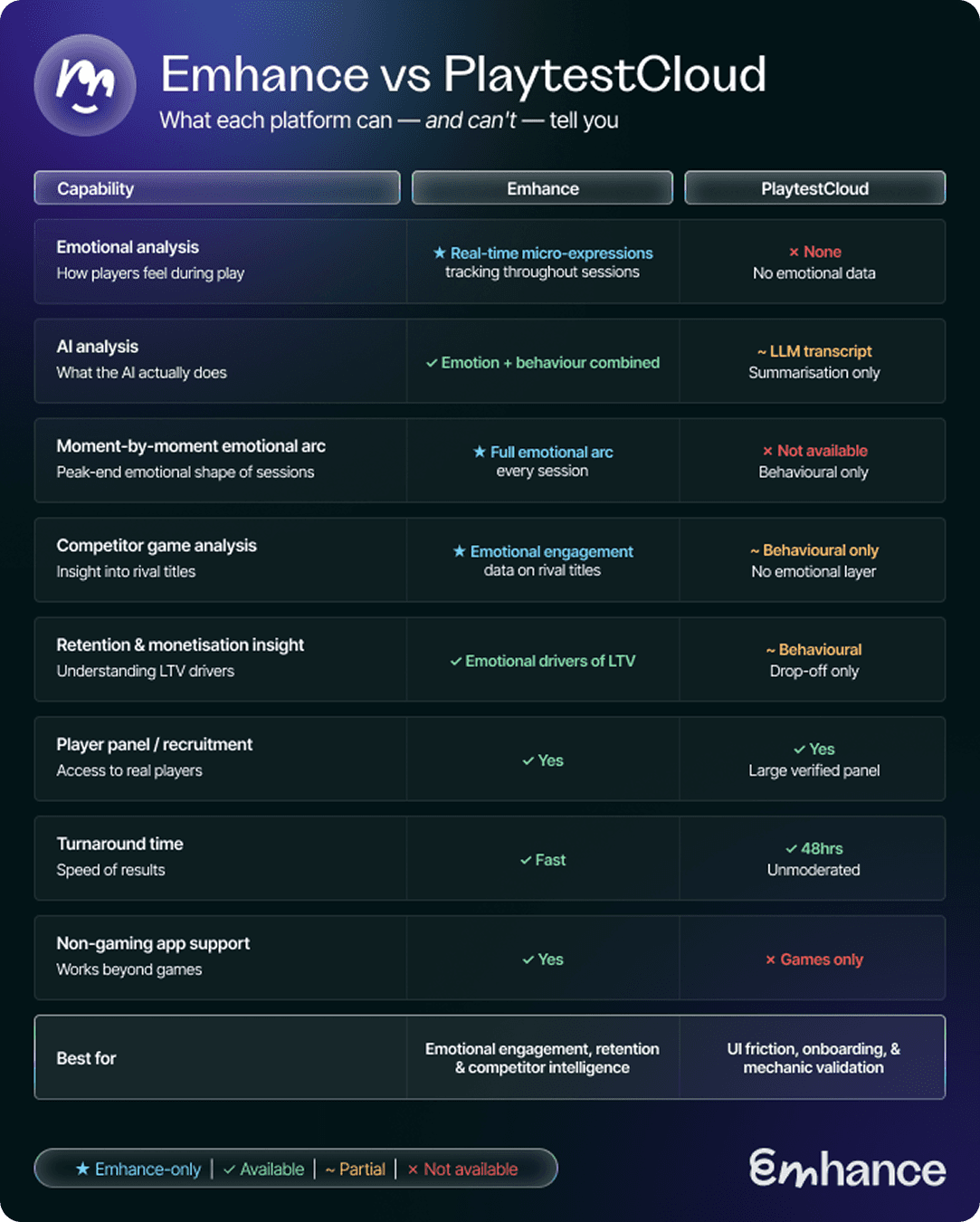
PlaytestCloud is where most studios start when they go looking for a playtesting tool. It is the most visible option in the category, and for straightforward usability testing it does what it says — 48-hour turnaround on unmoderated sessions, a large verified player panel, and video recordings with AI-summarised transcripts.
If you are here, you are probably evaluating it. Either as your first playtesting tool, or as the thing you are already using and wondering what it cannot tell you.
The honest answer to both questions is the same.
PlaytestCloud tells you what players consciously do: what they say, which UI elements they misread. That data is real and it is useful. What it cannot tell you is how players feel — what they register emotionally, moment by moment, underneath what they say and do.
That gap matters more than it sounds. A player can complete your tutorial without complaint and still feel disengaged. A session can be frictionless and emotionally flat. Neither shows up in a playtest recording. Both show up in your Day 7 retention numbers.
That is the difference this page is about.
Who should choose which
Choose Emhance if:
You are making decisions about FTUE, progression, or monetisation that affect Day 7 and beyond — and you need to understand the emotional conditions driving return behaviour, not just where friction occurs
You want to understand what is working inside a competitor's game at the moment-by-moment level, beyond what players say in session
Your team needs synthesised findings with clear recommendations rather than raw session footage to review internally
You have addressed the obvious friction points and retention still is not moving — and you suspect the answer is emotional, not mechanical
Choose PlaytestCloud if:
You need fast feedback on a specific UI flow, onboarding sequence, or new mechanic — and the primary question is whether players understand it
You have an internal research team with capacity to review session recordings and synthesise findings
Your question is about usability and friction identification rather than engagement and retention.
Many studios use both. PlaytestCloud for usability and friction. Emhance for the emotional engagement layer that determines whether players return. They are not the same tool solving the same problem.
PlaytestCloud can’t give you emotional data
This is the most important thing to understand about PlaytestCloud, and it’s worth stating plainly: there is no emotional analysis in what they deliver.
What you get is behavioural and verbal data. Video of players navigating your game. Transcripts of what they say. AI analysis of those transcripts — which is, at its core, a large language model summarising what players said out loud. Our post on addressing flaws in standard testing methodologies goes deeper into why this matters.
That’s genuinely useful for friction identification. Watching a player fumble with a UI element and say “I don’t know what this button does” tells you something real. Fixing it is better than not fixing it.
But here’s what the video and transcript can’t show you: how the player felt during those moments. Not what they did or said — what they experienced emotionally, underneath the narration.
A player can complete your tutorial without complaint and still feel nothing. They can navigate your UI perfectly and find it unrewarding. They can reach your first major milestone and feel mild satisfaction where they should feel a spike. None of that shows up in the recording. What shows up is that they got through it — which tells you almost nothing about whether they’ll come back on Day 7.
This is the core limitation of any playtesting tool built around video and transcripts. The data is real, but it’s incomplete. Behavior tells you what players did. Emotion tells you what the experience meant to them. Only one of those predicts retention.
PlaytestCloud can’t measure the emotional architecture of your session
There’s a well-established principle in psychology called the peak-end rule: people’s memory of an experience is shaped disproportionately by its emotional peak and how it ended — not the average of everything in between.
A session with some friction that ends on a genuine emotional high will be remembered more favourably than a frictionless session that ends flat. That’s not intuition — it’s how memory for experience works. And it has direct implications for what you should be measuring.
PlaytestCloud can tell you where players got confused. It can tell you which steps they skipped and what UI elements they misread. What it can’t tell you is where the emotional architecture of your session broke down — where the peak arrived too late, too weakly, or not at all. It can’t tell you whether your Day 1 experience contains the emotional conditions that produce Day 7 retention.
This matters most in your first-time user experience (FTUE). The onboarding obsession in game development isn’t wrong — FTUE drop-off is a real problem, and friction reduction produces measurable results. But treating FTUE purely as a friction-reduction exercise misses the structure that drives return behaviour. Our FTUE monetisation webinar covers exactly how top games structure their Day 1 experience to convert players into payers — and our FTUE monetisation ebook is free to download.
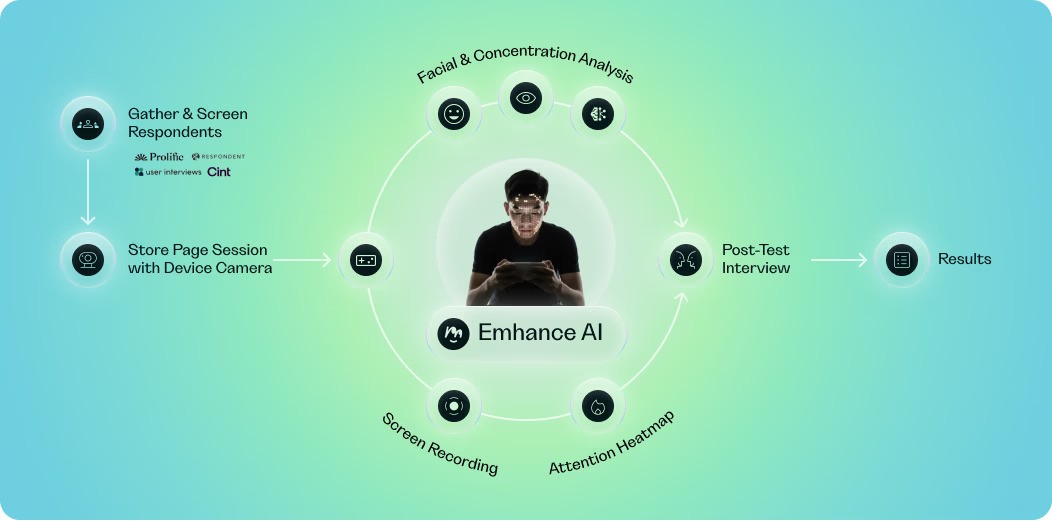
Emhance tracks micro-expressions in real time throughout a session, mapping the emotional arc as it happens. That means you can see not just where players hesitated, but where engagement genuinely spiked, where it flatlined, and what the overall emotional shape of the experience looked like. You can identify the peak, evaluate the ending, and build your FTUE around the structure that actually drives return behaviour — not just the structure that clears the usability bar.
In practice, this translates directly to retention numbers. Peaksel used Emhance’s emotional engagement data to identify two levels that were deflating the emotional arc — and changing those two levels drove a 14.5% increase in LTV. That’s not a usability fix. That’s understanding the emotional shape of the session and redesigning around it.
PlaytestCloud can’t explain why your competitor’s retention numbers look the way they do
PlaytestCloud offers competitor playtests — so it’s worth addressing this directly. Yes, you can run a session on a rival’s game through their platform. You’ll get video of players playing it and AI analysis of what they said.
What you still won’t get is how the competitor’s game makes players feel. Which moments generate genuine emotional engagement. Where in their session the spike happens that keeps players coming back on Day 30. The video tells you what your competitor built. It can’t tell you what’s actually working inside it.
This distinction matters more than it might seem. Knowing a competitor’s onboarding structure is easy — you can play the game yourself in twenty minutes. What you can’t see from playing it is how players respond to it emotionally, moment by moment. Which sequences are actually driving the retention their aggregate numbers suggest. Where in their loop engagement genuinely spikes, and which moments players register as noise.
Emhance’s competitor analysis surfaces exactly that. One studio ran a competitor study before finalising a progression redesign. The emotional engagement data showed that the rival title’s strongest engagement moment wasn’t in the progression system at all — it was in the boss fights at the end of each level. The redesign changed direction accordingly. That’s a different class of insight than anything a playtest video can deliver.
Watching someone play a competitor’s game tells you what they built. Emotional engagement data tells you what’s actually working inside it. Those are very different questions, and only one of them can be answered by a playtest.
What this looks like in practice
The clearest illustration of the gap between behavioural playtesting and emotional intelligence is in how studios use the data to make decisions.
Panoramik Games came to Emhance with a retention problem. Standard playtesting had identified friction points, but addressing them hadn’t moved the needle. Emotional engagement analysis revealed something the video couldn’t: the moments players were dropping off emotionally didn’t correspond to where they were dropping off behaviourally. The result was a 5% retention increase — driven not by removing friction, but by understanding the emotional conditions that keep players engaged.
For a broader picture of how emotional data applies across different stages of game development, our complete guide to mobile game playtesting is a good place to start. And if you’re thinking about how emotion shapes player decisions beyond the game itself, our research into how players’ emotional response impacts game ad performance is worth a read.
When PlaytestCloud is the right answer
Studios already using PlaytestCloud tend to be open to alternatives — not because the product is bad, but because they’re aware it doesn’t answer every question they have. The gap is emotional data, and it’s a gap that grows more significant the deeper into retention and monetisation optimisation you go.
To be direct: if you need to test a specific UI flow, validate onboarding clarity, or watch how a new mechanic lands with real players, PlaytestCloud handles that well. The format works, the turnaround is fast, and the video is genuinely useful for internal alignment and stakeholder communication.
Where it falls short is at the questions that sit underneath usability. What makes players feel something. What creates the emotional conditions for retention. What your competitor’s game is doing that yours isn’t, at the level of moment-by-moment emotional engagement.
If those are the questions your team is trying to answer, you need a different kind of data. Behavioural playtesting is a starting point, not the full picture — and the studios that understand that distinction are the ones building games that retain. You can see all of our client success stories here.
Frequently asked questions
Does PlaytestCloud offer emotional or facial expression analysis?
No. PlaytestCloud’s analysis is based on gameplay video, audio recordings, and player think-aloud transcripts. Their AI analysis summarises verbal feedback and highlights key behavioural moments, but there is no emotional or facial expression tracking in the platform.
What’s the difference between sentiment analysis and emotional analysis?
Sentiment analysis categorises language as positive, negative, or neutral — it analyses what players say. Emotional analysis, like the micro-expression tracking Emhance uses, measures how players feel in real time, independently of what they verbalise. Players often don’t express frustration or disengagement out loud, which is why sentiment analysis misses a significant portion of the emotional picture.
Can PlaytestCloud run tests on competitor games?
Yes — PlaytestCloud offers competitor playtests, where players can be recorded playing a rival title. This gives you behavioural and verbal data on a competitor’s game. It does not give you emotional engagement data, so you can see where players struggle or comment positively, but not where emotional engagement peaks and drops throughout the session.
What is the peak-end rule and why does it matter for game design?
The peak-end rule is a principle from psychology research showing that people remember an experience based primarily on its emotional peak and how it ended — not the average of everything that happened. For game developers, this means a session that has some friction but ends on a satisfying unlock will be remembered more favourably than a smooth session that ends flat. Measuring only friction — as behavioural playtesting does — misses the emotional architecture that actually drives whether players return.
What does Emhance do that PlaytestCloud doesn’t?
Emhance tracks micro-expressions in real time throughout gameplay sessions, producing a moment-by-moment emotional arc for each player. This reveals where engagement peaks and drops, what the emotional shape of a session looks like, and — crucially — whether the FTUE contains the emotional conditions that produce return behaviour. Emhance can also run emotional engagement analysis on competitor titles, going beyond what players say to measure how they actually feel. See our success stories for real examples.
Is Emhance a PlaytestCloud alternative?
Emhance and PlaytestCloud serve different purposes. PlaytestCloud is built around behavioural playtesting — recording players and analysing what they say and do. Emhance is an emotion intelligence platform that measures how players feel throughout a session using micro-expression tracking. Many studios use both: PlaytestCloud for usability and friction identification, and Emhance for understanding the emotional engagement that drives retention and LTV.
Want to see what emotional engagement data looks like on your own game — or a competitor’s? Book a demo with Emhance!