Sensemitter is now Emhance.
Read more

Articles
Emhance v Lysto. Lysto has more data than most playtesting tools. Here's the blind spot it can't close.
Written by:
Emer Rutherford
|
Marketing Generalist

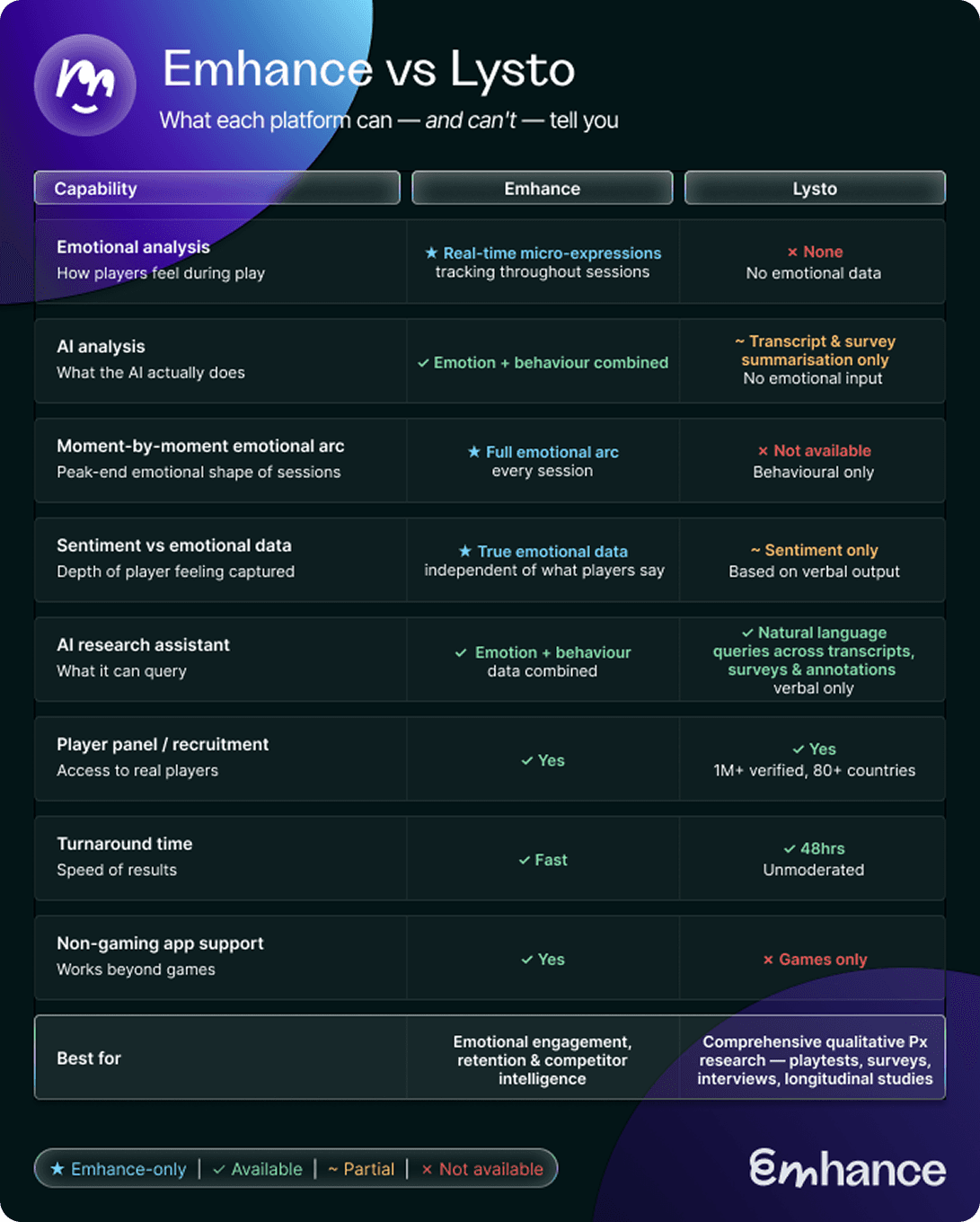
Lysto is a serious playtesting platform. A verified panel of over a million players across 80 countries. 48-hour turnaround. A full suite of research methods — playtests, surveys, interviews, longitudinal studies. An AI research assistant that turns hours of footage and transcripts into structured, queryable insight.
If you are here, you are either evaluating Lysto, or already using it and wondering what it cannot tell you.
The honest answer to both questions is the same.
Lysto’s platform is built around what players say and do — transcripts, surveys, behavioural signals, and the AI analysis that sits on top of them. That data is real and it is useful. What it cannot tell you is how players feel — what they register emotionally, moment by moment, underneath what they say and do.
That gap matters more than it sounds. Sentiment analysis tells you a player was positive or negative. It cannot tell you whether a session contained the emotional conditions that produce return behaviour. And those are different questions with different answers.
That is the difference this post is about.
Who should choose which
Choose Emhance if:
You are making decisions about FTUE, progression, or monetisation that affect Day 7 and beyond — and you need to understand the emotional conditions driving return behaviour, not just where friction occurs
You want to understand what is working inside a competitor’s game at the moment-by-moment level, beyond what players say in session
Your team needs synthesised findings with clear recommendations rather than raw session footage to review internally
You have addressed the obvious friction points and retention still is not moving — and you suspect the answer is emotional, not mechanical
Choose Lysto if:
You need comprehensive qualitative research — moderated playtests, longitudinal studies, player interviews, concept testing — and the primary question is what players say and do
You have a broad range of research methods to run and want them in a single platform
Your question is about usability, friction identification, or player sentiment rather than emotional engagement and retention
Many studios use both. Lysto for qualitative research breadth. Emhance for the emotional engagement layer that determines whether players return. They are not the same tool solving the same problem.
More data, same blind spot
Lysto positions itself around Player Experience data — Px data — which combines playtests, surveys, interviews, and gameplay signals, refined by AI and expert researchers. It is a broader data stack than most playtesting tools offer, and that breadth is genuinely useful. More signal from more sources means a richer picture of what players are doing and saying.
But here is the thing: none of that data tells you how players feel.
Sentiment analysis — which Lysto’s AI uses to surface patterns from transcripts and surveys — categorises what players say as positive, negative, or neutral. It is analysis of language. And language is an imperfect and often incomplete proxy for emotional experience.
Players frequently do not verbalise frustration. They do not narrate disengagement. A player who is drifting — whose attention is fading, whose emotional investment is quietly dropping — does not announce it out loud. They just stop coming back. Sentiment analysis, however sophisticated, only captures what players choose to express. It misses everything they feel but do not say.
This is the blind spot that sits at the centre of all transcript and survey-based platforms, regardless of how much AI is applied on top. The data is real and useful. It is just structurally incomplete.
Sentiment isn’t emotion — and the difference is your Day 7 retention
The distinction between sentiment and emotion is not semantic. It has direct consequences for the decisions you make.
Sentiment tells you a player was positive or negative about an experience. Emotional data tells you what their face did while it was happening, moment by moment, independently of what they said. These are different measurements of different things, and they frequently diverge.
A player can verbalise enthusiasm about a mechanic they find emotionally flat. They can complete a session without complaint and leave with no emotional investment at all. None of that divergence shows up in sentiment analysis. All of it shows up in micro-expression tracking.
There is a well-established principle in psychology called the peak-end rule: people’s memory of an experience is shaped disproportionately by its emotional peak and how it ended — not the average of what happened throughout. A session that has some friction but ends on a genuine emotional high will be remembered more favourably than a smooth session that ends flat. That is not intuition — it is how memory for experience works.
Lysto’s platform can tell you what players said about your session. It can surface friction points, identify confusion, and structure qualitative feedback into navigable insight. What it cannot tell you is what the emotional shape of your session actually looks like. Where engagement genuinely spiked. Where it dropped. Whether your Day 1 experience contains the emotional conditions that produce Day 7 retention.
Emhance tracks micro-expressions throughout a session in real time, producing a moment-by-moment emotional arc for each player. That arc is what you design your FTUE around — not the friction map, not the sentiment summary, but the emotional structure that actually drives whether players come back. Our FTUE monetisation webinar covers exactly how top games structure their Day 1 experience to convert players into payers — and our FTUE monetisation ebook is free to download.
What Lysto’s AI research assistant can and can’t find
Lysto’s AI research assistant is genuinely useful. The ability to ask natural language questions across your entire playtest dataset — transcripts, surveys, player profiles, AI annotations — and get structured, evidence-backed answers is a real step forward in research efficiency.
But the research assistant is only as good as the data it can query. And the data it can query is transcripts, surveys, and behavioural signals — all verbal or observational. Ask it “where did players feel most engaged?” and it will surface moments where players expressed engagement verbally or behaviourally. It cannot surface the moments where players were emotionally engaged but silent. It cannot query something it does not have.
Emhance’s emotional data adds the layer that makes those questions answerable in full. The moments where engagement peaked without narration. The sessions where sentiment was neutral but emotional investment was high — or vice versa. The emotional shape of the experience that verbal data alone cannot reconstruct.
What this looks like in practice
Panoramik Games came to Emhance with a retention problem. Standard playtesting had identified friction points — the kind of data Lysto’s platform is well-suited to surface — but addressing them had not moved the needle. Emotional engagement analysis revealed something the transcripts could not: the moments players were dropping off emotionally did not correspond to where they were dropping off behaviourally. The result was a 5% retention increase — driven not by removing friction, but by understanding the emotional conditions that keep players engaged.
Peaksel used Emhance’s emotional engagement data to identify two specific levels that were deflating the emotional arc of their session. Changing those two levels drove a 14.5% increase in LTV. That is not a friction fix. That is understanding the emotional architecture of the session and redesigning around it.
For a broader picture of how emotional data applies across different stages of game development, our complete guide to mobile game playtesting is a good place to start. And if you are thinking about how emotion shapes player decisions beyond the game itself, our research into how players’ emotional response impacts game ad performance is worth a read.
When Lysto is the right answer
To be direct: if you need comprehensive qualitative research — moderated playtests, longitudinal studies, player interviews, concept testing — Lysto’s platform is well-suited to that. The range of research methods is broad, the panel is large and well-targeted, and the AI analysis genuinely reduces the time it takes to extract insight from footage.
Where it falls short is at the questions that sit underneath what players say and do. What they feel during play. What the emotional shape of your session looks like. Whether your FTUE is building the emotional conditions that produce return behaviour. What is actually driving engagement in a competitor’s game beneath the surface of their design.
If those are the questions your team is trying to answer, you need data that goes deeper than transcripts and surveys. Behavioural and verbal playtesting — even at Lysto’s scale and sophistication — is a starting point. The emotional layer is what completes the picture. You can see all of our client success stories here.
Frequently asked questions
Does Lysto offer emotional or facial expression analysis?
No. Lysto’s platform is built around playtesting video, transcripts, surveys, and behavioural signals. Their AI analysis — including their research assistant — works across these data sources to surface patterns and structured insight. There is no emotional or facial expression tracking in the platform. Sentiment analysis, which identifies positive, negative, or neutral language in transcripts, is not the same as emotional analysis.
What’s the difference between sentiment analysis and emotional analysis?
Sentiment analysis categorises language as positive, negative, or neutral — it analyses what players say. Emotional analysis, like the micro-expression tracking Emhance uses, measures how players feel in real time, independently of what they verbalise. Players often do not express frustration or disengagement out loud, which is why sentiment analysis misses a significant portion of the emotional picture.
What’s the difference between Lysto’s AI and Emhance’s AI?
Lysto’s AI works on transcripts, surveys, player profiles, and AI annotations — verbal and observational data. It structures and queries that data to surface patterns and answer research questions efficiently. Emhance’s AI works on micro-expression data captured in real time throughout sessions, combined with behavioural signals. The output is an emotional arc for each player — showing where engagement peaked, where it dropped, and what the overall emotional shape of the experience looked like. These are different inputs producing different outputs.
What is the peak-end rule and why does it matter for game design?
The peak-end rule is a principle from psychology research showing that people remember an experience based primarily on its emotional peak and how it ended — not the average of everything that happened. For game developers, this means your FTUE needs to contain a genuine emotional peak and land cleanly — a frictionless session that ends flat still churns. Lysto can tell you where the friction was. Emhance can tell you where the emotional peak was, how strong it was, and whether the session ended in a way that produces return behaviour.
Can Lysto run analysis on competitor games?
No. Lysto’s research tools are designed for your own game. Emhance can run emotional engagement analysis on competitor titles — surfacing where in a rival game’s session engagement peaks and drops, and what is actually driving their retention numbers beneath the surface of their design.
Is Emhance a Lysto alternative?
Emhance and Lysto serve overlapping but distinct purposes. Lysto is a comprehensive playtesting platform covering a wide range of research methods — playtests, surveys, interviews, longitudinal studies — all without emotional data. Emhance is an emotion intelligence platform that adds the emotional layer Lysto does not have: real-time micro-expression tracking, moment-by-moment emotional arcs, and competitor emotional engagement analysis. Many studios use both: Lysto for qualitative research breadth, Emhance for emotional depth.