Sensemitter is now Emhance.
Read more

Articles
Player Research delivers gold-standard research. Here's what it can't do fast enough.
Written by:
Emer Rutherford
|
Marketing Generalist
Player Research is one of the most respected names in games user research.
Expert-led. Bespoke. Built on years of deep research for some of the most successful studios in the world. Their tagline — "where gaming instinct meets scientific insight" — reflects a methodology that genuinely delivers.
If you are looking for a research partner capable of deep, thorough, expert-led investigation into a complex player experience problem, Player Research is a serious option. The quality of insight they deliver is high.
Emhance is a different kind of tool. Not a consultancy — a platform. AI-accelerated emotional engagement analysis, delivered at development pace. The two sit at different points in a studio's research workflow, and understanding that difference is what this page is about.
Consultancy vs. platform
The core distinction is structural, not about quality.
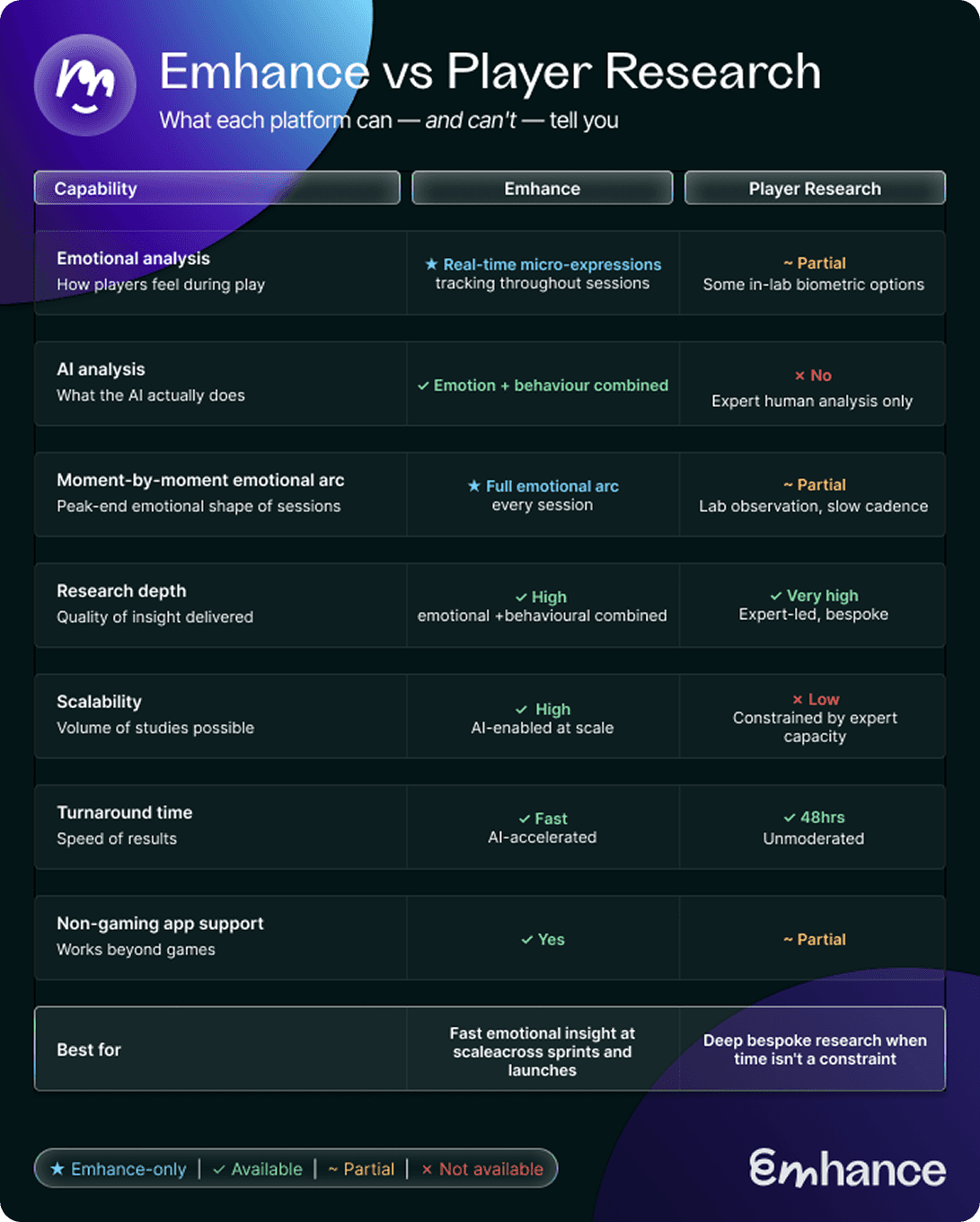
Player Research is a consultancy. Each engagement is bespoke — scoped, recruited, conducted, and analysed by expert researchers. That process produces deep, high-quality findings. It takes time, because rigour takes time. For the questions it is designed to answer — foundational design investigations, major pivots, complex UX problems — that depth is the point.
Emhance is a platform. Studies run at sprint cadence. Emotional engagement findings are AI-accelerated and available when the decision is still live. The format is built for iteration — testing, retesting, responding to live data — rather than for the bespoke, high-touch engagement that defines consultancy work.
These are different tools for different moments in a development cycle. Many studios use both.
Who should choose which
Choose Emhance if:
You are making decisions about FTUE, progression, or monetisation on a development timeline that can't wait days or weeks for findings
You need to run multiple research cycles across a sprint cadence — testing, iterating, retesting — at a pace that bespoke consultancy can't match
You want to understand the emotional conditions driving retention and LTV, not just the usability and appeal picture
You need competitor emotional engagement analysis to inform design decisions before a launch window closes
Choose Player Research if:
You have a foundational design question that requires deep, expert-led investigation and the timeline allows for it
You need rich qualitative insight into a complex player experience problem — the kind that requires experienced researchers in the room
You are at a stage of development where thorough, high-touch research is more valuable than speed
Budget is not a primary constraint and the decision you are making justifies the investment
Many studios use both at different stages. Player Research for foundational research early in development. Emhance for the faster, emotionally-led insight cycles that inform decisions at sprint cadence. They are not competing tools — they operate at different speeds for different questions.
Deep research without emotional data is still incomplete
Player Research's methodology covers usability, UX, appeal, and play experience — a genuinely broad scope. And in-lab research gives experienced researchers tools that remote playtesting doesn't: controlled environments, eye tracking in some settings, the ability to probe and follow up in real time.
What it doesn't systematically produce is a moment-by-moment emotional arc. The emotional shape of a session — where engagement peaked, where it dropped, how the experience landed — is not the primary output of qualitative UX research. What you get is a researcher's interpretation of player behaviour and verbal response, synthesised into findings and recommendations. That is valuable. It is not the same as continuous emotional data.
There is a well-established principle in psychology called the peak-end rule: people's memory of an experience is shaped almost entirely by its emotional peak and how it ended. A session that had some friction but ended on a genuine emotional high will be remembered more favourably than a smooth, frictionless session that ended flat. Understanding your session's emotional arc — not just its usability profile — is what tells you whether players will return.
Emhance tracks micro-expressions in real time throughout every session, producing a moment-by-moment emotional arc independent of what players say or do. That arc is what you use to design the FTUE around the structure that drives return behaviour — not just the structure that clears the usability bar. Our neuroscience of rewards webinar explores exactly how dopamine-driven design creates the emotional conditions that keep players returning.
What this looks like in practice
Peaksel used Emhance's emotional engagement data to identify two levels that were deflating the emotional arc of their session — not broken, just flattening engagement at the wrong moment. Changing those two levels drove a 14.5% increase in LTV. That finding came from continuous emotional data, not from a researcher's observation. It would not have surfaced in a qualitative study of the same sessions.
Panoramik Games came with a retention problem that friction-focused research had not solved. The emotional engagement data revealed that where players were dropping off emotionally didn't correspond to where they were dropping off behaviourally — they were separate problems. The result was a 5% retention increase, driven by addressing the emotional conditions rather than the friction.
You can see all of our client success stories here.
When Player Research is the right answer
To be direct: if you have a foundational question, a complex UX problem, or a design decision significant enough to justify a thorough bespoke investigation, Player Research is well-suited to that. The depth of their research is real, the expertise of their team is genuine, and for the right question at the right time, that level of rigour is worth the timeline.
Where it falls short is at development pace. The sprint cadence questions. The FTUE iteration cycles. The live ops decisions that need insight this week, not next month. And the competitor intelligence questions that no consultancy study on your own game can answer.
If those are the questions your team needs answered — and for most studios in active development, they are — you need a different kind of data, at a different speed. You can explore more in our complete guide to mobile game playtesting and our post on addressing flaws in standard testing methodologies.
Frequently asked questions
Does Player Research offer emotional or facial expression analysis?
Player Research uses a range of research methods including in-lab observation, play-at-home studies, and expert-led qualitative research. Some in-lab studies may incorporate biometric elements. However, continuous real-time micro-expression tracking throughout sessions — producing a moment-by-moment emotional arc — is not a standard output of their methodology.
What's the difference between qualitative UX research and emotional intelligence?
Qualitative UX research produces a researcher's interpretation of player behaviour, verbal response, and observed experience — synthesised into findings and recommendations. Emotional intelligence, as Emhance delivers it, produces continuous emotional data from micro-expression tracking, independent of what players say or do. Both are valuable. They answer different questions on different timelines.
How long does a Player Research study take vs Emhance?
Player Research studies are bespoke and timelines vary by scope — typically days to weeks from briefing to findings. Emhance delivers AI-accelerated emotional engagement data at development pace, with findings available when the decision is still live rather than in a report weeks later.
What is the peak-end rule and why does it matter for game design?
The peak-end rule is a principle from psychology research showing that people judge an experience almost entirely by its emotional peak and how it ended. For game developers, this means your FTUE needs a genuine emotional peak and a clean, satisfying ending — a deep, well-researched but emotionally flat session still churns. Player Research can tell you whether the session was well-designed. Emhance can tell you whether it had an emotional peak worth returning for.
Is Emhance a Player Research alternative?
They operate at different speeds for different questions. Player Research is a premium bespoke consultancy for deep, expert-led UX investigations. Emhance is an emotion intelligence platform that delivers fast, AI-accelerated emotional engagement data at development pace. Many studios use both: Player Research for foundational research, Emhance for the faster emotional insight cycles that inform decisions sprint by sprint.
Want to see what emotional engagement data looks like on your own game — or a competitor's? Book a demo →