Sensemitter is now Emhance.
Read more

Articles
Emhance V Antidote. Antidote removes friction from your game. Here’s what it can’t fix.
Written by:
Emer Rutherford
|
Marketing Generalist

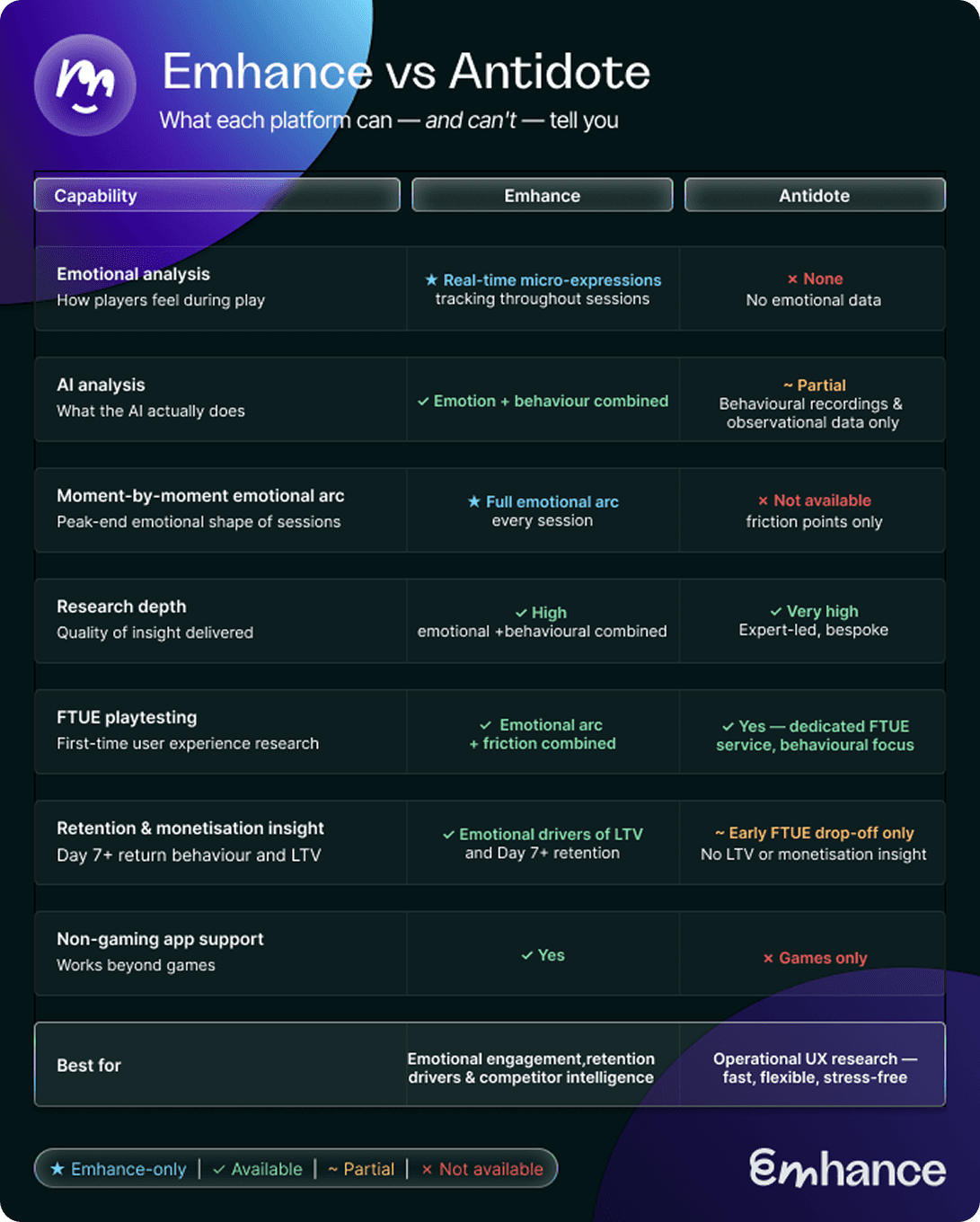
Antidote has built a genuinely useful playtesting platform. Self-serve UX studies that launch in twenty minutes. A full managed service if you want someone else to handle recruitment and moderation. Support across every major platform — Windows, Mac, iOS, Android, browser. Face recordings, emotion detection, eye tracking, think-aloud. Flexible pricing. A broad services menu covering FTUE, longitudinal studies, stress tests, market research, and soft launching.
If you are evaluating playtesting tools, Antidote is a serious option. It consolidates a lot of research operations into one platform, and for studios who find playtesting slow, complicated, or expensive to organise, that matters.
But there are two constraints in the architecture that are worth understanding before you decide what to act on.
However, there is a major constraint: you can only find what you told it to look for
Antidote ties emotion signals to specific game moments using SDK integration. Your engineering team instruments the build to mark the phases you want to measure before the study runs. If you didn't tag a phase, there is no moment-level emotion data for it.
This means the architecture requires knowing what you want to measure before the study runs. Unexpected moments — the phase no one anticipated would be a problem, the monetisation prompt that quietly deflates the session — don't surface, because they were never instrumented.
Emhance AI identifies moments and phases directly from the recording. Our machine learning platform is trained on thousands of real sessions, so it can pick out character selection, a boss fight or an offer wall, with no SDK or pre-tagging. If something breaks in a phase no one anticipated, it surfaces automatically. That is a different class of finding — because it doesn't depend on your team knowing the answer before they ask the question.
Who should choose which
Choose Emhance if:
You are making decisions about FTUE, progression, or monetisation that affect Day 7 and beyond — and you need to understand the emotional conditions driving return behaviour, not just where friction occurs
You want to understand what is working inside a competitor’s game at the moment-by-moment level, beyond what players say or do in session
You have addressed the obvious friction points and retention still is not moving — and you suspect the answer is emotional, not mechanical
Your team needs synthesised findings with clear recommendations rather than raw session footage to review internally
Choose Antidote if:
You need to launch UX studies quickly and with minimal operational overhead — self-serve, at your own pace
You want a managed playtesting service that handles recruitment, organisation, and moderation end to end
Your primary questions are about usability, friction identification, platform compatibility, or concept validation
You need flexibility across a wide range of study types — FTUE, stress tests, longitudinal studies, market research — in a single platform
Many studios use both. Antidote for operational playtesting efficiency. Emhance for the emotional engagement layer that determines whether players return. They are not the same tool solving the same problem.
De-risking is not the same as building engagement
Antidote’s positioning is honest and clear: remove the guesswork from development decisions, de-risk the process, avoid costly delays by validating your game at every stage. This is a legitimate and important problem to solve. Studios that don’t playtest make avoidable mistakes. Friction that could have been caught in a twenty-minute UX study ships in the final product.
But de-risking and engagement are not the same thing, and conflating them is where studios get stuck. De-risking is about removing what goes wrong. Engagement is about building what goes right. You can have a game with no friction and no engagement, and it will still churn — because players don’t return to games that work smoothly. They return to games that made them feel something.
Antidote’s platform tells you where your game failed players mechanically. It cannot tell you whether your game succeeded emotionally. A session can be clean, clear, and easy to navigate and still leave players with nothing to come back for. That verdict doesn’t appear in a UX report. It appears in your Week 2 active user numbers.
The friction map tells you what to fix. It doesn’t tell you what to build.
There is a well-established principle in psychology called the peak-end rule: people judge an experience almost entirely on how it felt at its most intense moment, and how it ended. Everything in between barely registers in memory. A player who hit one confusing moment but finished on an emotional high will remember the session positively. A player who sailed through without a single UI issue but ended on a flat, ambiguous note won’t come back.
This reframes what FTUE optimisation is actually for. Antidote has a dedicated FTUE playtesting service — and the friction work it enables is worth doing. Confusion in the first five minutes is a real problem. But a tutorial that is confusion-free and emotionally inert is still a tutorial that fails to hook players.
The question behavioural playtesting cannot answer is: where did the emotional peak happen, how strong was it, and did the session end in a way that creates the expectation of more? Those are the conditions that drive Day 7 return behaviour. Emhance maps them in real time throughout a session using micro-expression tracking, giving you the emotional arc alongside the friction data — so you can see not just what to fix, but what to amplify.
Our The neuroscience of rewards webinar goes deeper on exactly this — how dopamine-driven design builds the emotional conditions that keep players returning, and what the research says about reward structure, engagement peaks, and why some sessions feel worth repeating.
What Antidote’s AI can analyse — and what it can’t see
Antidote’s AI tools are built to reduce analysis time — surfacing patterns in session recordings faster than a researcher reviewing footage manually. For studios running multiple studies, that efficiency is real and useful.
The constraint is not the AI. It is what the AI is working on. Behavioural recordings capture what players did. Transcripts capture what they said. Neither captures what players felt in the moments they stayed silent — and players are silent for most of a session. The emotional response to a reward landing well, the quiet disengagement during a mid-game lull, the subtle flatness at the end of a session that predicts churn — none of it produces a verbal or behavioural signal that analysis tools can surface.
Emhance reads what players don’t say. Micro-expression data runs continuously throughout a session, independent of what players do or narrate, giving you a complete picture of the emotional experience rather than a reconstruction of it from observable proxies.
When friction fixes aren’t enough
Panoramik Games ran into exactly this problem. They had done the playtesting work — friction points had been identified and addressed. The game was cleaner. Retention still wasn’t moving. When Emhance ran emotional engagement analysis, the data showed that the points where players were emotionally disengaging didn’t line up with the friction points the UX work had targeted. They were separate problems. Addressing the emotional layer drove a 5% retention increase — without changing a single UI element.
The pattern holds across game types. Peaksel found that two levels in their progression were quietly deflating the emotional arc of each session — not breaking it, just flattening it at the wrong moment. Fixing those two levels produced a 14.5% increase in LTV. Neither of those levels would have stood out in a UX study. Both stood out immediately in the emotional engagement data.
If you want to understand why behavioural data alone leaves these gaps, our post on addressing flaws in standard testing methodologies goes into detail. And if you want a concrete illustration of the difference, our ebook on what neuroscience tells us about Match-3 players is a good example — the same failure pattern can come from confusion, cognitive overload, or a badly timed monetisation moment, and behavioural data alone can’t tell them apart.
When Antidote is the right tool
To be direct: if you need to move quickly on UX validation, run a managed study without in-house research capacity, or test across platforms without the operational overhead, Antidote is well-suited to that. Twenty minutes to launch a study is a genuine differentiator. The managed service is useful for teams that don’t have a dedicated researcher. The breadth of study types — FTUE, stress tests, market research, longitudinal — in a single platform is a real advantage.
What Antidote is not designed to answer is the emotional question. Why do players who complete your onboarding not come back? What is the emotional shape of your session, and is it the right shape? Where is engagement genuinely building — and where is it quietly leaving?
Those questions require a different kind of data. Friction and emotion are not the same problem, and removing the first doesn’t solve the second. You can see how studios have used emotional data to move the numbers that UX work left untouched in our client success stories.
Frequently asked questions
Does Antidote have emotion analysis?
Yes. Antidote has face recordings, but they still rely on think-aloud tests and only record obvious moments of high emotion The constraints are in the architecture: emotion signals are only captured for phases instrumented via SDK before the study runs, and there is no statistical layer that tests whether the findings are confirmed.
What’s the difference between UX playtesting and emotional intelligence?
UX playtesting identifies friction — where players struggle, what they misunderstand, where they drop off. Emotional intelligence measures how players feel throughout a session, independently of what they say or do. A game can pass every UX benchmark and still fail to generate the emotional engagement that produces return behaviour. Friction and emotion are separate variables, and studios that treat them as the same thing tend to find that fixing one doesn’t move the other.
Can Antidote tell me why my retention isn’t improving after fixing friction?
Not directly. If you have addressed the obvious friction points and retention is still not moving, the answer is usually emotional rather than mechanical. The session may be navigable but emotionally flat — the peak-end conditions that drive return behaviour are missing, and UX data cannot surface them. That is the specific gap Emhance’s emotional engagement data is designed to close.
What is the peak-end rule and why does it matter for game design?
The peak-end rule is a principle from psychology research showing that people judge an experience almost entirely by its emotional peak and how it ended. The average of the rest barely registers. For game developers, this means your FTUE doesn’t just need to be frictionless — it needs a genuine emotional peak and a clean, satisfying ending. A smooth session that ends on ambiguity still churns. Antidote can tell you whether the session was smooth. Emhance can tell you whether it had a peak worth returning for.
What does Emhance do that Antidote doesn’t?
Three things: identifies emotional moments from the recording without pre-instrumentation; runs the statistical test that confirms whether findings are real; and applies an interpretation methodology calibrated against 300+ studies to distinguish signals that look similar in raw FACS output.. See our success stories for real examples.
Is Emhance an Antidote alternative?
They solve different problems. Antidote is a UX research operations platform — fast, flexible, broad in study types, designed to remove the operational friction from playtesting. Emhance is an emotion intelligence platform — designed to measure the emotional conditions that produce retention, independently of what players say or do. Many studios run both: Antidote for UX validation efficiency, Emhance for the emotional layer that UX data can’t reach.
Want to see what emotional engagement data looks like on your own game — or a competitor’s? Book a demo →