Sensemitter is now Emhance.
Read more

Articles
Best PlaytestCloud Alternatives in 2026
Written by:
Emer Rutherford
|
Marketing Generalist
“You know players are quitting your game. PlaytestCloud can show you the moment they did — a session recording, a drop-off point, a survey answer about what felt “confusing.” While the players in the recording “think aloud” and use their own words to describe that moment, what it can’t show you is why the moment felt like that to the player, because that data was never captured. Self-report only gives you what a player consciously noticed and chose to write down or speak aloud. Talking aloud during a session also introduces a level of unreality, where players stop playing and start performing.
Despite this, PlaytestCloud has long been one of the go-to platforms for remote video game playtesting — recruiting players, recording sessions, and getting studios feedback within days. It does that well. But the data underneath is only part of the full picture: gameplay recordings, survey results and player narration can leave out key evidence.
If what you need is different — the emotional mechanism behind a drop-off, AI-moderated playtesting or — here are the strongest PlaytestCloud alternatives on the market, and who each one actually fits.
What to look for in a PlaytestCloud alternative
Before comparing tools, get clear on what actually matters for your studio:
Recruiting model — does the platform have its own player panel, or do you need to bring your own testers?
Data depth — do you get raw session video, survey responses, facial coding and concentration data, or gameplay analytics?
Platform coverage — mobile, PC, browser, or console?
Study design flexibility — single-session, longitudinal, moderated, or multiplayer testing?
Analysis support — raw data you interpret yourself, or researcher-assisted findings?
A solo indie dev validating a prototype needs something different from a live-ops team trying to diagnose a retention drop three months post-launch.
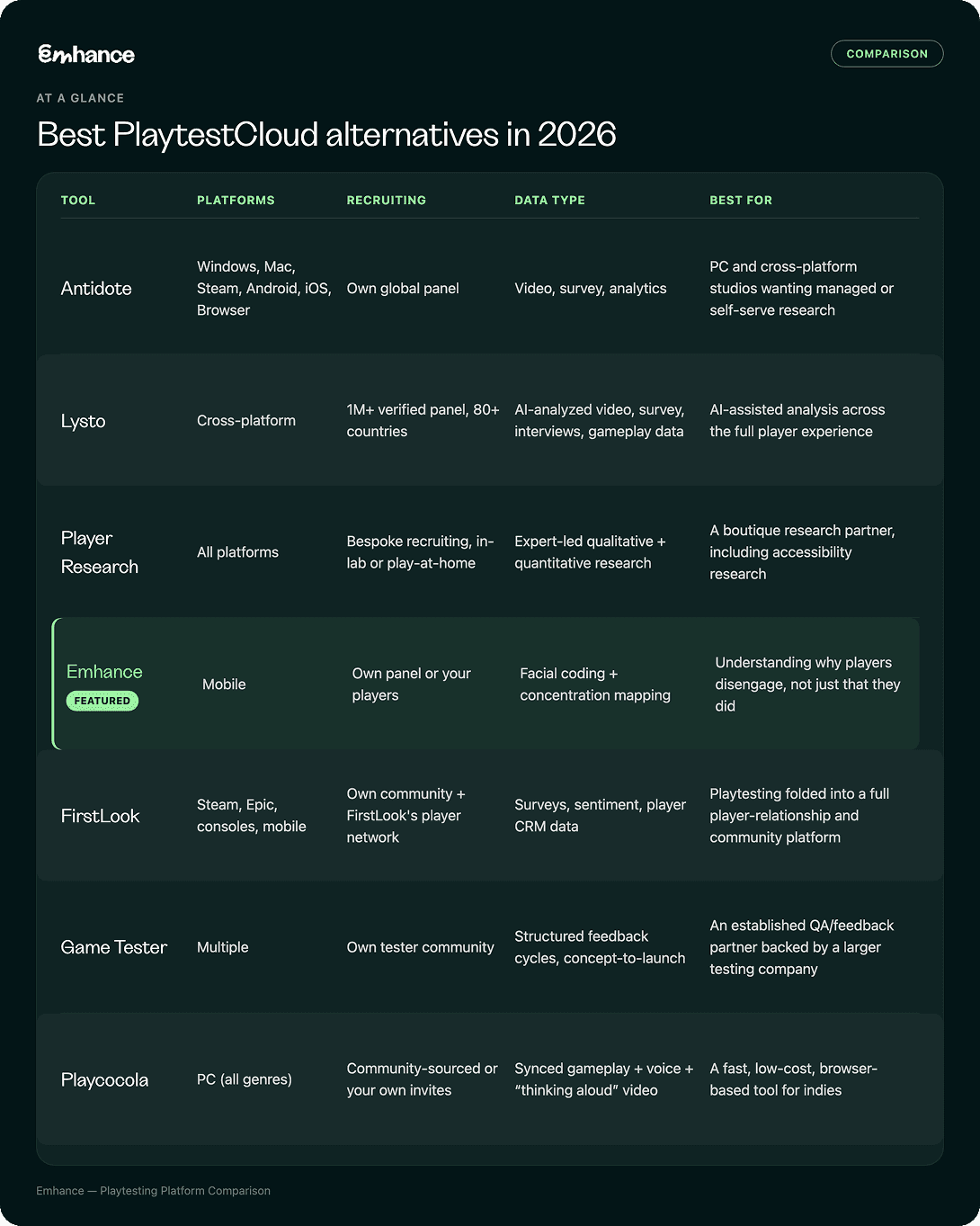
Best PlaytestCloud alternatives at a glance
The alternatives in detail
1. Antidote
Barcelona-based Antidote supports playtesting and UX research across PC, Steam, mobile, and browser, with three ways to work: fully self-organised studies on their platform, a fully managed service where Antidote’s UX team handles recruitment and moderation, or targeted market research for validating concepts and audiences ahead of production. Antidote maintains its own global panel, so studios don’t need to source players themselves, and offers analysis support from an in-house research team.
Studios including Remedy, Ankama, and Giants Software have used Antidote’s platform, with some reporting measurable retention gains after implementing findings from their studies.
2. Lysto
Lysto positions itself around “Player Experience (Px)” — combining playtests, surveys, interviews, and gameplay data, refined by both AI and expert researchers. It gives access to a panel of over 1 million verified gamers across 80+ countries, and supports concept and prototype validation, single and multi-session testing, longitudinal studies tracking retention over weeks, moderated sessions with a live researcher, and structured interviews or focus groups.
Its AI Analysis layer automatically flags friction points, bugs, and player sentiment across sessions, which can help studios triage large volumes of playtest footage faster than manual review.
Read our full Emhance vs. Lysto comparison for a deeper look at where the two platforms differ.
3. Player Research
Player Research takes a more boutique, agency-style approach than the self-serve platforms on this list. Rather than software you log into, it’s a full-service games user research partner — combining in-lab, play-at-home, and expert-led research across usability, UX, appeal, and player experience.
Player Research has worked on titles including Goat Simulator 3 and Life is Strange 2, and runs a dedicated accessibility research offering, helping studios test with and design for disabled players. It’s the strongest option for studios wanting deep, methodologically rigorous research led by specialists in human-computer interaction, cognitive psychology, and accessibility — rather than a self-serve dashboard.
4. Emhance
Most playtesting tells you what players said or where they got stuck. Emhance tells you what they felt in the moment — before they had a chance to forget it, downplay it, or fail to notice it consciously at all.
Emhance captures 421+ facial signals per second from a player’s own device camera during a session, mapping emotional intensity and concentration — engagement spikes, boredom zones, moments of deep focus — directly onto gameplay footage and in-game events.
This matters because 50% of in-game emotional responses never make it into a survey or interview. Players often can’t articulate the exact moment something started to frustrate them, or don’t consciously register it at all. Emhance is built to catch that gap, pairing session recordings with prioritised, actionable findings on what to change, tweak, or keep.
It’s built for player-obsessed mobile studios who’ve already run standard playtesting or user research and found that players are quitting, churning, or disengaging for reasons that observation and surveys alone can’t explain.
5. FirstLook
FirstLook has repositioned itself as a full “player relationship platform” rather than a narrow playtesting tool. Playtesting — including key distribution, NDAs, waitlists, and beta branches — is now one module within a broader suite that also covers player CRM, community management (including Discord integration), creator campaigns, referral-driven growth, and player analytics and sentiment tracking from pre-launch through live ops.
That makes FirstLook a good fit for studios that want playtesting to plug directly into their community and marketing stack, rather than sitting as a separate research tool. It’s less suited to studios purely after deep player-experience research, since that’s just one piece of a much larger product.
Read our full Emhance vs. FirstLook comparison for a deeper look at where the two differ.
6. Game Tester (Lionbridge Games Studios)
Game Tester — now operating under Lionbridge Games Studios — is a test-and-feedback platform built to identify a studio’s player base and provide regular feedback cycles from concept through to launch. Backed by Lionbridge, an established global testing and localisation company, it carries more infrastructure and scale than many independent playtesting startups — a fit for larger studios or publishers wanting an established vendor relationship.
7. Playcocola
Playcocola is built specifically for the indie “build-test-iterate” cycle. It’s entirely browser-based, with no downloads or integration required from testers, and captures synced video of gameplay alongside the player’s voice and “thinking aloud” commentary — a fast way to see exactly where players got stuck or delighted, not just read about it afterward.
Studios can invite their own testers or tap Playcocola’s community of indie enthusiasts and fellow developers. It supports PC games across genres, and its pay-as-you-go model — rather than subscriptions or enterprise contracts — has made it popular with solo devs and small teams working with limited budgets.
8. Still looking at PlaytestCloud?
It's worth considering whether it already fits your needs. It's one of the most established platforms in games user research, combining a large player panel with mature research operations, enterprise-grade security, and a wide range of study types. Teams can run everything from quick unmoderated playtests to longitudinal studies, moderated interviews, accessibility research, and large-scale surveys, with support from an experienced in-house research team.
Where PlaytestCloud is less differentiated is in the type of behavioural data it captures. Like most traditional playtesting platforms, its analysis is built around gameplay footage, player narration, and self-reported feedback. Studios looking for biometric or emotion-based signals, broader geographic recruitment outside its strongest markets (US, UK, Canada), support in additional languages, or more flexible one-off project pricing may find that another platform better matches their requirements.
The gap most playtesting platforms share
Every alternative on this list — including PlaytestCloud — is fundamentally built around what players say and do: survey answers, session recordings, click paths, sentiment pulled from transcripts. That's real, useful data. It's also incomplete.
Emhance's own methodology data backs this up: 50% of a player's emotional response during a session never surfaces in a survey or interview. Independent research goes further — studies combining biometric signals with observation reveal 63% more usability issues than observation alone. Players don't narrate the moment a session stopped feeling rewarding. They answer questions afterward, based on a remembered impression shaped disproportionately by how the session ended — not what actually happened moment to moment.
Emhance is built specifically to close that gap for mobile studios. Rather than inferring emotion from what players type into a survey, it reads it directly — mapping facial signals to the exact gameplay moment that triggered them. For studios that have already run standard playtests and still can't fully explain a retention or monetization problem, that's often the layer that was missing.
Frequently asked questions
What's the difference between PlaytestCloud and a UX research platform?
PlaytestCloud is a platform for running quick-turnaround moderated and unmoderated playtests, along with a suite of custom research services. The platform recruits from a large panel of players, and captures their gameplay, audio, and survey responses. PlaytestCloud has a research team, a Senior Research & Accessibility Lead running a games-accessibility research offering, and support for Longitudinal Playtests and Multi-Session studies with interviews built in via Moderated Playtests.
Broader UX research partners (such as Player Research) often approach engagements from a research-first perspective rather than a platform-first one. Studies are typically tailored to the questions a studio is trying to answer, with researchers selecting and combining appropriate methodologies, synthesising findings across multiple sources, and delivering recommendations alongside the underlying data. Many also support long-term research programmes that extend beyond playtests and help deliver ongoing research support.
Do PlaytestCloud alternatives provide video footage of playtests?
Most do, including Antidote.gg, Lysto, Playcocola, and Emhance, though the level of detail varies — from raw gameplay recordings to footage synced with voice commentary or facial/emotional data.
Can I run playtests without a big budget?
Yes. Playcocola is built specifically around indie-friendly, pay-as-you-go pricing, and several platforms on this list offer self-serve options that don't require a managed research engagement.
Is there a platform that shows why players are disengaging, not just when?
This is the specific gap emotion-AI tools like Emhance are built to address — mapping facial and emotional signals to gameplay moments, rather than relying only on what players consciously report.