Sensemitter is now Emhance.
Read more

Articles
Best Playtesting Tools For Games in 2026
Written by:
Emer Rutherford
|
Marketing Generalist
Your retention chart shows a cliff at day one. Your analytics dashboard shows exactly which screen players were on when they quit. What none of that tells you is why the screen made them want to leave — and closing that gap, in one way or another, is the entire job of every tool on this list.
Playtesting exists to answer the question analytics can't ask: not just where players struggle, but why. The tools below take genuinely different approaches — moderated versus unmoderated, self-report versus biometric, boutique research partner versus self-serve platform — and picking the wrong one for your actual question wastes a testing cycle most studios don't have time to redo before the next release.
Here are the strongest playtesting tools for games in 2026, and what each one is actually built to answer.
What to look for in a playtesting tool
Before comparing platforms, get clear on what your studio actually needs:
Recruiting model — does the platform have its own player panel, or do you need to bring your own testers?
Data depth — do you get raw session video, survey responses, facial coding and concentration data, or gameplay analytics?
Platform coverage — mobile, PC, browser, or console?
Study design flexibility — single-session, longitudinal, moderated, or multiplayer testing?
Analysis support — raw data you interpret yourself, or researcher-assisted findings?
A studio validating a prototype has a different question than a live-ops team trying to diagnose a retention drop three months post-launch. The right tool depends on which question you're actually asking.
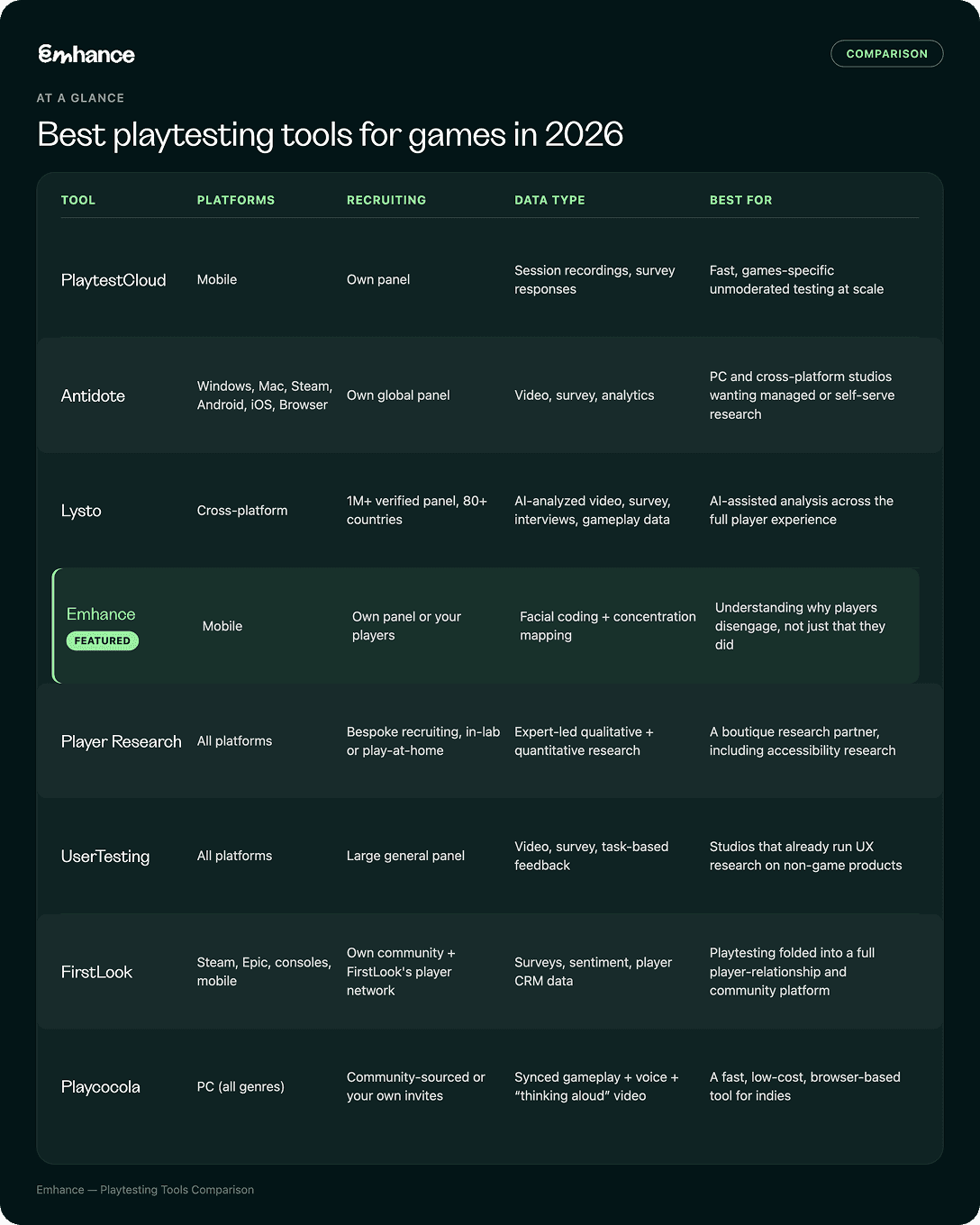
Best playtesting tools for games at a glance
The tools in detail
1. PlaytestCloud
PlaytestCloud is one of the most established names in remote mobile game playtesting — recruiting players from its own panel, recording sessions, and turning around studio feedback within days. It's built specifically for games, which shows in the recruiting and study tooling.
The data underneath is session recordings and survey responses — mostly self-reported, mostly about what players say and where they got stuck. That's genuinely useful for fast directional feedback on FTUE or a specific feature. It's a narrower signal than studios sometimes assume when the question is why a moment isn't landing rather than whether it landed.
2. Antidote
Barcelona-based Antidote supports playtesting and UX research across PC, Steam, mobile, and browser, with three ways to work: fully self-organised studies on their platform, a fully managed service where Antidote's UX team handles recruitment and moderation, or targeted market research for validating concepts ahead of production. Antidote maintains its own global panel, so studios don't need to source players themselves.
Studios including Remedy, Ankama, and Giants Software have used Antidote's platform, with some reporting measurable retention gains after implementing findings from their studies.
Read our full Emhance vs. Antidote comparison for a deeper look at where the two platforms differ.
3. Lysto
Lysto positions itself around "Player Experience (Px)" — combining playtests, surveys, interviews, and gameplay data, refined by both AI and expert researchers. It gives access to a panel of over 1 million verified gamers across 80+ countries, and supports concept validation, longitudinal retention studies, moderated sessions, and structured interviews.
Its AI Analysis layer automatically flags friction points, bugs, and player sentiment across sessions, which can help studios triage large volumes of playtest footage faster than manual review.
Read our full Emhance vs. Lysto comparison for a deeper look at where the two platforms differ.
4. Emhance
Most playtesting tells you what players said or where they got stuck. Emhance tells you what they felt in the moment — before they had a chance to forget it, downplay it, or fail to notice it consciously at all.
Emhance captures 421+ facial signals per second from a player's own device camera during a session, mapping emotional intensity and concentration together — the combination that defines real engagement, not either signal alone — directly onto gameplay footage and in-game events. That matters because 50% of in-game emotional responses never make it into a survey or interview. Players don't always notice the exact moment something started to frustrate them, let alone write it down afterward.
It's built for player-obsessed mobile studios who've already run standard playtesting and found that players are quitting, churning, or disengaging for reasons that observation and surveys alone can't explain. The output isn't a data dump — it's a production brief: which moment to fix, and why.
5. Player Research
Player Research takes a boutique, agency-style approach rather than software you log into — a full-service games user research partner combining in-lab, play-at-home, and expert-led research across usability, UX, appeal, and player experience.
Player Research has worked on titles including Goat Simulator 3 and Life is Strange 2, and runs a dedicated accessibility research offering. It's the strongest option for studios wanting deep, methodologically rigorous research led by specialists in human-computer interaction and cognitive psychology, rather than a self-serve dashboard.
6. UserTesting
UserTesting is a large, mature unmoderated user-research platform built for general software and product UX — not games specifically. Studios that already run broader UX research (on a companion app, website, or live-ops dashboard) sometimes extend the same platform to game testing for consistency.
The tradeoff is games domain expertise: UserTesting's tools aren't optimised for fast-paced gameplay, and its panel and study templates are built around web and app UX patterns rather than game loops, tutorials, or onboarding.
7. FirstLook
FirstLook has repositioned itself as a full "player relationship platform" rather than a narrow playtesting tool. Playtesting — including key distribution, NDAs, waitlists, and beta branches — is now one module within a broader suite that also covers player CRM, community management, creator campaigns, and player analytics from pre-launch through live ops.
That makes FirstLook a good fit for studios that want playtesting to plug directly into their community and marketing stack, rather than sitting as a separate research tool.
Read our full Emhance vs. FirstLook comparison for a deeper look at where the two differ.
8. Playcocola
Playcocola is built specifically for the indie "build-test-iterate" cycle. It's entirely browser-based, with no downloads required from testers, and captures synced video of gameplay alongside the player's voice and "thinking aloud" commentary.
Studios can invite their own testers or tap Playcocola's community of indie enthusiasts and fellow developers. Its pay-as-you-go model — rather than subscriptions or enterprise contracts — has made it popular with solo devs and small teams working with limited budgets.
The gap most playtesting tools share
Most of the tools on this list — including some of the most established names in the category — are built around what players say and do: survey answers, session recordings, click paths, sentiment pulled from transcripts. That data is real. It's also incomplete.
50% of in-game emotional responses never surface in a survey or interview. Studies combining biometric signals with observation reveal 63% more issues than observation alone, and physiological signals predict retention 1.7x more strongly than self-report. Players don't narrate the moment a session stopped feeling rewarding — they answer questions afterward, based on a remembered impression shaped disproportionately by how the session ended, not what happened moment to moment.
Emhance is built specifically to close that gap for mobile studios: reading emotional intensity and concentration directly from a player's face, rather than inferring engagement from what they typed into a survey afterward.
Frequently asked questions
What's the difference between playtesting and QA testing?
QA testing checks whether the game works — bugs, crashes, performance. Playtesting checks whether the game is fun and understandable — where players get confused, bored, or delighted, and why. Some platforms (like Game Tester/Lionbridge) blend both; most tools on this list are built for the player-experience side specifically.
Should I run a moderated or unmoderated playtest?
Unmoderated (PlaytestCloud, Playcocola, Emhance) is faster and cheaper, and works well for a specific, well-defined question. Moderated (Player Research, Antidote's managed service) is slower and more expensive, but a live researcher can probe further when something unexpected happens — useful for open-ended or exploratory research.
How is emotion AI different from a standard playtesting tool?
Standard playtesting tools capture what players say and do — survey answers, session recordings, click paths. Emotion AI tools like Emhance capture facial coding and concentration data directly, which surfaces the 50% of in-game emotional responses that never make it into a survey.
Can indie studios run proper playtests on a limited budget?
Yes. Playcocola is built specifically around indie-friendly, pay-as-you-go pricing, and several other platforms on this list offer self-serve options that don't require a managed research engagement.
How many participants does a playtest need?
It depends on the question. Directional FTUE feedback can come from 5-8 participants; the Skullgirls / Two&Half Gamers study on this basis used 7. Broader claims about a launch audience need a larger, more representative panel — which is where platforms with panels in the hundreds of thousands (Lysto, Antidote) have an advantage over boutique recruiting.