Sensemitter is now Emhance.
Read more

Articles
The Best User Research Tools for Mobile Games in 2026
Written by:
Emer Rutherford
|
Marketing Generalist
Most studios already do research. They run playtests, send surveys, read the App Store reviews nobody asked for. And the retention chart still drops in the same place next quarter.
That's not a research problem. It's a resolution problem. Most tools tell you where players leave. Very few tell you why — the actual moment engagement breaks, and what caused it.
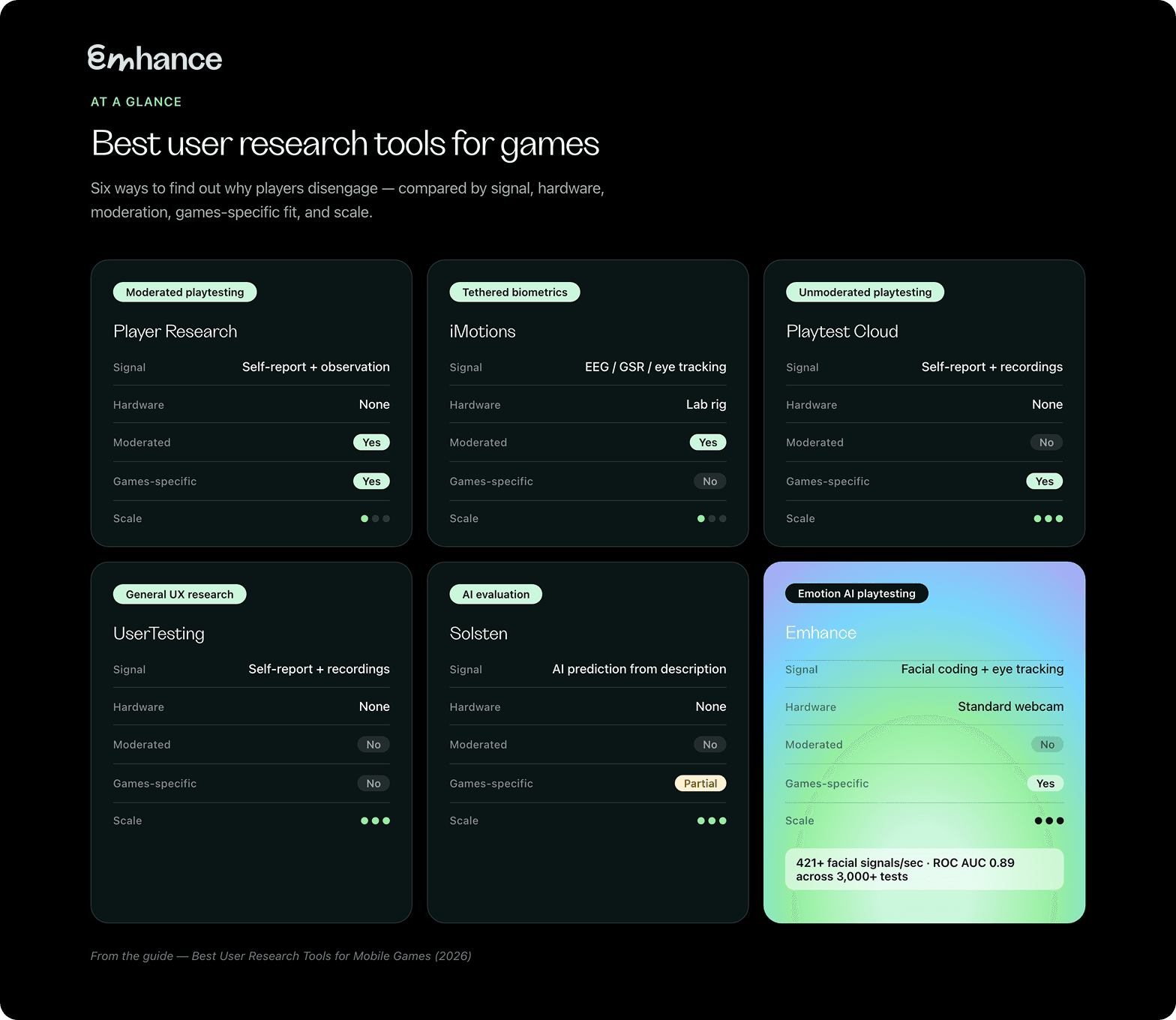
This guide walks through the tools studios use to answer that question, what each one is actually good at, and where each one runs out of road.
What to look for in a game research tool
Before the list, four questions worth asking about any tool on it:
Does it test the real game, or a description of it? Some tools evaluate your game. Others evaluate what an AI model assumes about games like yours.
Does it capture what players say, or what they do and feel? Self-report is useful, but players can't always tell you why they quit — recall bias and social pressure get in the way, even when they're trying to be honest.
Does it scale without a lab? Moderated sessions and tethered hardware produce rich data from a handful of people. Most studios need more than a handful.
Is it built for games? General UX research tools weren't designed around tutorials, core loops, or 15-second ad creatives. That gap shows up in the output.
The tools
1. Player Research — moderated playtesting
Human moderators run structured sessions, watch players in real time, and ask follow-up questions on the spot.
It's the most established method in the category, and moderators are good at catching things a script would miss. The trade-off is scale: findings are limited to what a person can observe live, and the debrief still runs through self-report — the same recall and social-pressure effects that soften any post-session interview.
Best for: deep, qualitative sessions with a small player group, where confidentiality and moderator judgment matter more than sample size.
We've written more on where this approach runs out of road: Player Research's biggest limitation.
2. iMotions — tethered biometrics
iMotions captures EEG, galvanic skin response, and commercial-grade eye tracking through dedicated lab hardware.
The signal quality in controlled conditions is genuinely strong, and it's a familiar name to anyone who's studied biometric research. But it asks a lot of the player: electrodes, gel, a rig, a lab. That changes how someone plays before you've measured anything, and it puts a hard ceiling on how many sessions you can run.
Best for: academic-grade research where the play environment doesn't need to resemble a phone on a couch.
3. Playtest Cloud — unmoderated games playtesting
Playtest Cloud recruits from a games-specific participant pool and runs unmoderated sessions at SaaS scale — cheap, fast, and built with games in mind.
The gap is the signal underneath it. Most of the analysis comes from watching session recordings and reading what players typed, often summarised by an LLM. That's still self-report, just faster to collect. It tells you players got stuck. It doesn't tell you whether they were confused or just finding the challenge satisfying — two states that look identical in a session recap.
Best for: high-volume qualitative feedback on functional issues, bugs, and usability, where games expertise and speed matter more than emotional signal.
We've written more on what this approach misses: What Playtest Cloud misses about your players.
4. UserTesting — general UX research
UserTesting is a mature, polished platform for unmoderated user research, built for software broadly rather than games specifically.
That breadth is also the limitation. A five-minute checkout flow and a fifteen-minute core loop are not the same shape of problem, and the tooling doesn't flex for tutorials, combat pacing, or onboarding cadence the way a games-native platform does.
Best for: studios that already run UserTesting for other products and want one platform, not the best-fit one.
5. Solsten — AI evaluation
Solsten takes a description of your game and returns a predicted player response — no sessions, no recruitment, results back almost immediately.
The speed is real. So is the ceiling: it's evaluating a description, not the game. New mechanics, unfamiliar genres, or anything that doesn't match its training priors are exactly where this approach struggles — because the model is guessing, not watching anyone play. Think of how many good meals sound unappealing written out as a list of ingredients.
Best for: early, low-stakes directional checks before a game exists to test.
6. Emhance — emotion AI playtesting
Emhance uses facial coding and eye tracking to capture what players feel while they play — no lab, no electrodes, no special hardware. Participants play on their own device, in their own environment, and the webcam does the rest.
The reason this matters: self-report structurally misses things. About 50% of in-game emotional responses never surface in a survey or interview, not because players are lying, but because they can't always narrate a reaction they didn't consciously register. Facial microexpressions and eye movement are involuntary — they show engagement whether or not a player can put it into words.
Emhance measures two signals together — emotional intensity (facial muscle activity) and concentration (blink suppression) — because either one alone is misleading. A player can look emotionally activated while checked out, or calm while completely locked in. Engagement is both signals present at once, mapped second by second across the session, so a report shows exactly where the engagement curve spikes and exactly where it flatlines — not an average, a timeline.
That's the difference between "players dropped off around level 3" and what one client actually found underneath it: players weren't struggling with difficulty, they were confused about how the game's rules had changed since the tutorial. Fixing the actual mechanism — not the tutorial, not the whole onboarding flow — moved level 3 completion up 9.6%, users reaching the monetisation depth threshold up 7.3%, and lifetime value up 14.5%.
Best for: studios that need to know why engagement drops — in FTUE (first-time user experience), a core loop, or an ad creative — and need it fast enough to act on before the next release.
Choosing by the problem you actually have
Retention drops you can't explain.
Analytics tells you where players leave. It doesn't tell you why. This is where a biometric, games-specific tool earns its cost — the mechanism behind the exit, not just the exit point.
Ad creative underperforming despite a proven format.
Two ads can share the same structure and beats and still produce completely different results. That difference usually lives in the emotional pacing — when tension lands, where the flat stretches sit, whether the CTA hits at a peak or during a dead zone. Creative testing with an emotional curve attached shows you which second to fix.
No live game yet, or a low-stakes early concept check.
A lighter, faster tool — even an AI-prediction pass — is a reasonable first filter before there's a real build worth testing properly.
Already run surveys and got vague answers.
"Players found it confusing" isn't a brief. If a previous research round produced feedback nobody could act on, the gap usually isn't more research — it's a different kind of signal.
Frequently asked questions about game user research tools
What counts as "user research" for a mobile game?
It's broader than playtesting alone. The category covers ASO testing, playtesting, UX/usability testing, ad creative testing, funnel testing, and playable testing — each answering a different question, from whether your store listing converts to whether your tutorial does.
Most studios run several of these at once. The tools in this guide sit mainly in two of them: playtesting and creative/video testing.
What's the difference between playtesting and user research?
Playtesting is one type of user research — specifically, watching or measuring players while they play the actual game. User research is the umbrella: it also includes things like funnel analysis, store-listing tests, and interviews that never involve gameplay at all.
If your question is "why do players behave this way in the game," you want a playtesting tool. If it's "why don't people install in the first place," you're further up the funnel.
Is an AI-predicted player response as reliable as testing with real players?
For an early, low-stakes check, it's a reasonable filter. For anything that matters — a new mechanic, an unfamiliar genre, a decision you're about to spend a sprint on — no.
An AI evaluation tool is working from a text description and its training priors. It hasn't played your game, so it can't catch a reaction nobody would have predicted from reading about the mechanic. Real players produce reactions a model can't.
Do you need lab equipment to measure how a player feels?
No — not anymore. Tethered biometrics (EEG, GSR, dedicated eye-tracking rigs) still exist and produce strong signal in controlled conditions, but they require a lab, specialist hardware, and a session that doesn't resemble how anyone actually plays on their phone.
Facial coding and eye tracking through a standard webcam capture the same category of involuntary signal — emotional intensity and concentration — without the rig. Players play on their own device, in their own environment.
How do you know if an emotion-AI or biometric methodology is actually valid?
Ask for the numbers, not the pitch. A credible methodology should be able to state its precision against real outcomes (for reference, Emhance's is a ROC AUC of 0.89, validated across 3,000+ tests) and should be able to point to peer-reviewed research behind the underlying signals — facial coding as a proxy for emotional intensity, blink suppression as a proxy for concentration.
If a vendor can't answer "how do we know this works," treat the output as a hypothesis, not a finding.
What drives the cost of game user research, and how do I choose?
More than the tool's list price. Moderation, lab hardware, and small sample sizes all add cost and reduce how many sessions you can run. Unmoderated, hardware-free approaches scale further per dollar spent, but the signal they capture (self-report vs. biometric) matters more than the price tag.
The right question isn't "what's cheapest" — it's "how many decisions ride on this answer." A one-off directional check can tolerate a lighter tool. A retention problem shaping the next release can't.
Where to start
None of these tools solve every problem. Pick based on the question in front of you, not the platform with the best deck.
If the question is why did engagement drop, and what do I do about it — that's the one Emhance is built to answer. Worth seeing on your own game before the next release, not a competitor's.